Building a Travel Ukulele: Bridge, Stringing It Up, and a Sound Test!

I’ve tended to avoid referring to this project as a “ukulele” and usually refer to it as a “piece of wood” or “plank.”  Today I’m calling it a ukulele since I was able to actually string it up and play it.

  1. Bridge.
    1. I wasn’t happy with the bridge brackets.  They looked uneven and even after plenty of time to dry, they still felt… gummy?  Tacky?  Grubby??  Not great, in any event.  I sanded them last night, again this morning, 150 grit, 400 grit, and then 1500 grit, washed them with soap, washed them without soap, set them out to dry, spray painted them again, set them out again, and this time after several hours they were dry.  They went onto the bridge and then the plastic posts in the ukulele with minimal post-processing.  It fit snugly with a little bit of force and went flush against the body of the ukulele.

      This slideshow requires JavaScript.

  2. Strings.
    1. I’ve never added strings to a ukulele before, so this was entirely new to me.
    2. I watched this video again and then dove into putting the strings on the ukulele.  This was another of those moments which felt a little tense.  In the end, it was really just the idea of doing something new and possibly ruining a string or a set of strings.  3D printing is so forgiving.  If I screw something up in design or printing or finish… I can just make more.  Wood and strings and metal are not so easily fixed.  Anyhow, it all turned out okay.
    3. Using what I’d learned from Soph, I decided to tie a knot in the strings, leaving enough extra so they could be fed back into the string holes, preventing any sharp bits from poking me as I played.
    4. I had drilled the string holes under the ukulele with a slightly larger diameter drill bit than the one at the top, so most of the knots disappeared into the holes.  Whenever I need to replace these strings, it will probably be a pain to get them out again, but that’s a problem for future me.
    5. I play my ukulele with a “C” tuning, so these strings my wife bought me to go in my regular ukulele worked just fine.  If you’re right handed, play chords with your left hand and strum with your right hand, then when you grip the ukulele neck in your left hand, the 1st string (A) would be closest to your fingers and the 4th string (G) would be nearest your thumb.  Going from the thumb-side to the finger-side, they would be 4th / G string, 3rd / C string, 2nd / E string, and 1st / A string.  I put a sticky note on my ukulele while I added the strings, one at a time, so I wouldn’t get anything mixed up.

      This slideshow requires JavaScript.

    6. After I got the strings on, I wrestled with tuning the strings.  They seemed to go out of tune pretty quickly – but I suspect this is due to the strings stretching a little.
    7. I’m glad I waited to install the strings and bridge until I had the black oxide hardware.  I’m sure the chrome or stainless steel would look great, but I prefer these design elements together.
  3. Volume.
    1. It’s a quiet instrument, but actually sounded a little louder than I would have expected.  After playing the travel uke for a few minutes, I grabbed a nearby checkbook box lid and put it between the ukulele and my body, which seemed to add a bit of volume.  As you know, I have a decibel meter from my whistle experiments, so I performed a little science for you.
    2. InstrumentDecibels
      Travel Ukulele, strumming57.9
      Travel Ukulele, playing73.6
      Travel Ukulele (with box), strumming64.8
      Travel Ukulele (with box), playing75.8
      Soprano Ukulele, strumming82.7
      Soprano Ukulele, playing94.5
    3. I was pleasantly surprised the checkbook box added so much to the volume.  It was an audible difference to myself and my family.  I may try this again with a wood box, plastic box, plank of wood, and sheet of plastic.  I have to wonder if something as commonplace as a frisbee would work well.  If so… awesome.
  4. Sound.
    1. I recorded myself playing the first few bits of House of the Rising Sun first with my store-bought soprano ukulele, the travel ukulele, and then the travel ukulele with the checkbook box lid underneath it.  I start off each 45 second sound test with a single downward strum on each chord before playing the first part of the song.
    2. Here’s a single video comprised of the three clips one after another.
  5. Turn Around
    1. The stainless steel turn around I swapped out for the black oxide ones (for purely aesthetic reasons) were only 1.25″ long because that’s what Home Depot had easily available.  Since I could choose almost any length and style, the black oxide machine screws are button head, socket drive, and 1.5″ long.  Since the ukulele is exactly 3″ wide, there was a chance the screws would touch in the center preventing the turn around from being secured in place.  Adding washers preventing this from being an issue – while also looking neat.
    2. If you’re willing to use a 1″ long machine screw, there are a lot of other potential choices for materials.  You could get bronze, steel, black oxide, chrome, nylon, etc.  I can’t be absolutely certain using 1″ screws would be fine, but I’m pretty sure it would be.  The plastic is really sturdy with thick walls, beefy infill, and able to withstand a fair amount of lateral compressive force based on how I chose to orient the print.
  6. Fret Markers
    1. I suspected that just using a hole punch on the cellophane wouldn’t work well.  I tried it anyhow.  :)  All it did was deform the cellophane.  Then I tried it again after pressing the cellophane into the sticky part of a post-it note.  I then tried punching it with the hole punch upside down and right side up.  I didn’t see much of a difference either way.
    2. In a perfect world, I would not have strung up the ukulele yet, figured out the fret markers, maybe added another layer of finishing oil, waxed again, and then installed the strings.  I was impatient, so I just went for it.
    3. Before I add fret markers, I’ll want to finish a larger piece of scrap wood1 to test the optimal glue and whether different sides of the cellophane behave differently.

      This slideshow requires JavaScript.

Now, the ukulele is playable, but it’s not done done.  Here’s what’s next:

  1. Figuring out fret markers
  2. Sanding and painting strap buttons
  3. Making a ukulele strap from seat belt material and heavy duty rip stop nylon, possibly with a 3D printed buckle / slider
  4. Write up a post-mortem of what I learned
    1. Always print extra parts, order extra parts, cut extra pieces, and finish extra test parts
    2. Testing materials, paints, finishes, and adhesives
    3. Be bold – maybe I’ll ruin a plank of wood, a string, or two months of work.  Or maybe I’ll end up with a ukulele.
DIY Travel Soprano Ukulele
  1. Learning Curves and Ukuleles
  2. Building a Travel Ukulele: Getting Started
  3. Building a Travel Ukulele: Cutting Stuff
  4. Building a Travel Ukulele: Cutting, Filing, Shaping
  5. Building a Travel Ukulele: Filing, sanding, filing, sanding, filing…
  6. Building a Travel Ukulele: Sanding.
  7. Building a Travel Ukulele: Test Fitting
  8. Building a Travel Ukulele: Preparation, Marking and Cutting Frets
  9. Building a Travel Ukulele: Shaping Frets, Sanding
  10. Building a Travel Ukulele: Building a Drill
  11. Building a Travel Ukulele: No Turning Back
  12. Building a Travel Ukulele: Sanding, sanding, and finishing
  13. Building a Travel Ukulele: Finishing, sanding, painting, etc
  14. Building a Travel Ukulele: So Much Experimentation, Bridges, Printing, and Sanding
  15. Building a Travel Ukulele: Plancratineering
  16. Building a Travel Ukulele: Swapping Hardware, Fret Experiments
  17. Building a Travel Ukulele: Bridge, Stringing It Up, and a Sound Test!
  18. Building a Travel Ukulele: Improvements
  19. Building a Travel Ukulele: Back to Basics
  20. DIY Soprano Scale Travel Ukulele
  21. Repairing My DIY Travel Uke
  1. That is to say sanding, sanding, sanding, sanding, wetting, sanding, sanding sanding, sanding, finishing oil, sanding, finishing oil, sanding, finishing oil, sanding, finishing oil, sanding, waxing, waxing, and waxing []

Building a Travel Ukulele: Swapping Hardware, Fret Experiments

Before it got too hot this morning, I spent a little time experimenting with materials before taking another scary step towards finishing the travel ukulele.

  1. Bridge.
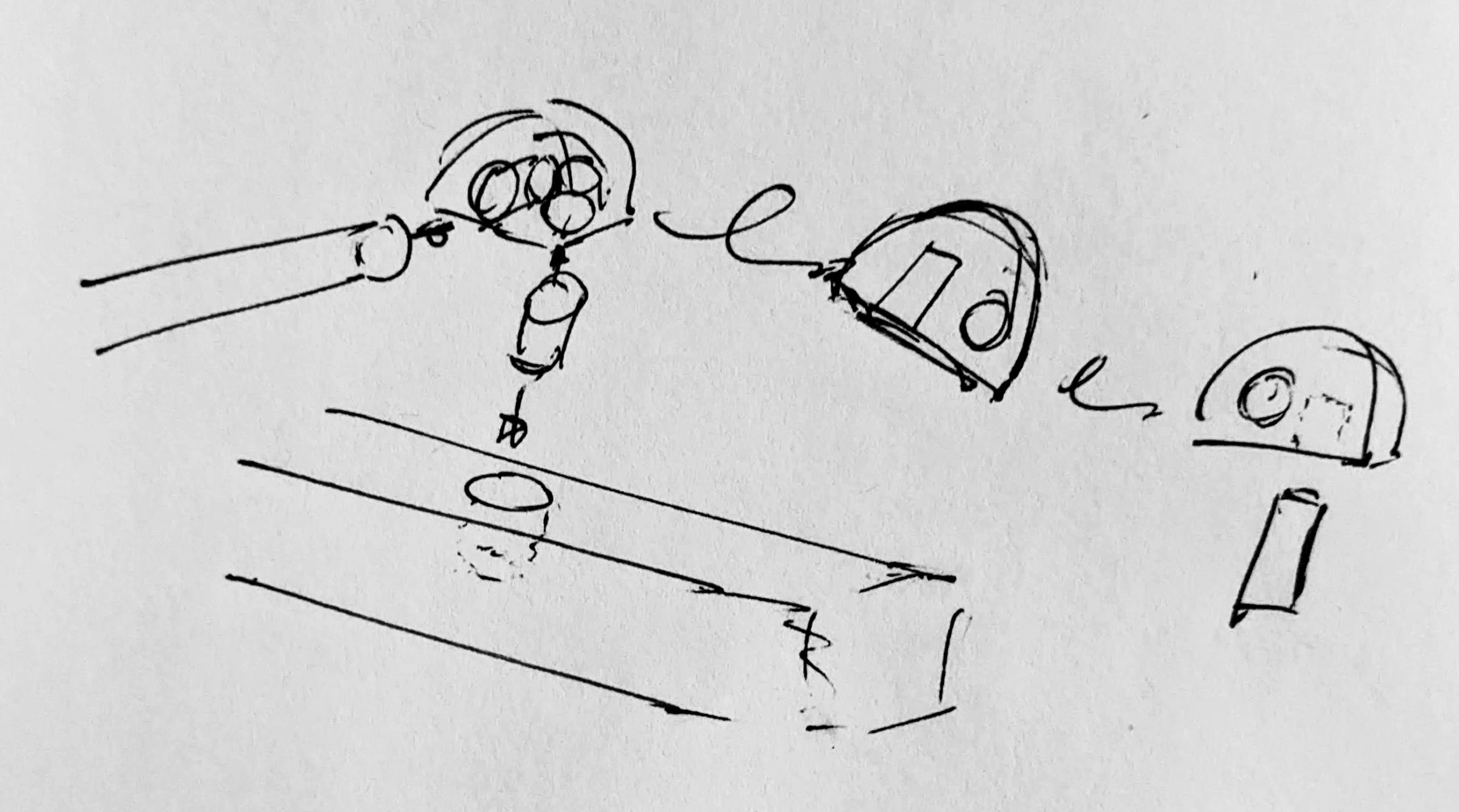
    1. Now, I could have called it a day with the bridge brackets I designed, printed, sanded, and painted.  But, it didn’t have exactly the aesthetic I wanted.  I didn’t want to see a screw on the top of the ukulele body.  I don’t know why, I don’t have a great reason for this, I just didn’t want that.  Instead, I worked on implementing the idea I had sketched out in a prior blog post.

      What's really on the back of the Declaration of Independence
      What’s really on the back of the Declaration of Independence
    2. With several interesting benefits, the major downside to this design change is … I would be taking a drill to my ukulele after I’ve “finished” sanding, oiling, and waxing it.
    3. Today I took a deep breath and went for it. I used my hacksaw to cut two small pieces of the plastic balloon rod that I’d been using to hold printed parts as I spray painted them.  I did some test drilling on scraps of wood and tested hot glue with the plastic rod.  Hot glue doesn’t stick to everything, so I wanted to run this test before I tried.  I… probably should have done this before taking a drill to the wood again.

      This slideshow requires JavaScript.

    4. Once I measured the two plastic posts I discovered they were very slightly misaligned.  It’s only 1-2 mm or so, but by having the brackets like this, I can just measure, design, and print a slightly longer bracket on one side.  Which is exactly what I did.  This is another defect / variation no one other than myself (or you, loyal reader) would ever notice.

      This slideshow requires JavaScript.

    5. There were some intermediary steps here.  I designed and printed several different iterations that didn’t work.
      1. If you need to print something that will fit a 5.0mm diameter part (such as these plastic rods sections), you can’t have a 5.0mm hole.  You need at least some clearance to be able to fit the part.  I like to use 0.35 – 0.5 mm for parts that are supposed to move against one another regularly and 0.175 – 0.2 mm for parts that are supposed to friction fit and stay together.  I completely forgot to add this variable to my first set of prints.
      2. My second set of prints didn’t work because I had left support structures enabled and there were little bits of plastic inside the holes which I could not remove.
      3. My third set printed well – but I lost one of them and had to reprint it.
    6. These two parts have now been painted black and are outside drying in the 95 degree heat.  :)
  2. Fret Markers.  I was toying with the idea of 3D printing silver PLA on diffraction grating for a sweet rainbow-y look to the fret markers.  For a variety of reasons, I won’t be doing this.  However, why not share some of my experiences? 1
    1. I have quite a lot iridescent cellophane because I want to make these papercraft LED crystals by Erin St. Blaine.  Would it be possible to 3D print directly onto cellophane?  A sample size of 1 tells me “no, this doesn’t work.”  The molten PLA only barely stuck to the cellophane and came off the surface part way through printing.  The underside of the model wasn’t even slightly shiny from being printed on a smooth surface.  It deformed the cellophane and turned into plastic spaghetti.

      This slideshow requires JavaScript.

    2. Now, it’s possible the coating / surface of both sides of the cellophane were not identical.  If so, perhaps I’d have better luck?  Both sides felt the same and since I didn’t mark the side I printed on in the first place, I would have to try this all over twice more just to figure out if it worked.
    3. I also considered printing on diffraction grating – or something with a similar texture.  There are several fantastic guides for this, from pouring chocolate holograms to 3D printing rainbow reflective plastic.  Both of these methods suggest dual axis diffraction grating.  With Amazon being out of the highest “lines per inch” of 13,000 or so, I looked to possibly source these sheets directly from the manufacturer’s website website.  Thanks to Caleb Kraft, I looked into specialized 3D printing bed surfaces.  It seems like these surfaces are large stickers for metal printing beds, but might even be the same or similar to craft cutter vinyl, heat transfer vinyl, or even contact paper.  Given I want to make some really small fret markers and all of these potential surfaces were either way larger or way more expensive than I was thinking, I considered some other ideas.  Several years ago I had purchased some coin cell batteries which came with “rainbow” glasses, which I knew to be made from diffraction grating.  I pulled them out of the drawer and tore them up, you know, for science.

      This slideshow requires JavaScript.

    4. Going through drawers finding project scraps for experiments is the kind of thing I can do indoors at night, but in the light of day I reconsidered this process.  If you’re going to try this process for yourself, keep in mind only the smooth side is “rainbow.”  I wasn’t able to immediately tear the diffraction grating out of the glasses cleanly, so I set this part until this morning.
    5. I think I would really like to try printing on diffraction grating / holographic surfaces.  I saw a post about someone who had used “cheap holographic stickers” from ebay.  I would have tried this, except I couldn’t find anything similar on eBay or Amazon.  I did find some companies selling large rolls of holographic vinyl.  I would be remiss if I didn’t mention the 4Quarters3D shop mentioned by Caleb Kraft.
    6. And, after all this research and pontificating, I’m not using any of the above ideas.  Drilling holes in the finished wood was a little nerve wracking.  The holes drilled into the body for the bridge resulted in more splintering than I wanted, despite care with drilling and taping the wood first.  The idea of drilling even more holes into the neck does not appeal to me.  Even if I were to achieve a rainbow-y 3D printed fret marker, whether by diffraction grating, special custom 3D printing surface, holographic sticker, or holographic vinyl transfer sheet, I would have to drill a hole into the neck, sand the printed fret marker, then glue it in place.  Each fret marker would represent a new chance to splinter the fretboard.
    7. Instead, I tried something else.  What about gluing a piece of the thin cellophane directly to the fretboard?  Surprisingly, the white glue didn’t work nearly as well as the glue stick.  After the white glue dried, the cellophane flaked right off leaving a shiny patch where the white glue looked smooth.

      This slideshow requires JavaScript.

    8. This could have been the result of placing more glue stick adhesive than white PVA glue, variations in wood finishing under the two pieces of cellophane, or perhaps the two sides of the cellophane have different properties and I accidentally flipped one of them.
    9. I really like the iridescent effect of the cellophane on the wood.  At certain angles, the cellophane appears to disappear – and at other angles looks quite prominent.
  3. Tuners.
    1. I just got the GraphTech Ratio Tuners!  They’re gorgeous, lightweight, black, anti-backlash, and… were intended to fit holes slightly smaller than the ones I’d drilled for the shiny metal tuners I had on hand.  After watching their installation videos, I inserted a thin strip of cardstock into each of the tuner holes, which shimmed the friction fit part into place.  An awl marked the spots for the screws, my thinnest drill bit wrapped in a rubber band and insert into the DIY 3D printed drill, and then secured in place with the included screws.

      This slideshow requires JavaScript.

  4. Hardware.
    1. The hardware from BoltDepot.com arrived today!  I had ordered both black oxide and chrome hardware.  I lost no time at all sprinting to the mailbox, pulling out the stainless steel screws / nuts, and dropping in the black oxide  coated stainless steel hardware.  Since the wood is 3″ wide and machine screws were 1.5″ wide, I also ordered black oxide coated washers which gave it just enough space so screws can fit without a problem.
    2. It’s something of an extravagance, but I also purchased a pair of chrome plated machine screws (they only came up to 1″ long), washers, and nuts.  After playing with these a little, I preferred the black oxide.
    3. If you wanted to go with black oxide hardware without having to buy any extra parts, you could get away with one 1.25″ machine screw, one 1.5″ machine screw, two nuts, and skip the washers.  These would cost you a whopping $0.66 plus shipping.  The catch here is the shipping is $4.95, so you almost might as well splurge and try a few combinations.  The screws I purchased also require an imperial hex set, so keep that in mind.  You can find these screws in black oxide with a Phillips head, but then they only go up to 1″ long.
    4. The overall cheapest route is the stainless steel hardware in a 5-pack of 1.25″ machine screws and nuts for $1.28 from Home Depot.

      This slideshow requires JavaScript.

  5. Tim’s Ukulele
    1. Tim had hit me up for my pattern, which I happily shared, and then shared his own variation back with me.  I had created my pattern as a 18″ or so PDF which could be printed onto multiple sheets using registration marks.  My buddy Andrew suggested using this software by WoodGears.CA and it’s use of diagonals would help.  Tim had split up the pattern I created.  Print-soprano-travel-ukulele-template1_013_overlap.pdf (14412 downloads )   If you use his, keep in mind you’ll need to double check the printed rulers against actual rulers to ensure proper sizing, since printing to the edge of the paper can sometimes interfere with that.
    2. I’m slightly jealous of Tim’s progress.  He went from “May I see your template?” to tweeting “Did you know that you can just build a musical instrument and no one can stop you?” in five days.  I’ve been working on mine for just over two months and am only now is the finish line in sight.  :)  This latest ukulele is Tim’s second attempt, with his first shared on his Instagram page.
    3. A few notes on Tim’s build:
      1. Tim posts a lot of cool stuff made from leather.  He made a neat “back plate” / soundbox for his ukulele from stiff leather to hopefully help amplify the sound.
      2. In his first build the turn around was a little wider than the wood he used, causing it to stick out and not lay flat.
      3. Like my own build, Tim cut the ukulele with a coping saw and the tuning pegs went in “wonky.”  He used a softer wood, which caused the strings to bite into the holes, which made the ukulele go out of tune.

What’s left?  Not much!!

  1. Allow the bridge brackets time to dry.
  2. Put the bridge in the brackets, brackets on the board.
  3. Add strings to it (which I’ve never done before!)
    1. This video suggests adding a little lubricant over the frets to prevent them from abrading the strings as they are tightened and paying attention to the rotation of the tuners as the strings are added.  I’ll watch the entire video again before I try.
DIY Travel Soprano Ukulele
  1. Learning Curves and Ukuleles
  2. Building a Travel Ukulele: Getting Started
  3. Building a Travel Ukulele: Cutting Stuff
  4. Building a Travel Ukulele: Cutting, Filing, Shaping
  5. Building a Travel Ukulele: Filing, sanding, filing, sanding, filing…
  6. Building a Travel Ukulele: Sanding.
  7. Building a Travel Ukulele: Test Fitting
  8. Building a Travel Ukulele: Preparation, Marking and Cutting Frets
  9. Building a Travel Ukulele: Shaping Frets, Sanding
  10. Building a Travel Ukulele: Building a Drill
  11. Building a Travel Ukulele: No Turning Back
  12. Building a Travel Ukulele: Sanding, sanding, and finishing
  13. Building a Travel Ukulele: Finishing, sanding, painting, etc
  14. Building a Travel Ukulele: So Much Experimentation, Bridges, Printing, and Sanding
  15. Building a Travel Ukulele: Plancratineering
  16. Building a Travel Ukulele: Swapping Hardware, Fret Experiments
  17. Building a Travel Ukulele: Bridge, Stringing It Up, and a Sound Test!
  18. Building a Travel Ukulele: Improvements
  19. Building a Travel Ukulele: Back to Basics
  20. DIY Soprano Scale Travel Ukulele
  21. Repairing My DIY Travel Uke
  1. Which is what I’m calling mistakes… []