I’ve been really looking forward to the MakerFaire (Bay Area) for – oooooh – probably about a year now.
Last year was the first time I had attended and I got to see a giant bronze snail car, a Victorian house car, the steampunk area, a giant set of rotating metal wings, pneumatic rockets, LCD guitars, numerous R2D2’s, a chunk of the Long Now clock (the very same which inspired Stephenson’s book Anathem), bicycle powered rock bands, a CandyFab, and, of course, a fully operational MakerBot complete with the MakerBot guys printing off amazing things.
I looked, I saw, I even hoola hooped. And I’m looking forward to seeing all new amazing stuff.
This most recent Z-Woggle arrester/eliminator is one of the most interesting. Unlike the super-fantastic Z axis crank, this part does more than just make the MakerBot easier to use – it will almost certainly improve the quality of your prints. Also, unlike it’s predecessors it does not require the installation of a second set of Z axis rods.
Another thing I like about this part is it easily made with a 3D printer, but much more difficult to manage with just a laser cutter.
One possible issue I could see with this part is that it may cost you a slight bit of Z axis resolution. Since the part doesn’t appear to fit snugly in the Z stage, the Z axis rod will have to rotate a little before it will “catch.” (Or, so I suspect).
I don’t know if this thing was added as a joke or not, but it makes me sad. The author posted this description, “Apparently there is still a competition who can post the least printable object in obscure formats or preferable entirely without file and instructions.”
This is like having a contest over who can leave the biggest turd in someone else’s pool.
Actually, I suppose it’s more like who can donate the shittiest book to a library. Yeah, you could do it – but why?
One of my interests outside MakerBot/RepRap is origami, the Japanese art of paper folding. At it’s inception it was really only a hobby for the rich – the only ones who had access to such a luxury as paper. Modern technical origami restricts one to only a single sheet of square paper transformed only through folding – no cuts, glue, tape, etc.
A lot of very interesting origami models have been developed over the years by some incredibly talented artists through a combination of experience and trial and error. These kinds of models have so much personality they almost appear to be real – rather than mere squares of paper. One of my favorite origami artists of this “genre” is Eric Joisel. I still find it hard to believe his models, such as the “Woman in Dress 2008,” can really be made of just a single square of paper.
There’s been a movement in the last two decades to bring a more methodical and mathematical approach to design, sometimes with the assistance of a computer. One of my favorite technical origami artists is Robert Lang). His models tend to the more realistic, rather than representational (as with Joisel). His insects, such as the stag beetle, are a prime example.
Lang has used his background in mathematics and origami to develop a giant collapsing/expandable lens – so that it could be transported to outer space and then deployed. This allows a normal space craft to deploy a much larger lens than would otherwise be possible.
Robert Lang's "Stag Beetle BP, opus 477"
Unlike Josiel’s models which are typically totally unique and irreproducible by anyone (including Josiel!) Lang’s mathematically assisted models are usually carefully documented by diagrams or, increasingly frequently, crease patterns. A crease pattern is what you would get if you totally unfolded a completed origami model. Typically only the “major” structural folds are depicted in a crease pattern.
Brian Chan's "Attack of the Kracken"
An interesting intersection between mathematics and origami is the problem of determining the most efficient manner of placing the most number of equally sized circle within the smallest possible area, called, “circle packing.” The reason this is important to origami is that the center of each circle can be turned into an appendage. Lang has developed a computer program that allows the creation of truly arbitrary proportions – any number of points with any kind of ratio of one appendage to another.
Brian Chan's crease pattern for "Attack of the Kraken"
Even to someone who doesn’t have any experience with origami or the mathematics involved, the appearance of circles in crease patterns can start to make intuitive sense. One of my all time favorite origami models is the “Attack of the Kraken” by Brian Chan. (Check out the larger pictures of that model. The entire thing is just one sheet of paper. If you look closely you’ll see some of the tentacles are grabbing sailors!) In addition to a picture of his final model he has also posted a picture of his crease pattern for that model, even labeling which parts of the model are derived from which regions of the sheet of paper.
If you’re the least bit interested in origami, I’d highly recommend (in this order) Peter Engel’s “Origami from Angelfish to Zen,” a documentary on origami called “Between the Folds,” and Lang’s book “Origami Design Secrets.” The Angelfish to Zen book is one of my favorite books for background on origami and a very accessible introduction to the hidden geometry underlying even the most simple models (and real life too!).
The ball joint I designed a little while ago just hit the featured things page. I think it is the only thing I have designed for which someone else created a derivative. Just after I posted the ball joint r3becca posted her amazing Beco Blocks. (I do not for a moment think r3becca’s blocks are a derivative or even inspired by my own shoddy work. I mention the timeline simply because I am always astounded how often two people can come up with slightly similar solutions totally independently of one another. My favorite example is the feud between two origami masters who each claimed to have designed the same origami pig, nicknamed the “Case of the Purloined Pig.” If you’re interested in origami, you should check out Peter Engel’s “Origami from Angelfish to Zen,” and this essay from the Bay Area Rapid Folder’s website on origami ethics). The ball joint I created is printed as a single piece and then snapped so it can then rotate, but the result is only okay. If the flanges that hold the ball joint in place are too thin, they’ll pop off. If there are too many threads between the ball and the flanges, it won’t rotate.
R3becca’s solution is far more elegant – two pieces printed separately that pop together and stay connected well. The best part is that it has almost a complete range of movement. If I needed to add a ball joint system to an existing model, I’d almost certainly use one of the Beco Block assemblies as the connecting mechanism.
Have you ever browsed a dollar store, store going out of business, or garage sale? The senses are overwhelmed with the sheer number and variety of things you’d never ever want to take home with you. It boggles the mind to even conceive of how or why such things were created in the first place. The frustrating part of it is – there’s probably a really good deal on something very useful somewhere inside that place.
Unfortunately, this is kind of how I’m beginning to feel about Thingiverse. I love the idea of a place for sharing digital designs. Over the last month it has gotten flooded with “things.” People just uploading Sketchup, SolidWorks, or other 3d modeling files directly to Thingiverse, outright plagiarism, and stuff that could never be printable/cuttable/makeable (such as several objects with zero thickness).
I’m totally good with uploading an unfinished design, partial designs, or the outline of an idea. But, for heaven’s sake, please include a title, description, and a copy of your file for sharing. And, by sharing I mean an STL or DXF file – not a proprietary format. By all means, include your source Sketchup or SolidWorks file, but please also include a file type that’s actually meant for assisting in the production of the thing.
Next in the cranky-pants series: Hey you kids! Get off my damn lawn!
Problem: Broken crayons, useless crayon bits, or crayon shavings. Crayola has their own crayon making system – a cross between an easy-bake-oven and little molds. However, I don’t think it is quite versatile enough. Plus, why pay $20 for what could be accomplished easily for $0.20 worth of plastic parts?
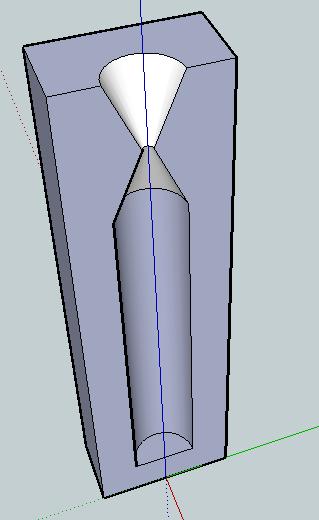
I would want at least three different molds – the normal crayon size, the fat crayon size, and then a triangular non-rolling crayon size. I’m picturing a two part mold for each, with the seam of the two parts running along the crayon lengthwise and a half funnel for pouring.
In addition to the half-mold, I’d also design a snug fitting square block for fitting the assembled mold into. That way you could stand it up and pour crayon wax into it.
Another potential use for this would be to place the pieces of crayon inside the mold, close it up, then heat. This would allow you to mend a broken crayon.
Usage: I can think of several different ways to use this mold. Frankly, I’m not sure which is easiest/most advisable/least advisable. There are easily several considerations:
Assembly:
The mold could be assembled with crayon inside to be melted and repaired.
Crayon pieces could be melted and then poured into the assembled mold.
Crayon pieces could be placed in the funnel at the top of the mold, the entire system heated and crayon allowed to melt down into the mold.
Melting:
Crayon could be melted in a test tube or similar container in the oven, microwave, hot water bath (such as on the stove) or perhaps even open flame and poured into the mold.
Crayon could be melted while inside the mold by placing the mold in a heat source (oven, microwave, hot water bath).
Crayon could be placed in the funnel and allowed to melt down into the mold with the application of a heat source (oven, microwave, hot water bath, open flame?, or sunlight plus magnifying lens!)
Cooling:
Allowing to naturally cool to ambient room temperature.
Placing in fridge.
Placing in freezer.
Placing in cold water bath.
I’m not sure which method of heating and cooling are optimal. Though I’d suspect it is preferable to apply the least amount of heat over the shortest period possible.
Variations: It would be interesting to create these molds in different shapes besides cylinders. You could top each one with a geometric shape, the head (or tail!) of some kind of animal or character, or something else entirely. You could mold crayons into spheres, blocks, chips, or little figurines. While not particularly sturdy, you could even mold them into building blocks or components of some larger device. A clever person could use some left over nichrome wire to build a heated metallic funnel.
That said, my extruder isn’t pumping out plastic until it hits 200 degrees Celsius at least. [↩]
I really like WordPress and was kinda hoping I’d make it to SF WordCamp this year. Unfortunately, it is not to be. If you’re going, I’ve got a silly frivolous request –
If you spot one of those WordPress “W” stickers, would you snag one for me?
I’m getting a new laptop (actually, I’m getting an old relatively unused laptop from someone else) and I’d like to slap an official WordPress, MakerBot, PHP, and MySQL sticker on it.
I can’t help liking the NBC show Chuck. A show about a nerd getting the girl? Sign me up.
After the last episode NBC put up a “playlist” from the show. The music from the show has been really good and I rather like several of the songs from the playlist. In any case, here it is (mostly for my own future reference):
“Heart Skipped a Beat” The XX
“Swim” Surfer Blood
“Rhinestone Eyes” The Gorillaz
“Polyesterday” Gus Gus
“Step It Up” Stereo MC’s
“Tape Song” The Kills
“Light & Day / Reach for the Sun” The Polyphonic Spree
“California Desert Party” Jonathan Richman & The Modern Lovers
“Feeling Good” Nina Simone
“Friday On My Mind” The Easybeats
“Ain’t No Sunshine When She’s Gone” Bill Withers
“Lump” The Presidents of the United States of America
Moving the print platform to the front/back/side of the MakerBot for ejecting the finished print
Ejecting the printed part
Returning the platform to 0,0,0 / center
From the video posted on Charles’ site, it looks like he’s managed #3 and #4 already. The extrusion path around the print that we see in Nophead’s prints probably would work at #2. I also seem to recall some (such as Zaggo?) have mounted a toothbrush head on the build platform for auto-wiping of the extruder head.
Returning the platform to 0,0,0 is an interesting proposition. This would seem to work best once the opto-endstops are installed. I’ve got my set of six fully assembled opto-endstops sitting in a box next to my MakerBot because I haven’t really needed them and they tend to get in the way of printing. Although the opto-endstops have been removed from the standard MakerBot kits, I think we may now start to see them returning.