
I just placed my order for my own birthday presents on behalf of my technically challenged family. :)
What it may lack in surprise, it will make up for in AWESOME.
Q: What did you get for your birthday?
A: A bunch of awesome robot parts.
I just placed my order for my own birthday presents on behalf of my technically challenged family. :)
What it may lack in surprise, it will make up for in AWESOME.
Q: What did you get for your birthday?
A: A bunch of awesome robot parts.
I recently bought the Perhaps with a joule thief?)1 Since I know very VERY little about electronics, I’d appreciate some diagrams, descriptions of parts, etc.
My end goal is to install this device into a MakerBot made replica of the 11th Doctor’s Sonic Screwdriver.
If you’re interested in this project or just want to help, I’ll gladly accept any assistance. Let me know if I can help with any printing projects in return.
Thanks!
MakerBot Industries is giving away ten MakerBots to ten teachers at any educational level. Let’s just consider this my entry:
So, I’ve got a birthday coming up. Getting older doesn’t bother me much – it’s really just a number associated with the number of times I’ve traveled around the sun. 1 I will gleefully relate to anyone that I’m easily the luckiest man in the world. I’ve got a wonderful family, good friends, everyone is healthy, interesting and challenging work, and a fair amount of free time to do with as I wish. These are the sorts of things that are truly important to me, so by any measure of success I care about, I’ve got it all.
With my birthday approaching, my family starts to ask me about what they can get me for a present. My usual answer is, “Nothing, let’s just hang out.” This year, I actually have a list.
As it looks like both MakerGear and MakerBot are out of the magic pixie dust that will let me print in PLA without tears, the rest of my list is as follows:
I’m rather excited about some of these upgrades. I’m looking forward to a heated build platform for smoother warp free ABS builds. I’m looking forward to the rainbow pack for some crazy wacky fun. 2 And, I’m looking forward to needed the extra spare parts as infrequently as possible. :) Since my last major repair, I’ve been lucky enough to enjoy several months of carefree printing. 3
My prior copy of this 3x2x1 Rubik’s Cube was printed a few parts at a time – I’d print one part, test it, print up another, etc. Last night I was able to use my production file to generate all seven pieces in one go. It took 1 hour and 45 minutes to complete the print job, but well under three minutes to clear most of the pieces of the raft off the parts and assemble the puzzle. In order to help people modify and improve upon my design, I’ve upload the original Sketchup files, the STL I used, as well as my own GCode.
Owenscenic on Thingiverse asked,
I am interested in trying your gcode, how did you generate it? How well does it minimize strings between the printed parts? I’ll look at is to see how it starts and the temp…
In case you’re wondering too, the answers are as follows:
Owenscenic, please let me know how your print of this turned out! Please post a picture!
I’ve wondered for a while about the cost of operating a MakerBot. Let’s break it down and see what happens:
Thus,we may estimate the cost of operating a MakerBot in terms of consumption of goods and resources (excluding computer, human, and MakerBot time and wear and tear) as follows, where V is the volume of the extruded object in cubic centimeters or “cc”:
Supposing I wanted to recoup the entire cost of my MakerBot to date and spread it across the entire life of a single 5 pound roll of ABS. 2 Let’s round the cost of the MakerBot, all repairs, and all extra MakerBot related materials up to $1,500.00. One 5 pound coil would have 1890 cc’s of plastic. This would come to $0.794 per cc of plastic. So, I would suggest the cost of buying a MakerBot and printing off an entire coil of plastic would probably end up costing you about $0.85 per cubic centimeter of plastic.
Resource cost of printing a 19cc totally MakerBottable 3x2x1 Rubik’s Cube is $0.80.
Actual pro rated cost of printing a 19cc totally MakerBottable 3x2x1 Rubik’s Cube is $16.15.
Absolute cheapest MakerBot usage I’ve seen anywhere at Metrix:Create for members printing from Thingiverse is $0.30/minute, which would print the totally MakerBottable 3x2x1 Rubik’s Cube for $25.65.
The design should be pretty intuitive. However, I went ahead and took some pictures of the assembly anyhow.
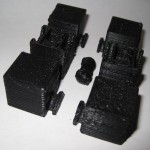
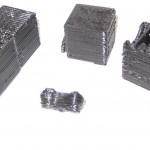
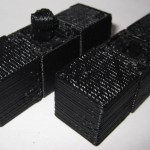
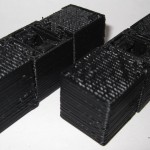
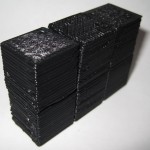
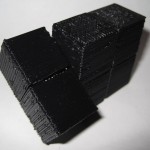
As I mentioned in an earlier post, I think this one came out really really well. :)
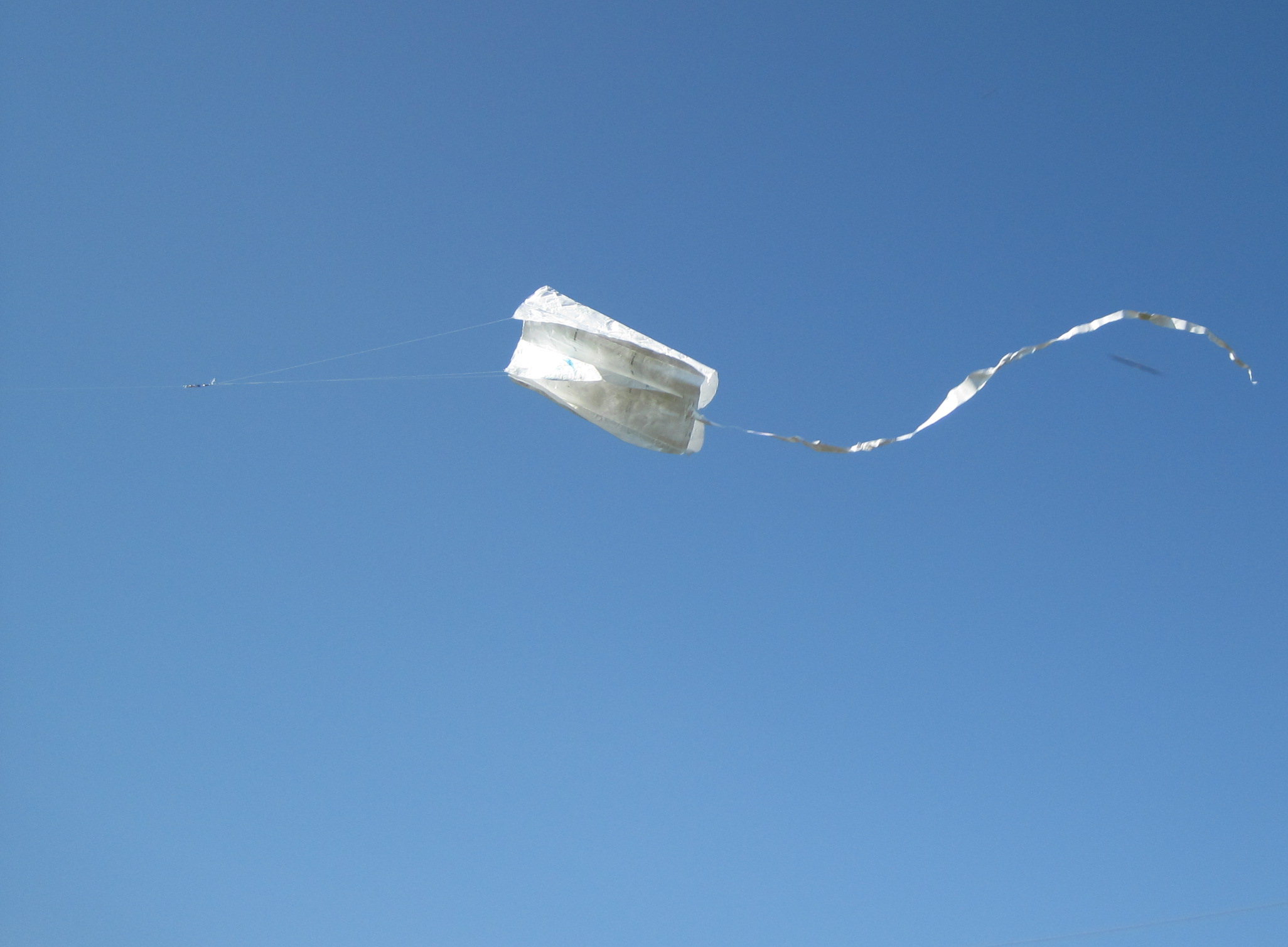
The picture to the right is of a kite that I built several weeks ago and only got around to actually flying this weekend. It’s basically made out of office supplies. :)
Originally I just wanted to make the Tyvek sled kite from the Howtoons shown in Craft Magazine, Volume 8. 1 But then I wanted to see how much of the kite I could assemble just using things from the office. The answer is, basically all of it.
The Howtoons calls for:
Instead I used:
Since the envelopes are significantly smaller than the sheet of Tyvek rolls, I had to either make my kite smaller or stitch them together into a larger sheet. I did both. I scaled the plans down to about 2/3rds the size from the diagrams and then used packing tape to put them all together. To get the most surface area out of each envelope, I burst all of the envelopes at the seams and then taped them up. Once I had a 36″ tall sheet, I started cutting it into the pieces I needed, re-taped it back together as indicated by the diagram, and then set it aside for weeks while I didn’t fly it. :)
On the day of the launch I made the tail out of strips of leftover envelopes taped together with the gluey bits from some of the envelope flap sealants and more packing tape. I punched a hole in the three ribs using a pen, ran the line through each of the three ribs, reinforced it with more packing tape… and launched.
The only non-office supply things used in the construction were:
It flew pretty well.
I’m so happy with the way this has turned out.
I’ve made a bunch of changes since the last revision of this printable 3x2x1 Rubik’s Cube puzzle:
The was one design choice on which I waffled. I considered making the center cubes non-identical, with one having half a barbell stick out and with the other having the internal connector you see now. This would have removed much of the sideways flex – since the barbell would be stationary. I did not go with this design choice because whether the puzzle used one barbell and two connectors or male/female center cubes, there would always be some flex caused by the use of a connector rather than a static pin. And, to be honest, I much preferred the symmetry of having everything assembled out of just three unique parts.
I know I’ve mentioned this before, but I really like the idea of a MakerBot printable toy that can be printed in one go and then assembled without tools or any additional hardware. I also think this would make a great MakerBot print demonstration.
I’ll post some pictures of the parts a little bit later.
I’ve printed up pieces uploaded this morning to Thingiverse, tried them together, broke two pieces, modified them, printed, and fit some together. I’ve just modified the STL for what I hope is the last time. However, I have the barbell fit snugly into the center cube. It rotates relatively freely and does not want to pop out. (Of course, I’m sure it could/would if I applied enough force). This leaves the outside cubes. I modified the semicircular tabs a little and will reprint them later.
The only problem is that it takes about 40 minutes for my machine to print up two cube parts and a barbell, since they’re so solid.
The important thing is that I’ve just been able to print up and assemble the crucial mechanisms for this puzzle. I think the next iteration may be what I needed.