When I read the RepRap blog or the RepRap builder’s blog I see people printing incredible things in PLA. And I never hear about their troubles with PLA. Nothing about it jamming or being fussy about temperatures. What am I missing? What are Darwins and Mendels doing that my little MakerBot isn’t?
RepRap interim challenge obstacles
The RepRap challenge has a number of obstacles for the interim award. There are two in particular that seem insurmountable.
- Maintain a total materials and parts cost under $200 and that 90% of the volume of the printer parts be printed.
- The ability to print autonomously without a PC attached.
I have to imagine something large enough to accomplish all of the other goals would cost well over $200.00. If an entire Darwin or Mendel were trasmorgrified King Midas1 style into pure plastic, I would think the plastic alone would eat up 90% of the budget. Even the best deals around the internet for RepRap parts just the electronics are roughly $215.
I say it seems insurmountable – but if someone had told me two years ago I could one day buy a full kit for building a robot that would make me any plastic thing I could imagine for $1,000.00 I would have laughed at them.
- or Calvin and Hobbes [↩]
The RepRap Prize
A commentator suggested that the RepRap Challenge prize is set up to avoid paying out. This seems like a silly and vacuous charge to me. The $20,000 and $80,000 prize payouts have firm award dates of 12/31/2012 and 12/31/2015, respectively. If someone hasn’t achieved the specific milestones by those dates, by the terms of their declarations (and assuming they are good to their word), they’ll have to award those sums to whoever is closest.
In any case, here’s a summary of the list of the requirements for those interested.
Interim Personal Manufacturing prize of $20,000.00 to be awarded on 12/31/2012:
- Print at least three different materials, including one that is usefully electrically conductive.
- The ability to print electronic circuit boards.
- Print beds1 must be of a material which may be reused with minimal refurbishment for at least 20 print cycles.
- Maintain a total materials and parts cost under $200 and that 90% of the volume of the printer parts be printed.2
- Demonstrate a build volume of the printer above 300x300x100mm in order to insure that items daily utility can be printed.
- The capacity to print a full set of parts for a complete replica of itself within 10 days unattended save for clearing no more than one printer head jam.
- The ability to print autonomously without a PC attached.
- Uses no more than 60 watts of electrical power.
Grand Personal Manufacturing Prize of $80,000.00 to be awarded on 12/31/2015:
- That the cost of the material used for printing does not exceed $4/kilogram.
- The capacity to print a full set of parts for a complete replica of itself within 7 days, including the time for reloading, and clearing of printer head jams.3
- Maintain a total materials and parts cost under $200 and that 90% of the volume of the printer parts be printed.4
- Participating teams are expected to regularly publish and make available their technology on an ongoing basis. All technology developed by participating teams becomes open source under a GPL or BSD license. Therefore, the winning team will have to have published at least some of their innovations more than 12 months before the deadline.
- Print beds are flat surfaces onto which parts are printed. [↩]
- Print beds are not necessarily a permanent part of the printer and are not figured into either the cost or the volume requirements of a printer. [↩]
- According to the article it currently takes approximately 21 days with 90% of the time requiring human involvement. [↩]
- Plastics such as HDPE and Polypropylene, of which millions of tons exist as waste matter, may be suitable candidates, and recycling of such waste material would be viewed favorably by the judging panel. [↩]
Wait a second… that’s not a trap at all!
I just realized that the second variation of my funnel/one-way-door mousetrap doesn’t really trap mice at all!
Since it is specifically designed to provide an avenue of escape to the mouse, there’s no trapping being done, and I may have just miserably failed the design challenge. The challenge specifically states that the winning design is the one that first catches his mouse.
Plus, this particular design would require you to drill a 4cm hole and 4x 3mm holes in a door. I’m guessing this is one of those “cure is worse than the disease” solutions.
How to test a ridiculous idea
Cathal Garvey posted his recommendations as to how those without mice can test their designs. He suggests:
*Think* like the mouse, *be* the mouse!
Alternatively, leave one outside in the country or garden, and await your furry, diseased reward!
But how do you test a one way door/mouse funnel mousetrap if you don’t want to invite mice into your house? I suppose a box with two such funnels installed with a bit of peanut butter inside. If you wake up and find no mice or peanut butter – it either worked perfectly1 or it failed miserably2 ! If the mouse is stuck inside… well I guess it kinda succeeded.
All the kinds horses
Unfortunately, my Leonardo Robot has a broken hip – I kid you not. One of the hinge tabs on his hip snapped.
Fortunately, I’ve got a MakerBot. I can build him better than before. Perhaps with a 40% fill this time. ;)
Must… stop… brain…
I can’t help it. Another idea using the last mouse funnel occurred to me.
What if you had a long tube with a series of bristles all pointing in the same direction just like the mouse funnel? Put some peanut butter on the outside, install in a door, and walk away happy and content that you’re saving mouse lives.
Once the mouse started down that tube it wouldn’t be able to turn around or back up easily. Given the option of unlimited freedom outdoors and chewing its way back through pokey bits, I can’t imagine it would choose plastic splinters.
Self-emptying mouse funnel mousetrap
I’ve spent WAAAAY too much time thinking about this problem. Here’s my new idea:
- Print two mouse funnel mousetraps.
- Drill a 4cm hole in a door along with 4x 3mm holes
- Install one mouse funnel mousetraps at the bottom of that door, with the pointy bits facing outside
- Put a box with peanut butter in it on the other side of that door
- Put the second mouse funnel mousetraps in the box, with the pointy bits facing outside
The hope is that a mouse inside your house will walk out the hole in the door to get to the peanut butter on the other side of the funnel. Once inside the box with all of the peanut butter consumed the mouse can either (a) try to struggle past the pointy bits back into the house or (b) slip outside through the second funnel.
Mouse funnel mousetrap
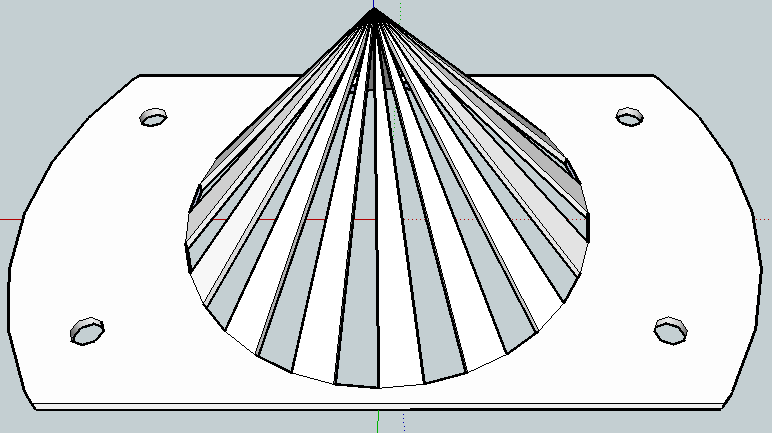
After thinking a bit more about my design for a Peanut Butter Jar Mousetrap, I decided it could be even more minimal/adaptable.
This new mouse funnel mousetrap design requires four bolts, four nuts, and some kind of container with a 4cm hole in it.
Peanut butter is still a really good idea.
Peanut Butter Mousetrap design notes
I treat this blog as part of my lab notebook on printing and designs to help keep me organized. Having it automatically add tags, adding a time stamp, organizing everything in chronological order, and then making it available for others to learn and comment back are all just a huge bonuses.
Anyhow, here are some of my design notes for this Peanut Butter Mousetrap Insert:
- I was going for a minimal design – minimal plastic, printing, and machine time.
- I wanted something that would be “ABS warp” resistant. Even if you end up with a warped flat surface, clamping the insert between the lid and the jar should even it out.
- I wanted a resilient design. Even if the insert is badly warped after clamping down, a flat surface is not critical to its function and it should still work.
- I wanted something that could be adapted easily. I don’t know how to use OpenSCAD, so a parametric design is kinda out the window. Even so you could print this object at full size and then cut it down to what you need. 1
- For the record, I did download OpenSCAD before designing this. I just wanted to get it out there. [↩]