Author: Maker Block
Working out
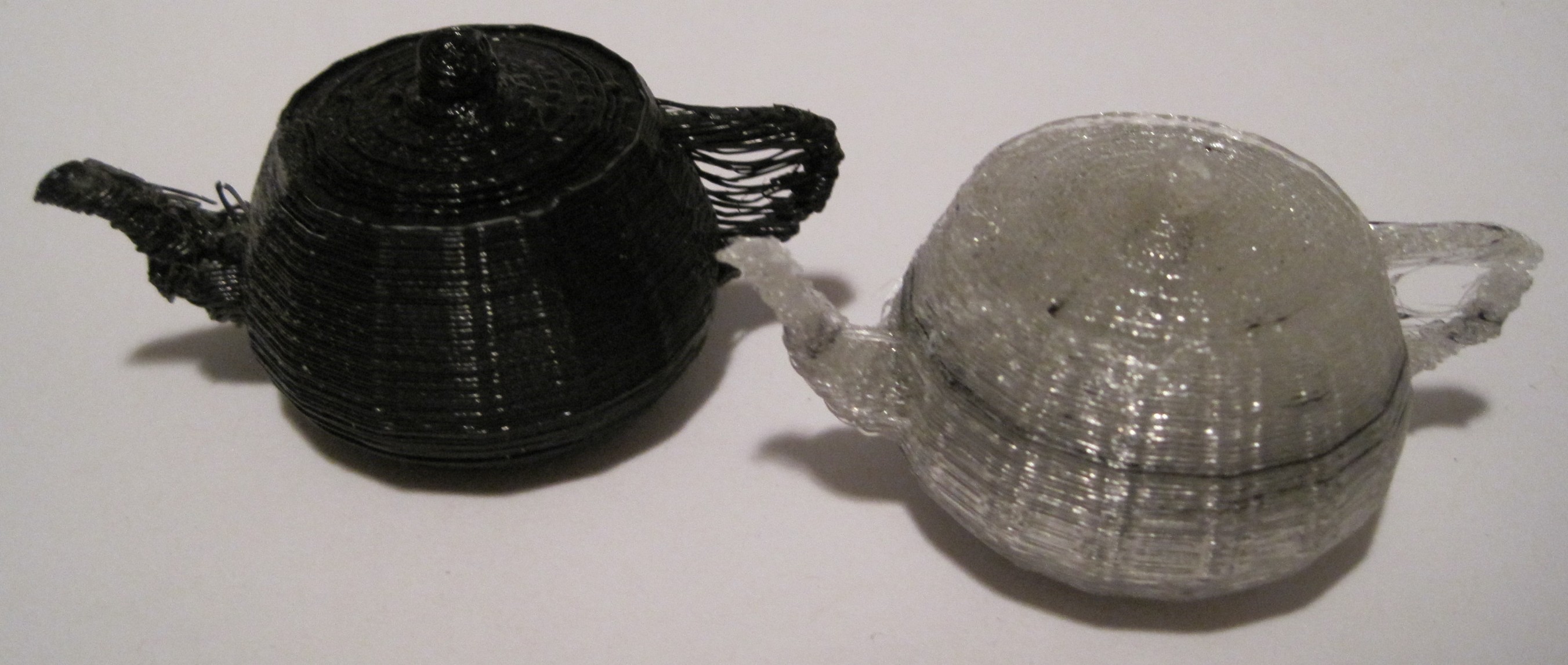
I would have thought that the PLA would have just worked out all of the black ABS out of the way already, but it’s still got the occasional black streak. Again, I don’t mind – I kinda like it. However, I would like to be able to build some pieces out of pure PLA. No matter, I’ll keep printing stripey non-cosmetic parts. :)
The only problem with that system is…
Not really a problem after all. I’m printing up a (well, another) teapot right now. Having just run the PLA through rather than trying to actually remove the ABS the teapot has these black streaks throughout. I kinda like it.
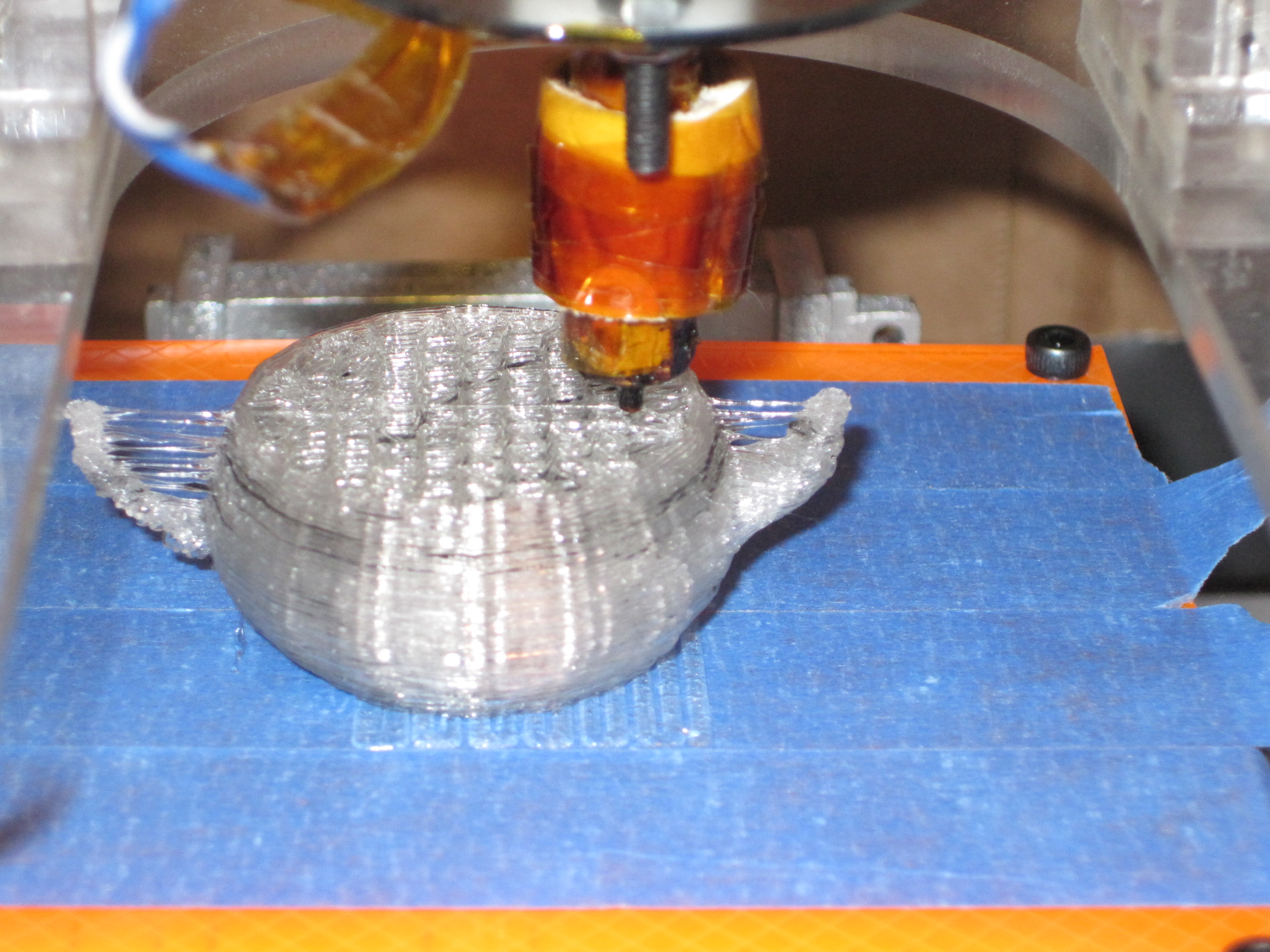
PLA success?!
I figured, what the hell – I built it and I can (probably) repair it, right?
So, I backed out the black ABS I have been printing in, jammed in some freaking sweet PLA, ramped up the heat on the extruder to the exact settings I use for ABS, and then FIRE THE MAKERBOT!
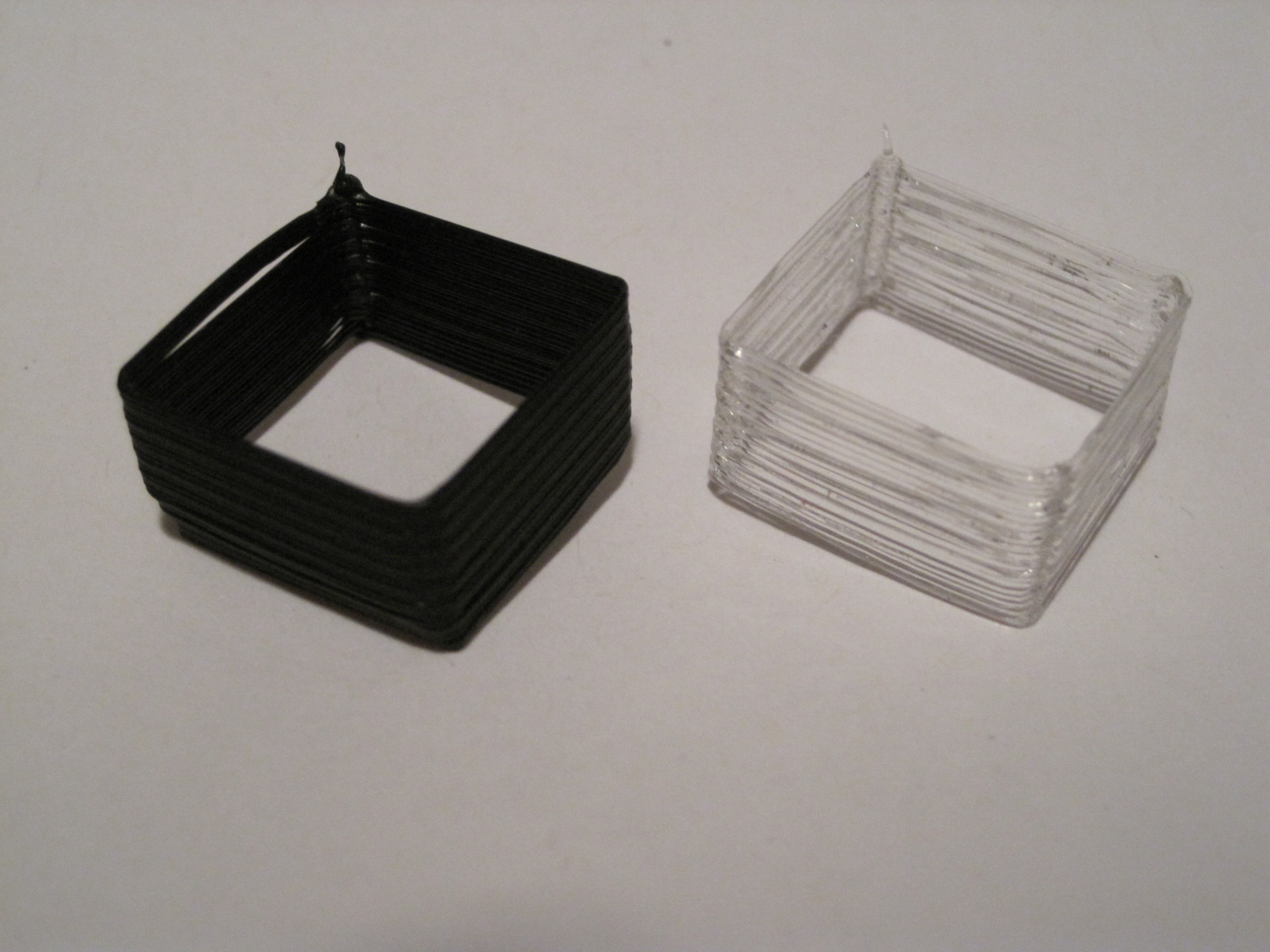
For comparison’s sake I used the same exact settings, same exact Gcode file from the last single walled test piece.
What did it look like, pray tell?
I thought you’d never ask.
MakerBot, Mendel, Mendel-Mini Build Areas
Owning a MakerBot, I’m not even sure why someone would need something to print pieces much larger than the MakerBot build area. Printing something as large as just the maximum build volume of a MakerBot would take ages.
- Darwin’s build area is about 23cm x 23cm x 10cm: 5290 cubic centimeters
- Mendel’s build area is about20cm x 20cm x 14cm: 5600 cubic centimeters
- Cupcake CNC’s build area is 10cm x 10cm 13cm: 1300 cubic centimeters
- Mendel Mini’s is supposedly approximately 11cm x 14cm x 10cm: 1540 cubic centimeters
While the official longest print logged on the Makerbot website is Zach’s Disney head, clocking in at 2 hours and 45 minutes, I’ve read about people printing for up to 8 continuous hours. If the build volume for a Mendel is 4.3 times that of a Makerbot, it would take more than 34 hours to fill that build area.
When you’re printing a door hook in 15 minutes, it doesn’t pay to drive to the hardware store. When it takes 34 hours to print a big plastic brick, you’re better off driving to the gas station, filling up your tank, driving to McDonald’s, filling out an application, working an hour, quitting and demanding your paycheck, driving to the hardware store, buying a single brick, and then driving back home. I figure that kind of silliness would only take half a day or so. Heck, with 34 hours, you could do this at least six times over.
Mendel Mini
I’m voting for the Mendel Mini because:
- Quicker to print
- Less plastic
- Can still self-replicate
- Can still create the parts for a full Mendel
Mendel or Mini-Mendel
Which would you rather have?
Skeinforge tuning guide
Nick Ames has posted a very thorough guide to tuning Skeinforge.
There are some things I like about this guide – such as he suggests keeping extruder speed and platform speed maxed. ;)
I’ll print something up with my current settings, zip those, and then trying this guide out.
Skeinforge calibration test 1, 2
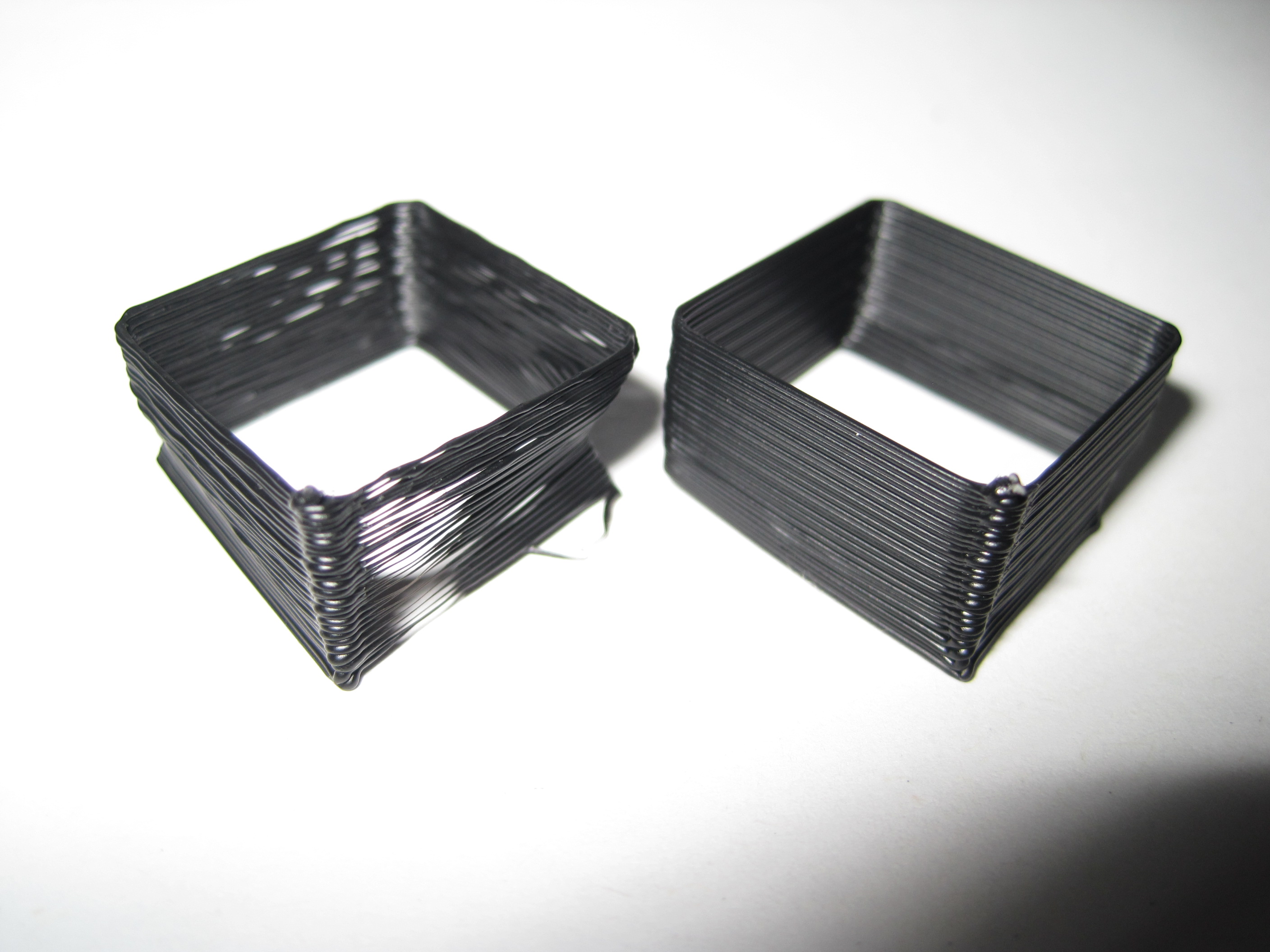
For these tests I used the “single walled test piece” from Da3v
- Test 1 on the left
- Temperature: 220
- Skeinforge -> Carve -> Layer Thickness (mm): 0.36
- Skeinforge -> Speed -> Flowrate PWM Setting (if PWM Setting is Chosen): 230
- Skeinforge -> Speed -> Feedrate (mm/s): 40
- Skeinforge -> Speed -> Travel Feedrate (mm/s): 40
- Extrusion diameter: 0.57
- Skeinforge -> Speed -> Extrusion Diameter Over Thickness (ratio): 1.583
- Wall thickness of the test piece: 0.40
- Test 2 on the right
- Skeinforge -> Speed -> Feedrate (mm/s): 30
- Skeinforge -> Speed -> Travel Feedrate (mm/s): 30
- Wall thickness of the test piece: 0.40
- Skeinforge -> Speed -> Extrusion Diameter Over Thickness (ratio): 1.583
- Skeinforge -> Carve -> Extrusion Width over Thickness (ratio): 1.583
- Skeinforge -> Inset -> Extrusion Perimeter Width over Thickness (ratio): 1.583
That’s a pretty big improvement. I haven’t tried printing something small with lots of details, but now I’m curious how well these settings hold up. My previous settings (which I zipped in case I totally messed this up) were reasonably good, but the layer adhesion was merely adequate.
Dragging my feet on PLA
I’ve been a total slacker about getting started printing in PLA. Part of the reason is I’ve seen others have a lot of problems printing with it – ruining extruders, oozing out of barriers, too hot, too cold, too just right, the heat is uneven, the barrel jams, etc, etc. However, since I’ve been printing larger and larger objects I’m finding that warpage is become more of an issue. This means I need to either buy/make a heated platform for the ABS or I need to switch to PLA.
There’s a few things I’d like to build that are big and flat. I’d like to print up a modular chess board (already have it designed in my head, I just need to export it to Sketchup) and crank out a few Mendel or Mini Mendel pieces.
Default Series Title