I’m not sure if I wrapped my thermistor better or what, but I seem to be getting more consistent readings from it. Perhaps this is due to RepG v12? I would tend to think not since I’m using RepG v12 with the Zach 1 temperature table – the same table I was using before RepG v12.
He found that 10W-30 oil added lightly to the PLA as it entered the extruder, by adding oil to a piece of cotton wrapped around the filament, helped it print without jamming
He noticed that pausing the extruder for more than a few seconds would jam the barrel
He found he could print at 180-210 degrees (I assume he’s measuring the nozzle temperature as you would with an ABS setup)
Nick’s results suggesting a nozzle temperature of 180-210 seem to match up with Rick’s findings of 190 or so. I think I’ll give Polly another shot and see if I can extrude at those temperatures.
I was concerned that after having PLA ooze through the threads that I would be forced to use my backup PTFE barrier. However, I’ve been pleasantly surprised to discover that I can print just fine with my reassembled unclogged extruder. I’ve been able to print several things without so much as a hiccup.
So be delicate with your PTFE even after plastic has oozed into the threads – you may just be able to use it if you can clear out the plastic from the threads.
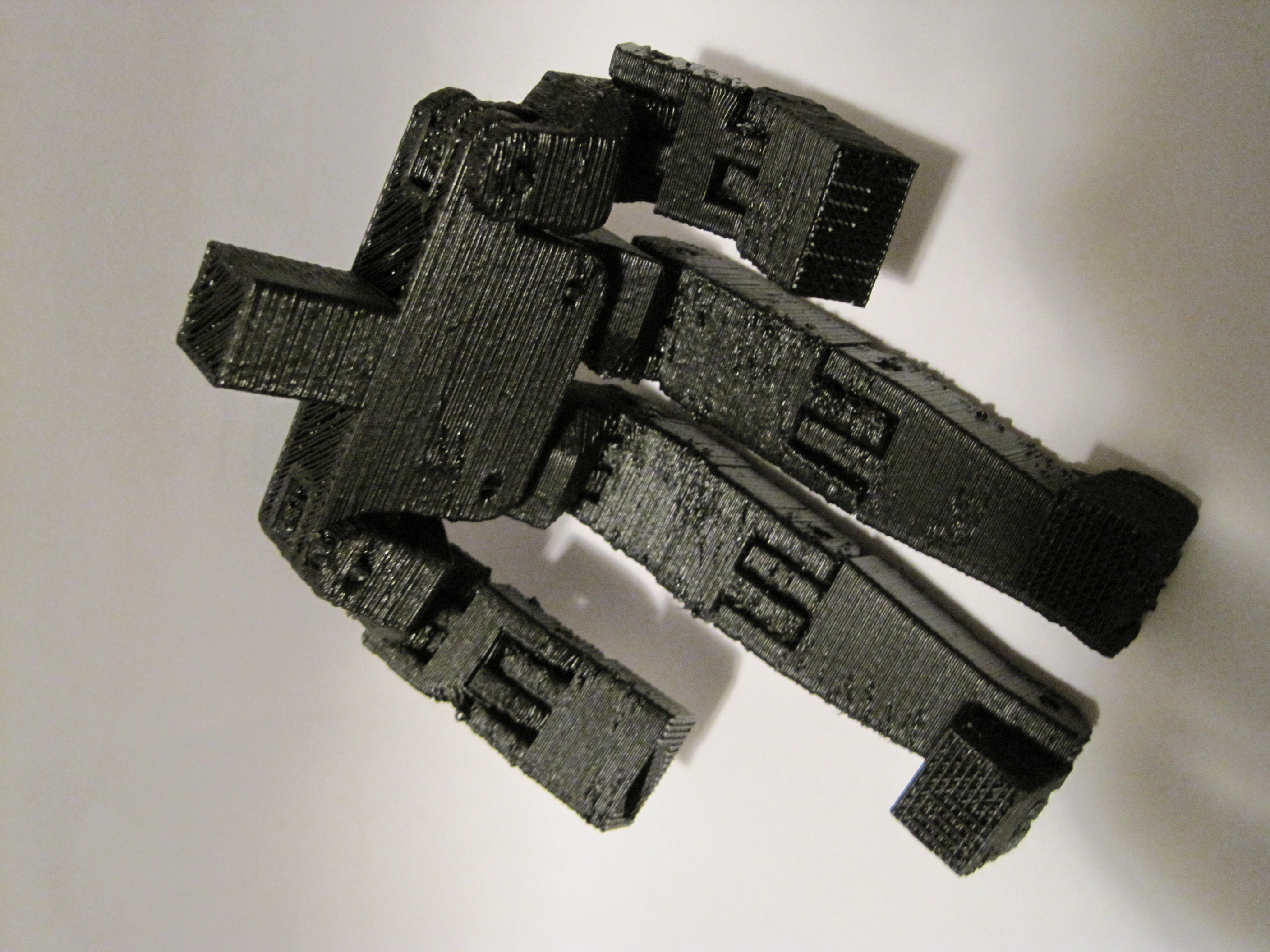
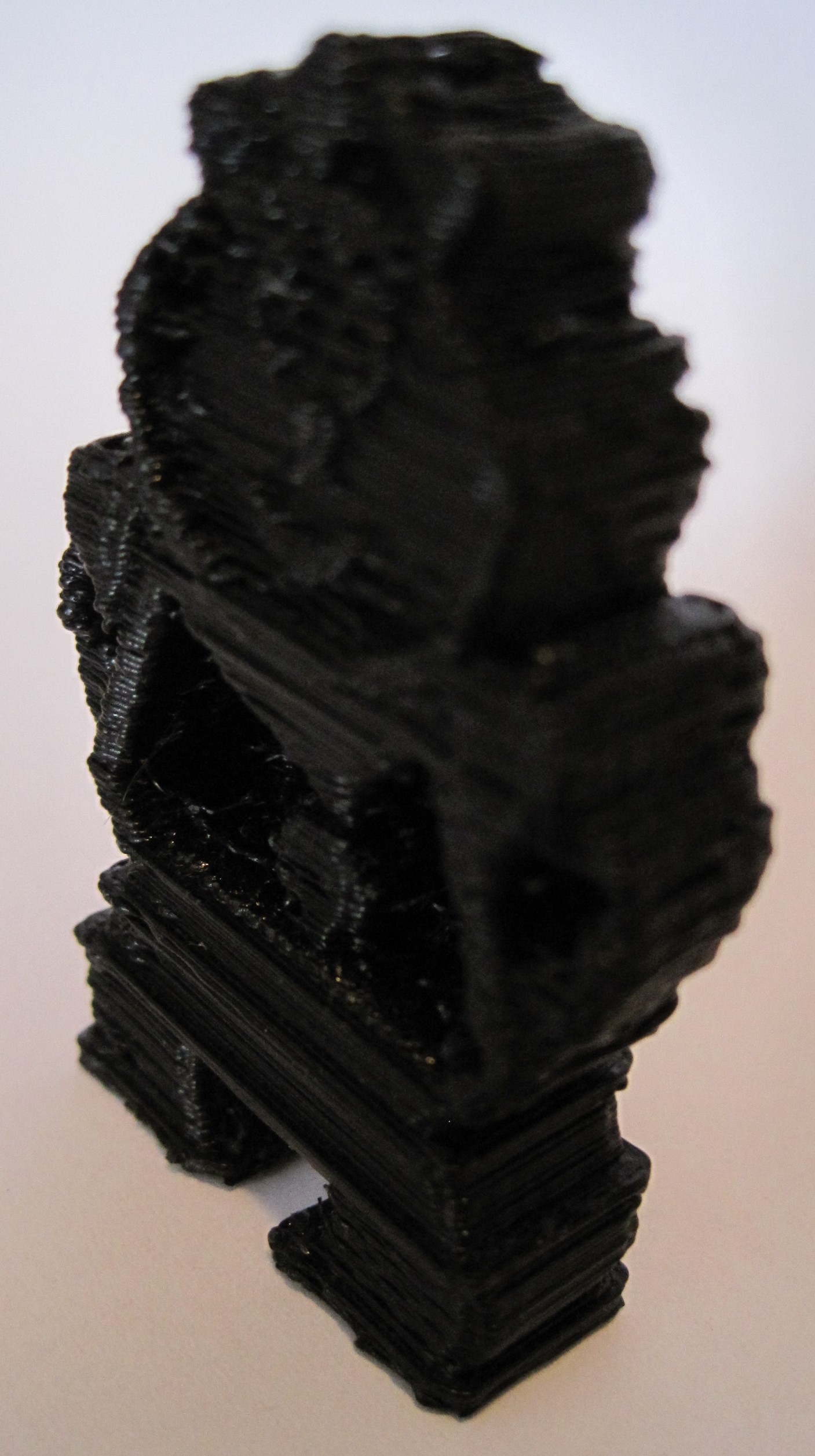
I designed this in Sketchup, exported to STL, Skienforged to gcode, RepG’d to an S3G file, and printed. The feature I’m the most proud of is the pendulum inside his chest.
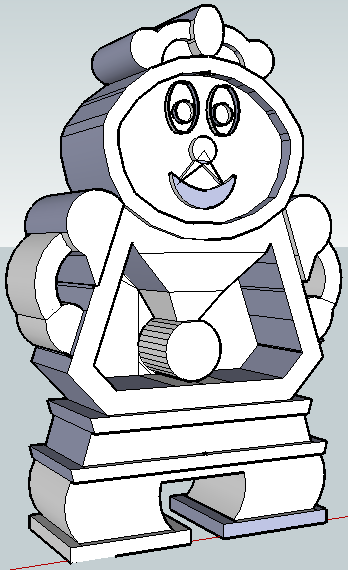
Digital CogsworthPhysical Cogsworth
The design needs to be tweaked a little since parts of him have too much plastic and a few parts have too little. But, overall I’m quite happy with the result.
Here’s the process I used to unclog my extruder barrel and nozzle without a lot of extra equipment. Obviously you should take all reasonable safety precautions with goggles, gloves, tongs, with a fire extinguisher, etc. Plan ahead and be safe.
Materials:
Clogged extruder
Yarn
Q-tips
Heavy iron hook
Wrench
A big rock
Ethernet cable
Wire strippers
Blow torch
Safety equipment
Drill bits
Thick rubber band
Cleaning the inside of the nozzle - kinda gross
Process:
Disassemble the extruder
Since PLA had gotten into the threads I had to leave the extruder warm as I unscrewed the PTFE insulating barrier.
Unwrap the heater – taking off the ceramic tape, thermistor, nichrome, and Kapton tape.
Remove plastic from the extruder
I wrapped the unsharp end of my smallest drill bit in a thick rubber band to give it a grip.
I then rotated the drill bit into the barrel by hand.
Extruder barrel and thick yarn
When I had gotten as much out as I could, I switched to a slightly larger drill bit (again wrapped in a rubber band for grip) and drilled out as much as I could. I repeated this until I had gotten to my largest drill bit that would fit in the barrel.
I used a precision flathead screwdriver to follow along the threads of the extruder barrel and chip out plastic.
I used the same precision flathead screwdriver to follow the threads inside the PTFE and chip out plastic.
I was unable to remove the nozzle from the barrel. Don’t worry if you can’t either.
Put the extruder nozzle and barrel inside the large washer so the barrel is hanging down through the washer with the nozzle keeping it in place.
Place the washer on a big iron hook or some similar piece of large thick heavy metal.
Weigh down one end of the hook with the rock.
With all reasonable proper safety measures in place and with adult supervision, heat the barrel and nozzle with the blow torch until it emits black smoke (which you should NOT breathe) and then keep it hot until it stops emitting smoke.
Flossing the nozzle with copper wire
Use the wrench to pick up the assembly and check if you can see through the nozzle.
If you can’t see through the nozzle, keep heating it.
Once you can see through the nozzle, it’s time to clean the extruder again
Clean the extruder
Once the barrel and nozzle had been heated, I found the nozzle came off very easily.
Clean out the large cavity of the nozzle with the Q tip.
Clean out the barrel with the yarn by inserting the yarn and “flossing” it.
I happened to have pieces of an ethernet cable lying around. I cut open one of the wires inside and pulled out the thin copper strands. I took two of them and fed them through the 0.5mm nozzle. I “flossed” the nozzle until it felt reasonably clean.
Well, not really playing. But, I suppose not really “working” either. Here’s how my experiments in unclogging a clogged extruder barrel went:
You can see where there is some minor plastic residue left over from the PLA in PTFE insulator which oozed into the threads. I had used a precision screw driver to follow along the threads and chip out plastic.
PTFE insulator, mostly clean
Here’s the clogged barrel. I had chipped out plastic from the threads using the same precision screwdriver. You can see some of the scar marks from my brilliant idea to use a wrench on the smooth part of the barrel at one point. (FYI, that was sarcasm – don’t use a wrench on the barrel. It was, in fact, a bad idea). I was totally unable to remove the nozzle from the barrel.
Extruder barrel, clogged
This was my idea for the setup so that the flame/heat would not discolor everything. You can see where the nozzle has gotten a thin layer of black ABS fused to it. Again, you can also see the marks on the nozzle where I tried to use a wrench. And, again, not a good idea. All I managed to do was just scar it up.
Extruder barrel with nut partway on
This is similar to the setup I settled on for trying to unclog the barrel. I’m going to cut the suspense and let you know – this doesn’t work and you shouldn’t try it. This setup did not work for two very important reasons you can learn from. First, it was too low to the ground and the blow torch kept going out when I tilted it to get to the heater barrel. Second, it relied on kitchen tiles – which is a terrible terrible idea.
Kitchen tiles - good intentions, bad idea
Here’s the next part of the setup: blow torch, flint, wrench for picking up hot things, and fire extinguisher. Off camera right is a garden hose. Again, this setup relies on kitchen tiles – which will actually shatter when this kind of heat is applied. So don’t do it. Oh, and it turned out I did have a blow torch – but it was empty. :)
Setup - empty propane tank, bad kitchen tiles
This is a better setup – with a brand new propane tank – but still a terrible idea with kitchen tiles.
Setup - FULL propane tank, bad kitchen tiles
This was a good setup. Friend nearby with a garden hose and fire extinguisher, no nut on the barrel so it sits in the washer and is easier for me to heat the entire barrel, suspended in air by a metal hook, held down by a big rock, high enough that I didn’t have to tilt the blow torch. Here you can see the scorched and shattered kitchen tile in the pile on the right.
GOOD setup with extruder barrel suspended in air by metal
Since I was in charge of the blow torch and my friend had the fire safety equipment I really only pictures of stuff as it was in a relatively cool state. This means I did not get a picture of the barrel as I was heating it – I had gotten it glowing red hot which was pretty nifty. I also missed out on getting a picture of flame spewing from the nozzle as the ABS inside ignited. It was like a mini flame thrower tossing out a thick black smoke.
I was expecting some of the ABS to leak out of the bottom – but the barrel was essentially clean. I could see all the way through the nozzle with no problem.
I learned a lot this morning! And now you don’t have to learn, as they say, the hard way.
Never ever ever use tiles. I thought I was being very clever with the tile idea. Apparently leftover kitchen tiles can shatter and fly apart when you heat them. Who knew?
Instead, use a big piece of metal to hold the barrel. I ended up using a piece of metal I had laying around to hold the extruder barrel and weight it down with a rock. This worked perfectly.
Don’t tilt your blow torch too much. Probably an elementary thing for most people. My torch kept going out when I tilted it too far – probably a safety feature. This meant I had to change the set up so that the barrel was somewhat elevated so I could keep the torch mostly vertical.
Keep a friend handy. This was one of my few ideas/preconceptions that actually worked out. Thankfully I didn’t need him to use the fire extinguisher or garden hose, but I very well could have.
Don’t leave a nut on the extruder barrel. At the last minute I decided to screw a nut part way on the barrel. I figured I could prop the extruder barrel up in the washer, heat it, and not discolor the nut or washer. This didn’t work out because I needed to apply more heat to the barrel to get the clog out.
Don’t get me wrong – I like the acrylic dinos I have. But what if you want to replace yours with a printed set? Or what if you want to print up a full extruder kit for a friend? Well, now you can! I just uploaded some designs for a printed set of dinos. Depending upon your batch you may have Big/Little dinos or Weird/Big dinos. These should work in place of either, assuming that the placement of the bolt holes in the Z stage haven’t changed. 1
I’ve uploaded the sketchup files to make it easy to play with the designs. As I was mocking these up I was tempted to turn them into bunnies instead of dinos. Or to give the dinos some more features. Since I was so torn about which route to take I decided to upload the bland models and let others embellish if they want.
So, print up printstruder and a few dinos for an authentic fully printed printruder.