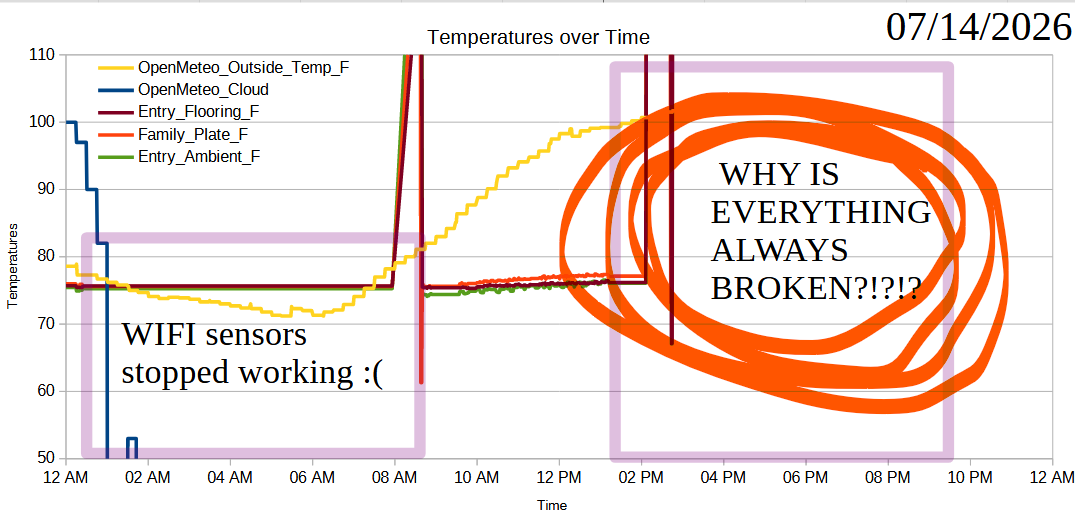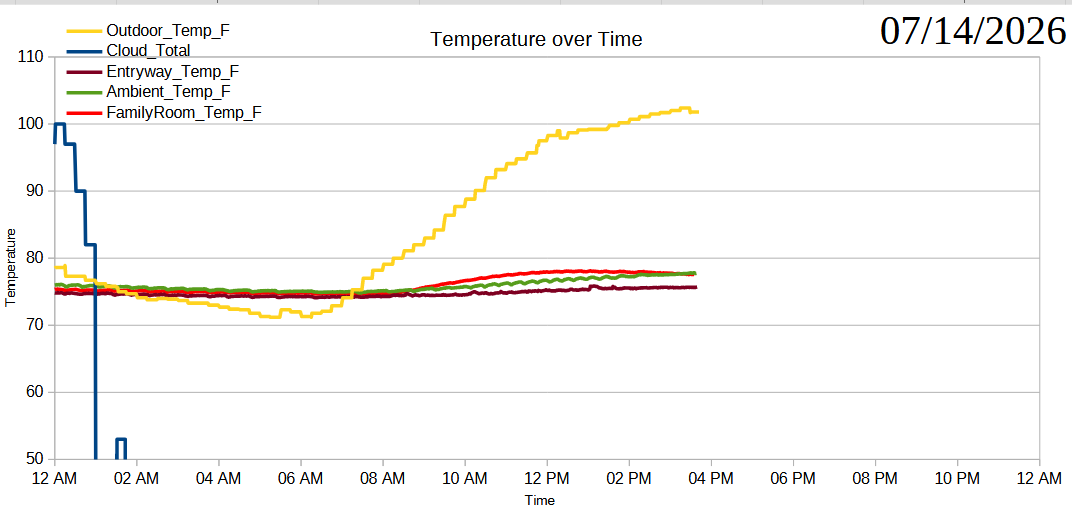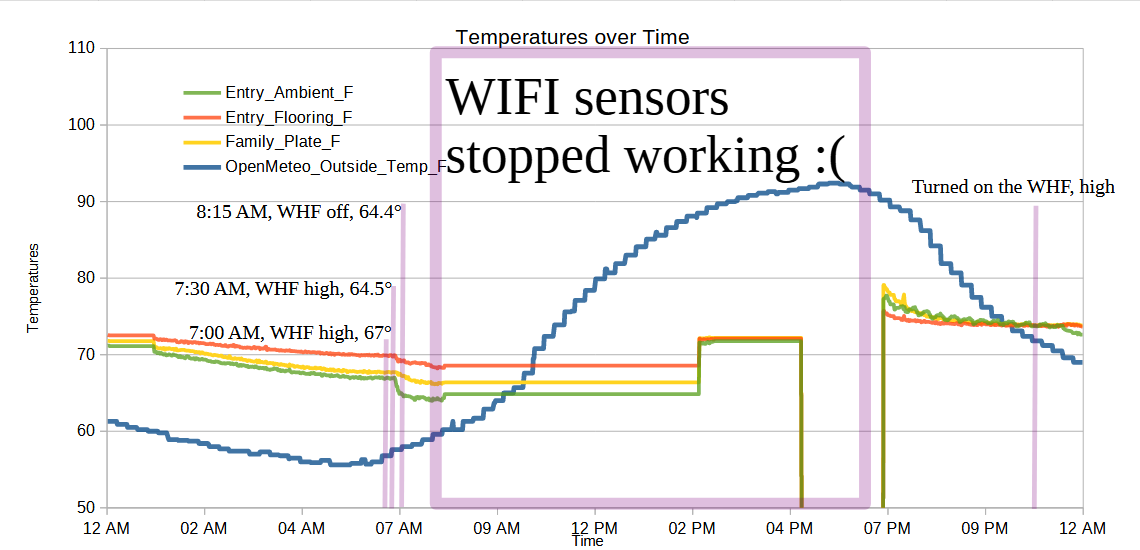
WWMWD?

Welp.  I guess this is a good time to dust off this little gem from the book, “The Martian.”

Not give up, that’s what he’d do

I’ve been trying to get consistent readings inside the house for a little over a week now.  The infrared thermometer was helpful, but was too manual and to variable in readings despite trying to control by checking at wider intervals and taking measurements in very specific sections of the floor, wall, and ceiling.  The XAIO board and thermistors were a great first step, but required too many wires and it was also having trouble broadcasting data. 1 The Wemos D1 Mini, while an underpowered board, took a lot of fiddling to get running and a fair bit of soldering, but has worked very well.

Until external factors cropped up.

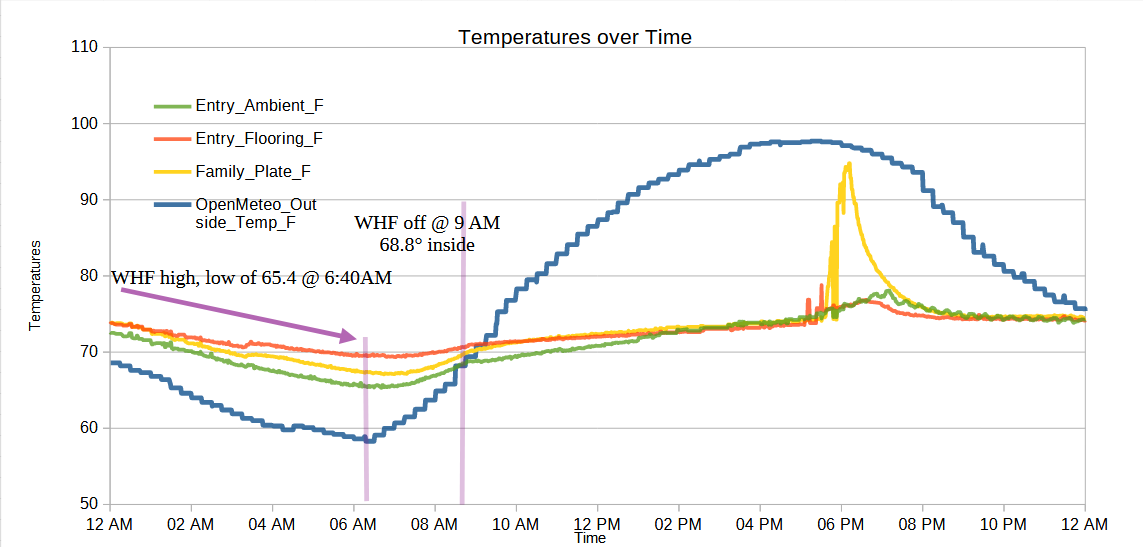
Yesterday, at the absolute peak of outside heat, our AC unit stopped working.  I’m pretty sure the sound of it turning off yesterday was the last time it was working.  The temperature inside reached about 86 degrees upstairs based on the home thermostat and stayed at that level until about midnight when we started up the whole house fan.2

If I were comparing a given day’s temperature to a different day’s temperature, all the readings would be basically useless.  However, I’m actually more interested in figuring out if a single sunscreen can soften or blunt the increases in internal house temperatures.  The data from yesterday is going to be useless for looking at absolute changes in temperature, but it certainly shows what would happen if we don’t have a working AC unit on a very hot day.3

Yeah, having the AC go out is a hassle – but on the bright side, at least it happened during a time when I was running some science experiments.

But, with about a week left to go, I’m less certain I’m going to be able to present the findings and associated original project I was planning on.

Summer Science - Testing Effects of Window Coverings on Interior Temperatures
  1. Testing the Effect of Interior and Exterior Window Coverings on Interior Temperatures
  2. Testing Interior Temperatures – preliminary results
  3. Readings so far… 07/11/2026
  4. Now with remote sensors
  5. Repeatedly Redundant (Sensing Sensors)
  6. WHY IS EVERYTHING BROKEN?!
  7. Musings on measurements and a wacky cat
  8. WWMWD?
  9. Back on track
  10. House Temperature Readings So Far
  1. Though, now that I think about it, this might have been improved if I attached the antenna to it? []
  2. 86 degrees inside sounds comparable to Italian AC []
  3. Though, it shouldn’t take a rocket scientist to realize it’ll get warmer here without AC. []

WHY IS EVERYTHING BROKEN?!

How it’s going

The running joke / perennial axiom of hardware startups is “hardware is hard.”  I’m not even dealing with any kind of wild hardware.  I’m using off-the-shelf sensors and an off-the-shelf board, connecting these in a way I can prove works, and transmitting data back to my PC.  For some reason the XIAO ESP32C3 board is just not transmitting data back to the PC.  Sure, sometimes I have to restart it which is no big deal.  We all need a break.  But, now it’s just not resetting properly when I power cycle it.

Anyhow, it’s clearly going haywire:

XIAO ESP32C3 board is acting up

The good news is that the sensor data coming in from the single microcontroller + three hardwired sensors seems very consistent to the data that’s coming in from the three microcontrollers + single sensors, both over the last day and when compared against readings over the last week.

The observed trends is basically:

  1. Outside temperature dips overnight, with a low around 5-6 AM, peak heat at around 3-4 PM.
  2. When there’s no cloud cover, the house temperature at the entryway bumps first, then the family room, then the ambient house temperature peaks about two hours after entryway bump.
  3. The house and outside temperatures are about the same by 10 PM to 12 AM.

In an ideal world, I’d just restart all the readings right now using the new system, get the sunscreen, then compare these patterns.  However, the science display is due in about 10 days, which means I don’t have a lot of time to keep restarting / pivoting.

I guess what I’m doing now is just looking at the baselines.  From there, I’ll make a prediction about what would happen with a sunscreen.  Some of this sunscreen stuff may depend on external factors – the availability of the sunscreen vendors to measure/make the sunscreen.  I don’t know what their lead times are, but I imagine during this heatwave they might be extra busy.  Otherwise, I might try to make some predictions about how else we can affect the house temperature and humidity, perhaps with timing the opening windows, opening/closing blinds, and use of the whole house fan.

Three Wemos D1 Mini boards

On interesting aspect of the more distributed Wemos boards / sensors is that these three sensors are also at different heights.  The entryway sensor is at floor level in the path of the sun, the family room sensor is at about 6 feet off the ground, and the ambient sensor is at about 13-15 feet in the air.  I am expecting the ground level to spike first, then the other two.  I’m not sure if I should expect the 6 foot sensor to react first, because it’s closer to the ground height or the 13 foot sensor because it’s closer to the ceiling where the hot air will be collecting.  If I had to guess, I would guess the higher one.

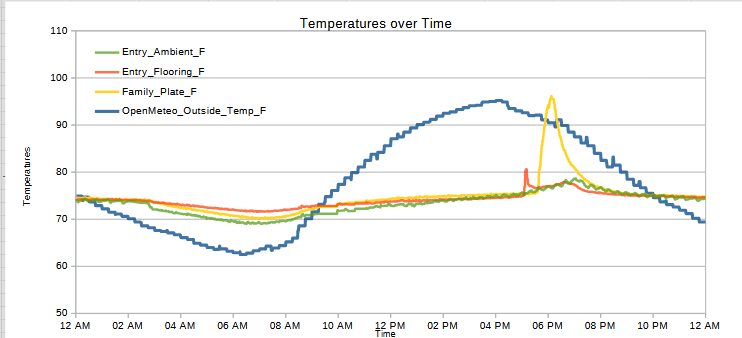
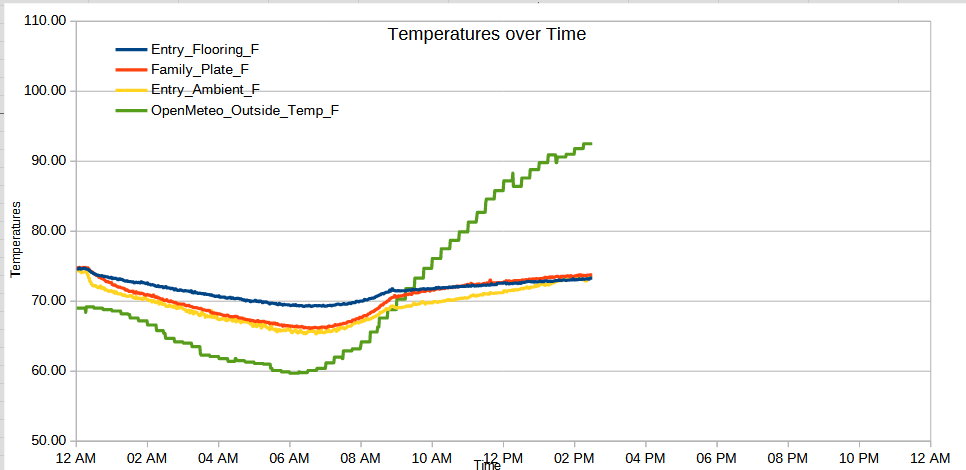
Although today is a real scorcher, the one upside is that I can compare it pretty nicely against the data from a very warm day last week with almost no cloud cover.

Summer Science - Testing Effects of Window Coverings on Interior Temperatures
  1. Testing the Effect of Interior and Exterior Window Coverings on Interior Temperatures
  2. Testing Interior Temperatures – preliminary results
  3. Readings so far… 07/11/2026
  4. Now with remote sensors
  5. Repeatedly Redundant (Sensing Sensors)
  6. WHY IS EVERYTHING BROKEN?!
  7. Musings on measurements and a wacky cat
  8. WWMWD?
  9. Back on track
  10. House Temperature Readings So Far

Readings so far… 07/11/2026

Here are the readings so far from 07/07/2026 to today 07/11/2026.

There will be a few momentary blips in the data because now and then I have to restart my PC for some stupid reasons.  In an ideal world, I’d have a dedicated Raspberry Pi (or even a special computer) designed to specifically capture this data.  But, time constraints mean that I’m doing the best I can with what I have.  I ordered some AHT10 boards to connect to the Wemos W600 boards (since this board doesn’t have an analog input) I have lying around – only to discover that the Wemos W600 boards are basically abandoned/unsupported and just won’t detect anything coming out of those sensor boards.  I then tried some Wemos D1 Mini boards… and no dice there either.

I think the lesson might be…  Just get more of the boards that I know will work.  These days, that means the Adafruit QtPy boards and the SeeedStudio XIAO ESP32 line.  They’re small and at $5-$8, I’ll save WAY more time than if I was trying to get a $2 board working.  I guess it could be that the sensor boards are junk – but I won’t really know until I dig into these deeper and that’s not going to happen until the weekend.

I was inspired to start testing this stuff by a local science fair put on by our local utility company.  But, let’s not kid ourselves, I’m only too happy to dive into a project like this.  Rather than having a bunch of wires from one single ESP32 board going to three different locations in the house, I’d like to ideally have three remote sensors that are battery operated and I could place throughout the house.  In a move that may well bite me in the backside, I’m trying to use a Wemos D1 Mini for these remote sensors.  I already have them lying around, can run Micropython, and can connect to the I2C / AHT10 sensors I purchased.  Rather than scrapping the existing system, I’m going to see if I can build up the new system in parallel, get it running, then disconnect the old system.

While I’ve shopped around for some window screens, I haven’t actually purchased one yet.  However, I still have about 2 weeks to go before the science fair, so hopefully I still have time to get this done.  :)

Summer Science - Testing Effects of Window Coverings on Interior Temperatures
  1. Testing the Effect of Interior and Exterior Window Coverings on Interior Temperatures
  2. Testing Interior Temperatures – preliminary results
  3. Readings so far… 07/11/2026
  4. Now with remote sensors
  5. Repeatedly Redundant (Sensing Sensors)
  6. WHY IS EVERYTHING BROKEN?!
  7. Musings on measurements and a wacky cat
  8. WWMWD?
  9. Back on track
  10. House Temperature Readings So Far

Testing Interior Temperatures – preliminary results

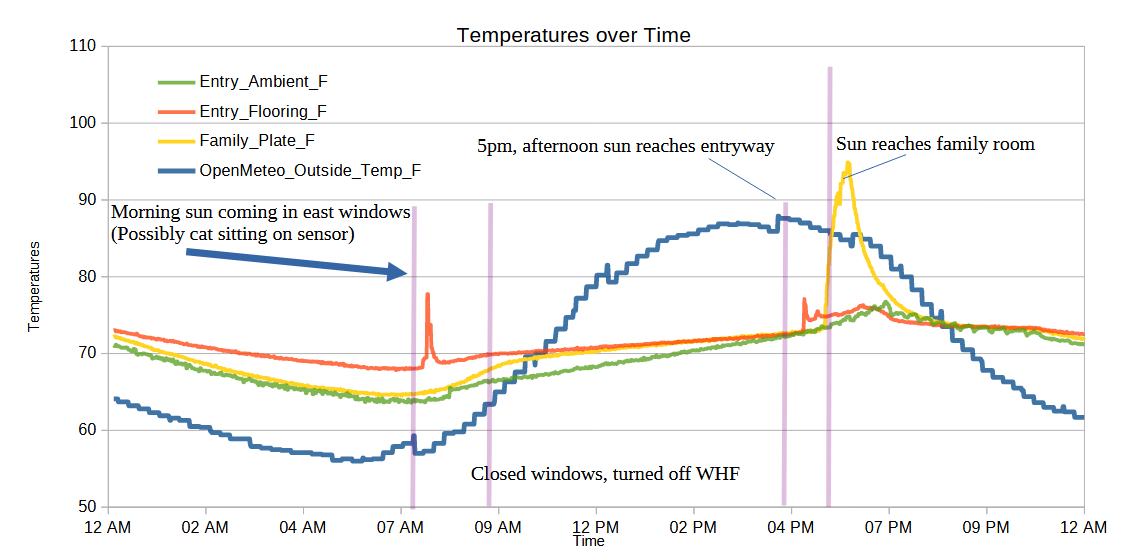
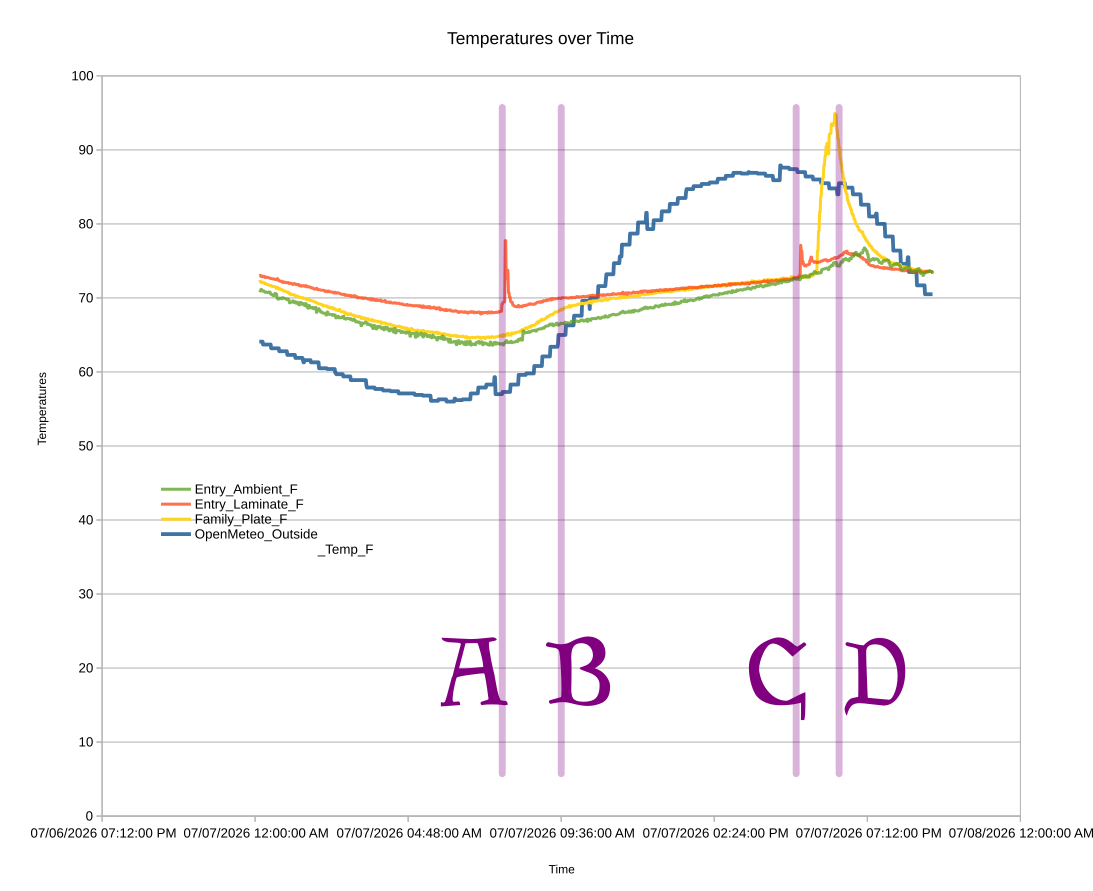
I’m not going to bury the lede.  There are several spikes or “upticks” in the household temperature.  There’s one at about 7:30 AM (A) I’ll discuss below, one at about 5 PM (C) which coincides with the afternoon sun reaching the entryway, and another starting around 5:45 PM (D) when the afternoon sun starts to creep into the family room.  Around 9:30 AM I closed the the windows that were open overnight and turned off the whole house fan.

While the above graph is based on about 1,200 samples from about midnight on 07/07/2026 to about 9:30 PM the same day, it’s just a sample of part of one single day.  Even so, I find some interesting take-aways:

  1. I turned off the whole house fan and closed the windows at the right time.  In another few minutes, the interior temperatures would have reached equilibrium with the outside temperatures – and then quickly overtaken.
  2. The readings on the laminate and metal plate spiked when expected, the laminate before the plate.  The more exaggerated uptick is probably because the metal plate absorbed heat faster and then held onto it longer than laminate.
  3. What I didn’t fully appreciate before I started the experiment was that the interior ambient temperatures were clearly lagging behind the floor sensor temperatures.
  4. There’s an a sharp rise on the laminate temperature in the morning as well as a rise in these temperatures from about 7 AM to 9 AM.  I believe this probably coincides with the morning sun coming in from the east facing windows.
  5. Another thing I didn’t think about until after seeing these results is – what else could explain a temperature rise in the afternoon?  Obviously, the house is going to heat up overall throughout the day – but are there any other factors?  Our front door is painted black and the hardware becomes uncomfortably warm/hot with later afternoon light.  While I would expect certain household objections to painting the entire front door white or covering it in aluminum foil in the name of science… I could run a small and less objectionable test by putting something insulating over the exterior door hardware to prevent it from heating up, and thereby not heating up the internal hardware.
  6. You might wonder why the blue line, indicating the exterior temperatures, is so jagged compared the more detailed and noisy interior temperatures.  The exterior data comes from a public source and is only updated once very 5 minutes, thus, it’s going to look more choppy than the data I can sample over WIFI multiple times a minute if I want.  With updates only every 5 minutes, variations can look more pronounced as well.  There’s a strange dip in the exterior temperature at around 7 AM, 12 PM, and 4 PM.  The 7 AM dip coincides with a sharp increase in the cloud cover and the 4 PM dip appears to line up with a modest increase in cloud cover.  I don’t see any immediate patterns which jump out at me regarding the 12 PM dip in exterior temperature.  It would be interesting to look at the temperature data on a time graph as well as the humidity, cloud cover, wind, direct/diffuse radiation from the sun, and possibly even the air particulate counts.  But, that would really only help me better understand exterior temperature trends in my particular climate.  I’m more interested in how do the exterior temperatures and sunlight affect my interior temperatures – and what could I do to favorably effect these results.
  7. One thing I’m wondering is whether it’s “fair” to measure the temperature in the family room using a black metal plate that will absorb and retain heat.  I can’t reliably measure the carpet temperatures using this setup, so I have to use something.  I’m concerned cardboard would be too good an insulator, I don’t have a spare plank of clean wood or tile, so I’m just kinda making do with what I have.  Fortunately, I don’t really care about the temperature of that section of the room or even this piece of metal – I care about what’s heating it up and how I can blunt those effects.  If I put in a sun screen and all of a sudden that sharp spike gets dulled – wonderful!
Summer Science - Testing Effects of Window Coverings on Interior Temperatures
  1. Testing the Effect of Interior and Exterior Window Coverings on Interior Temperatures
  2. Testing Interior Temperatures – preliminary results
  3. Readings so far… 07/11/2026
  4. Now with remote sensors
  5. Repeatedly Redundant (Sensing Sensors)
  6. WHY IS EVERYTHING BROKEN?!
  7. Musings on measurements and a wacky cat
  8. WWMWD?
  9. Back on track
  10. House Temperature Readings So Far
Test