

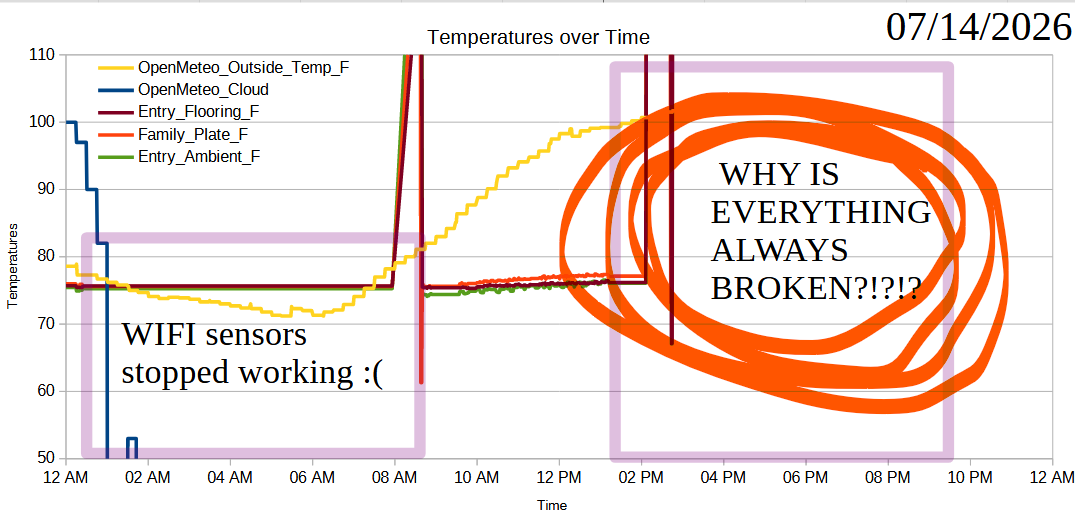
The running joke / perennial axiom of hardware startups is “hardware is hard.” I’m not even dealing with any kind of wild hardware. I’m using off-the-shelf sensors and an off-the-shelf board, connecting these in a way I can prove works, and transmitting data back to my PC. For some reason the XIAO ESP32C3 board is just not transmitting data back to the PC. Sure, sometimes I have to restart it which is no big deal. We all need a break. But, now it’s just not resetting properly when I power cycle it.
Anyhow, it’s clearly going haywire:
The good news is that the sensor data coming in from the single microcontroller + three hardwired sensors seems very consistent to the data that’s coming in from the three microcontrollers + single sensors, both over the last day and when compared against readings over the last week.
The observed trends is basically:
- Outside temperature dips overnight, with a low around 5-6 AM, peak heat at around 3-4 PM.
- When there’s no cloud cover, the house temperature at the entryway bumps first, then the family room, then the ambient house temperature peaks about two hours after entryway bump.
- The house and outside temperatures are about the same by 10 PM to 12 AM.
In an ideal world, I’d just restart all the readings right now using the new system, get the sunscreen, then compare these patterns. However, the science display is due in about 10 days, which means I don’t have a lot of time to keep restarting / pivoting.
I guess what I’m doing now is just looking at the baselines. From there, I’ll make a prediction about what would happen with a sunscreen. Some of this sunscreen stuff may depend on external factors – the availability of the sunscreen vendors to measure/make the sunscreen. I don’t know what their lead times are, but I imagine during this heatwave they might be extra busy. Otherwise, I might try to make some predictions about how else we can affect the house temperature and humidity, perhaps with timing the opening windows, opening/closing blinds, and use of the whole house fan.
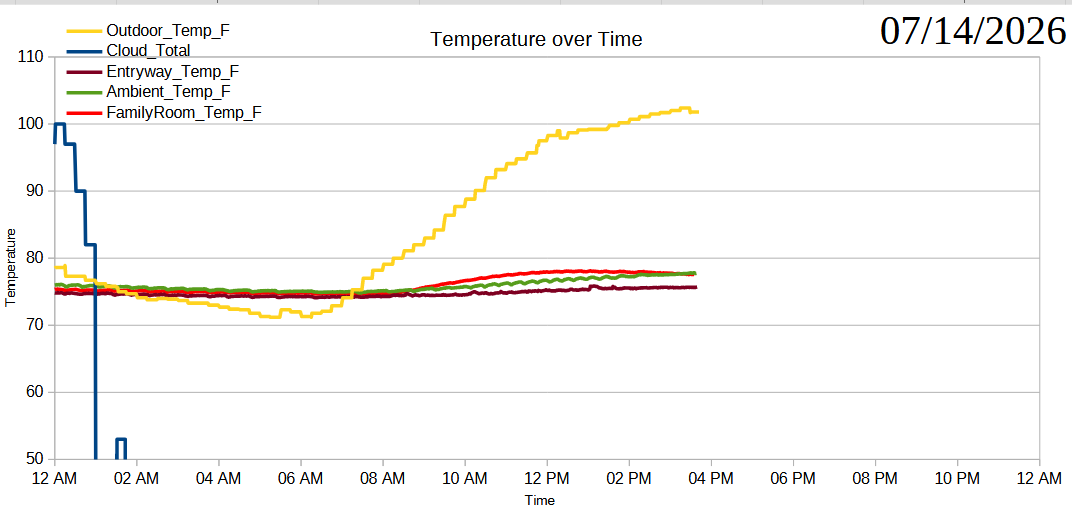
On interesting aspect of the more distributed Wemos boards / sensors is that these three sensors are also at different heights. The entryway sensor is at floor level in the path of the sun, the family room sensor is at about 6 feet off the ground, and the ambient sensor is at about 13-15 feet in the air. I am expecting the ground level to spike first, then the other two. I’m not sure if I should expect the 6 foot sensor to react first, because it’s closer to the ground height or the 13 foot sensor because it’s closer to the ceiling where the hot air will be collecting. If I had to guess, I would guess the higher one.
Although today is a real scorcher, the one upside is that I can compare it pretty nicely against the data from a very warm day last week with almost no cloud cover.
Summer Science - Testing Effects of Window Coverings on Interior Temperatures- Testing the Effect of Interior and Exterior Window Coverings on Interior Temperatures
- Testing Interior Temperatures – preliminary results
- Readings so far… 07/11/2026
- Now with remote sensors
- Repeatedly Redundant (Sensing Sensors)
- WHY IS EVERYTHING BROKEN?!
- Musings on measurements and a wacky cat
- WWMWD?
- Back on track
- House Temperature Readings So Far