
I’m not going to bury the lede. There are several spikes or “upticks” in the household temperature. There’s one at about 7:30 AM (A) I’ll discuss below, one at about 5 PM (C) which coincides with the afternoon sun reaching the entryway, and another starting around 5:45 PM (D) when the afternoon sun starts to creep into the family room. Around 9:30 AM I closed the the windows that were open overnight and turned off the whole house fan.
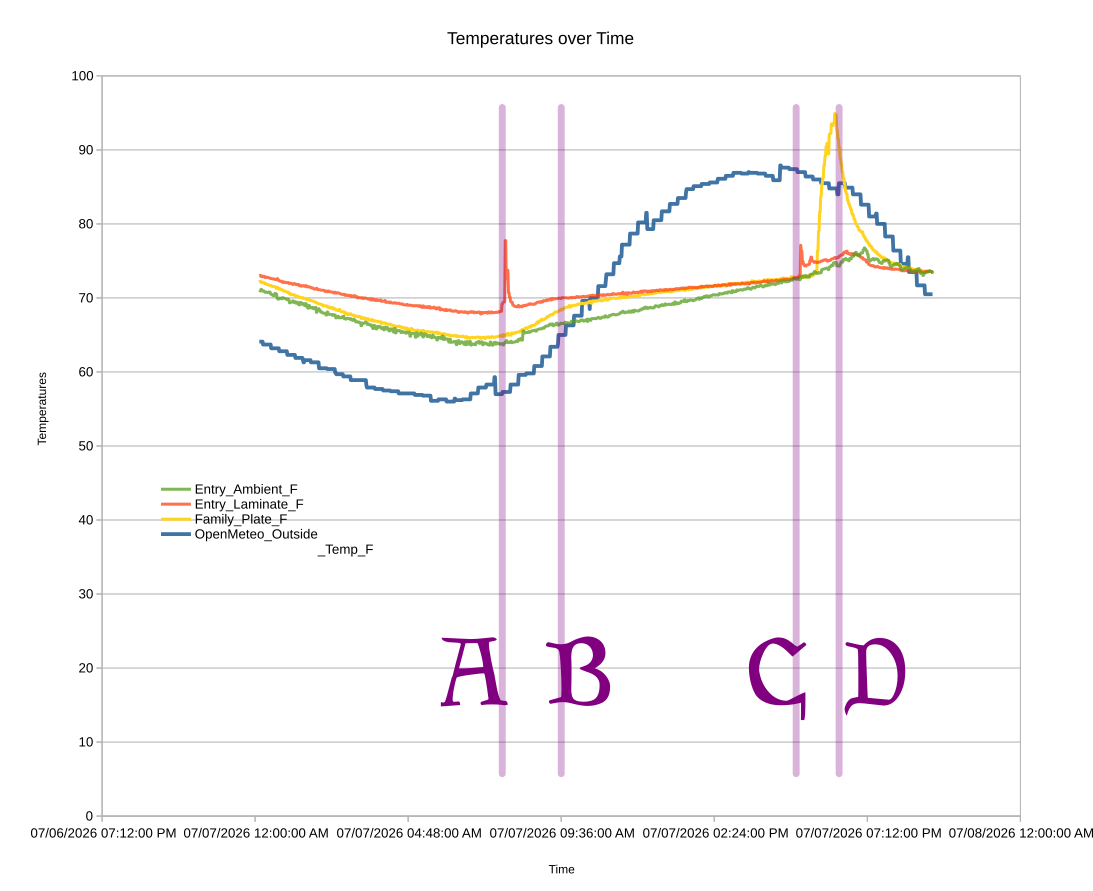
While the above graph is based on about 1,200 samples from about midnight on 07/07/2026 to about 9:30 PM the same day, it’s just a sample of part of one single day. Even so, I find some interesting take-aways:
- I turned off the whole house fan and closed the windows at the right time. In another few minutes, the interior temperatures would have reached equilibrium with the outside temperatures – and then quickly overtaken.
- The readings on the laminate and metal plate spiked when expected, the laminate before the plate. The more exaggerated uptick is probably because the metal plate absorbed heat faster and then held onto it longer than laminate.
- What I didn’t fully appreciate before I started the experiment was that the interior ambient temperatures were clearly lagging behind the floor sensor temperatures.
- There’s an a sharp rise on the laminate temperature in the morning as well as a rise in these temperatures from about 7 AM to 9 AM. I believe this probably coincides with the morning sun coming in from the east facing windows.
- Another thing I didn’t think about until after seeing these results is – what else could explain a temperature rise in the afternoon? Obviously, the house is going to heat up overall throughout the day – but are there any other factors? Our front door is painted black and the hardware becomes uncomfortably warm/hot with later afternoon light. While I would expect certain household objections to painting the entire front door white or covering it in aluminum foil in the name of science… I could run a small and less objectionable test by putting something insulating over the exterior door hardware to prevent it from heating up, and thereby not heating up the internal hardware.
- You might wonder why the blue line, indicating the exterior temperatures, is so jagged compared the more detailed and noisy interior temperatures. The exterior data comes from a public source and is only updated once very 5 minutes, thus, it’s going to look more choppy than the data I can sample over WIFI multiple times a minute if I want. With updates only every 5 minutes, variations can look more pronounced as well. There’s a strange dip in the exterior temperature at around 7 AM, 12 PM, and 4 PM. The 7 AM dip coincides with a sharp increase in the cloud cover and the 4 PM dip appears to line up with a modest increase in cloud cover. I don’t see any immediate patterns which jump out at me regarding the 12 PM dip in exterior temperature. It would be interesting to look at the temperature data on a time graph as well as the humidity, cloud cover, wind, direct/diffuse radiation from the sun, and possibly even the air particulate counts. But, that would really only help me better understand exterior temperature trends in my particular climate. I’m more interested in how do the exterior temperatures and sunlight affect my interior temperatures – and what could I do to favorably effect these results.
- One thing I’m wondering is whether it’s “fair” to measure the temperature in the family room using a black metal plate that will absorb and retain heat. I can’t reliably measure the carpet temperatures using this setup, so I have to use something. I’m concerned cardboard would be too good an insulator, I don’t have a spare plank of clean wood or tile, so I’m just kinda making do with what I have. Fortunately, I don’t really care about the temperature of that section of the room or even this piece of metal – I care about what’s heating it up and how I can blunt those effects. If I put in a sun screen and all of a sudden that sharp spike gets dulled – wonderful!
- Testing the Effect of Interior and Exterior Window Coverings on Interior Temperatures
- Testing Interior Temperatures – preliminary results
- Readings so far… 07/11/2026
- Now with remote sensors
- Repeatedly Redundant (Sensing Sensors)
- WHY IS EVERYTHING BROKEN?!
- Musings on measurements and a wacky cat
- WWMWD?
- Back on track
- House Temperature Readings So Far