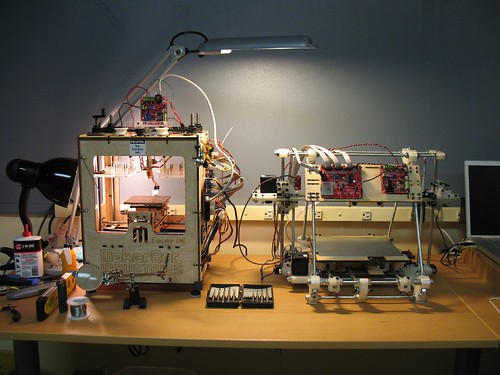
Thanks to MakerBot for retweeting my MakerBot poll. The number of responses basically doubled in a single day. It’s been a busy day so I’ll go into more detail this upcoming weekend. For now, I’m going to close the poll and show the questions:
Why are you interested in MakerBot
Have you heard or read about RepRap or RepRap.org?
Have you tried to design anything in 3D?
Have you tried to upload anything to Thingiverse?
If you had a MakerBot, what would you want to download from Thingiverse and print?
If you had a MakerBot, what would you want to design and print?
If you had a MakerBot, what would you use it for? (Help starving children, make toys, make tools, etc)
Why haven’t you purchased a MakerBot yet?
It’s not worth $1,000.00 to own an awesome robot.
It’s not worth $1,000.00 to make my own stuff with an awesome robot.
I don’t have $1,000.00 to spend on awesome robots.
I’m interested in MakerBots, but not interested enough to buy an awesome robot.
I don’t think I have what it takes to build awesome robots.
I fear awesome robots.
My parents were killed by awesome robots.
My friend has an awesome robot, so I just use theirs.
If the recent MakerBot competition and media coverage1 and showed us anything, it’s that there’s a lot of people who are interested in getting a MakerBot.
I’ve noticed that all the RepRap and MakerBot polls thus far are really geared towards people who already have such a machine. But, what if you don’t have an awesome robot that makes other robots? Well, I’m a curious guy, so I put together this poll. It’s fewer questions than the census and WAY less invasive! 2
The guys at i.materialize turned down a request to print what appeared to be an ATM skimming device cover plate. 1 Like the power of a high quality full color photocopier and a stack of twenties, owning a MakerBot is a serious responsibility.
One of my interests outside MakerBot/RepRap is origami, the Japanese art of paper folding. At it’s inception it was really only a hobby for the rich – the only ones who had access to such a luxury as paper. Modern technical origami restricts one to only a single sheet of square paper transformed only through folding – no cuts, glue, tape, etc.
A lot of very interesting origami models have been developed over the years by some incredibly talented artists through a combination of experience and trial and error. These kinds of models have so much personality they almost appear to be real – rather than mere squares of paper. One of my favorite origami artists of this “genre” is Eric Joisel. I still find it hard to believe his models, such as the “Woman in Dress 2008,” can really be made of just a single square of paper.
There’s been a movement in the last two decades to bring a more methodical and mathematical approach to design, sometimes with the assistance of a computer. One of my favorite technical origami artists is Robert Lang). His models tend to the more realistic, rather than representational (as with Joisel). His insects, such as the stag beetle, are a prime example.
Lang has used his background in mathematics and origami to develop a giant collapsing/expandable lens – so that it could be transported to outer space and then deployed. This allows a normal space craft to deploy a much larger lens than would otherwise be possible.
Robert Lang's "Stag Beetle BP, opus 477"
Unlike Josiel’s models which are typically totally unique and irreproducible by anyone (including Josiel!) Lang’s mathematically assisted models are usually carefully documented by diagrams or, increasingly frequently, crease patterns. A crease pattern is what you would get if you totally unfolded a completed origami model. Typically only the “major” structural folds are depicted in a crease pattern.
Brian Chan's "Attack of the Kracken"
An interesting intersection between mathematics and origami is the problem of determining the most efficient manner of placing the most number of equally sized circle within the smallest possible area, called, “circle packing.” The reason this is important to origami is that the center of each circle can be turned into an appendage. Lang has developed a computer program that allows the creation of truly arbitrary proportions – any number of points with any kind of ratio of one appendage to another.
Brian Chan's crease pattern for "Attack of the Kraken"
Even to someone who doesn’t have any experience with origami or the mathematics involved, the appearance of circles in crease patterns can start to make intuitive sense. One of my all time favorite origami models is the “Attack of the Kraken” by Brian Chan. (Check out the larger pictures of that model. The entire thing is just one sheet of paper. If you look closely you’ll see some of the tentacles are grabbing sailors!) In addition to a picture of his final model he has also posted a picture of his crease pattern for that model, even labeling which parts of the model are derived from which regions of the sheet of paper.
If you’re the least bit interested in origami, I’d highly recommend (in this order) Peter Engel’s “Origami from Angelfish to Zen,” a documentary on origami called “Between the Folds,” and Lang’s book “Origami Design Secrets.” The Angelfish to Zen book is one of my favorite books for background on origami and a very accessible introduction to the hidden geometry underlying even the most simple models (and real life too!).
Frankly, I would have thought it would have sold for more. Printed parts are still selling in the $300-$450 range, electronics clocking in at $250 or so, bearings at $50, and all the other bits probably costing another $100 for belts, rods, nuts, bolts. This means just the materials would cost $700 – $800. Then there’s the delay and extra expense of sourcing all of the parts for yourself.
Some people have suggested MakerBot is somehow stealing thunder from the RepRap project. 1 Here’s a super simple way every MakerBot sold could, in a very small way, help the RepRap project.
Why not put a copy of every Mendel part as an STL on the SD card that comes with the MakerBot? Actually, why not put Spacexula’s set of Mendel production STL’s?
This is a cheap and fast way to disseminate plans for RepRap files to people who are actually capable of making them.
Having reached the bottom of a market can actually be a very good thing. It means anyone who wants a set of RepRap parts can have them for as little as the market will bear. Right now there are lots of options for someone who wants to get involved in building a RepRap/RepStrap. You can get a MakerBot, RapMan, ShaperCube, Profound Devices, Isaac Mendel, or pick up a large selection of parts on eBay.
As an owner of a MakerBot, I’m far more likely to want to print up my own RepRap parts than buy them. However, each of Spacexula‘s Mendel print sets would probably take me 2-3 hours of print time plus about 15 minutes of human intervention/monitoring.1 I would of course also print up parts for any friends/family who wanted parts. 2 I’d be willing to do this to create my own Mendel, but the idea of spending three weeks3 , say $30 in plastic4 , and about six broken up over that three weeks fiddling with stuff5 makes me wonder if there’s a better way to make $300.00.
Setting that aside, I wonder where the bottom of the RepRap parts market is heading? Spacexula has suggested around $250 or so based upon the price for lasercut parts. I suspect the price of printed parts will always be higher than the price for lasercut or molded parts – because of the time involved. Lasercut parts can be cranked out as quickly as a lasercan cut. 6 Molded parts can be churned out as quickly as the poured material can be dried. Plus, no matter how nice lasercut/molded parts are – you still have a RepStrap, not a true RepRap. Assuming identical quality, I’m probably always going to be more interested in printed parts over alternatives.
Such as setting up, warming up, untangling plastic, checking, peeling off, etc. [↩]
At this point, this is purely theoretical/hypothetical since none of my family/friends are interested in their own RepRap. Hmm… Maybe I should talk about RepRap MORE??? [↩]
A price could be set for a particular RepRap plastic part, depending upon size, complexity, scarcity, how many more are needed to make a full set, etc.
People with RepRaps/Straps can register for an account and send in RepRap parts, and get their account credited for those parts.
Ideally, the website would also have an area where you can print out a table of contents – with bar codes. That way the receiver could just scan the parts into their inventory – and verify the contents/quality later.
People who send in parts are paid on a regular basis electronically.
The site also contains a store where you can purchase an entire set of printed/molded RepRap parts – or perhaps just those ones you need.
It would be quite handy if such a site also sold the various other parts needed for a RepRap – bearings, metal rods, electronics, fasteners, etc.
I suppose the sets could be sold on a bid-style basis – and the parts paid for pro-rata. 1
This idea isn’t without it’s problems:
How do you ensure a minimum quality in crowdsourced parts?
Why would someone buy/sell from a website like this rather than eBay?
Well, eBay and Etsy each take about 3.5% with PayPal snagging another 3% or so. Assuming sales are handled through PayPal2 , you’re talking about basically 6.5% out of the seller’s end.
Assuming you go with PayPal (3%) and you charge less than the 3.5% for eBay, you can probably attract buyers and sellers. The problem is once you’ve gotten this far, you’ve basically re-created eBay buy-it-now or an Etsy store. To succeed you’ll need to serve the market better or cheaper.
As soon as RepRaps in the wild increase or demand for parts is met, won’t the bottom drop out?
Quite possibly. A week ago Mendel plastic parts were selling for $450. 3 Today it looks like parts are going for about $300 or so. Then again, a set didn’t sell with a $200 reserve just a few days ago.
How many sets have been sold on eBay anyhow? A dozen? Let’s say it was 20 sets at $450 each. 20 * $450 * 3.5% is $315.00. If 100 sets are sold at $300 with a 3.5% cut, that’s $1050. Neither of these amounts would not have been enough to entice me to code a RepRap sales site – but I’m a slow coder.
I caught sight of this through Spacexula‘s RepRap Aggregator Feed – a $100 open source CNC mill. I was just thinking the other day how cool it would be to have an additive and subtractive CNC machine sitting next to one another.
But, $100?! It’s like someone would be paying me to build the thing.