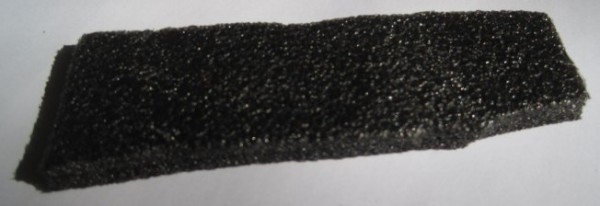
This post has been a long time coming. My kiddo and I made Fallout inspired combat armor out of Harbor Freight floor mats. We’ve now brought these to Maker Faire 2024 and 2025. They’re only $13 for about 16 square feet of 1/2 inch thick sheets of material which was enough for a front and back panel plus enough to do it all again.
I’ll update the photos below with pictures of the finished1 armor. However, below is what it looked like part way through the construction process. We added some 3D printed parts to allow the front and back “plates” to be kept together with some seat belt looking nylon webbing.
The very short version of the build guide, for our first simple builds with these mats, would be:
- Make patterns on paper or cardboard
- Trace and/or cut out of foam using a utility / craft knife you don’t care about because the foam will dull the knife quickly
- Bevel/shape/sand as needed
- Using gloves, apply a thin layer of contact cement to one piece of foam and the other piece where it’s supposed to go. Let it dry. Then, carefully place one piece upon the other – because the moment the two pieces are joined the contact cement will bond instantly making adjustments2 impossible.
- Bevel/shape/sand/paint as needed
- If making weathered armor / metallic features, consider using a silver pen or paint to dry brush on the silver color
I tend to take pictures as I build things out of an ambition to turn them into a blog post at some point. So, hopefully these pictures give a sense of how the build went:
These were easy enough to create as the entire design was basically just bit flat planks of material. Making more complicated / curved features would probably best be done by using a heat gun to soften and shape or cutting the curved features into flat panels with “darts” / wedges cut out so that when they’re glued together and the form built up, it will take on a curved shape.
The tutorial videos from Robert van de Walle and Evil Ted Smith are absolutely worth watching. The short version would be that when copying another form, you could cover it with aluminum foil, that in duck tape, draw in lines for what could be fairly flat sections, including registration marks, cut the duck tape into flattened sections with “darts” as necessary, trace onto and cut out from foam, heat-shape as necessary, apply and allow contact cement to dry, assemble. Some stills from ETS’s videos might be helpful:
These stills won’t do the full videos justice, so you should go watch those. Robert’s point with his short 3 minute video was basically that these materials are incredibly inexpensive, able to build up huge shapes quickly, and look great. I’d agree on all counts.