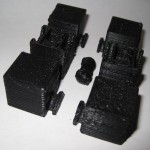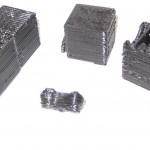
I placed my order for a MakerGear Enhanced Operator’s Pack on 8/11/2010, it shipped the same day, and arrived today 8/13/2010. My extruder has been working really well and without problems with ABS since my last rebuild. I’m really hoping I won’t need these bits any time soon…
I recently bought the Perhaps with a joule thief?)1 Since I know very VERY little about electronics, I’d appreciate some diagrams, descriptions of parts, etc.
If you’re interested in this project or just want to help, I’ll gladly accept any assistance. Let me know if I can help with any printing projects in return.
Thanks!
Why do I get the feeling I’ve seen the guy on the right before??? [↩]
Sheesh. These are getting harder. Okay, how about “MakerBlock.com”? No? “MakerBlock U”?
The address you’d like the MakerBot sent to if you are chosen
Same place as my last order. ;)
A paragraph describing how you would integrate the MakerBot into your curriculum. Include some description of the learning environment and what you teach
I would integrate a MakerBot into my curriculum by using it as a demonstration of iterative design, digital fabrication, digital design, invention, and innovation. The learning environment is the whole freaking internet. 1 I teach digital plastic AWESOME.
A lesson plan that you will implement if you get a MakerBot
Pssh. Just one? I’ll give you THREE.
You’ve got a MakerBot, a laptop, unlimited plastic and electricity. You are trapped in a mineshaft. How do you get out?
You’ve got a MakerBot, a laptop, unlimited plastic and electricity. You are trapped in a mineshaft with a tiger. How do you get out?
You’ve got a MakerBot, a laptop, unlimited plastic and electricity. You are trapped in a mineshaft with a tiger shark. How do you get out?
Actually, according to Feedburner and Google Analytics, the number is just a few hundred people a day [↩]
So, I’ve got a birthday coming up. Getting older doesn’t bother me much – it’s really just a number associated with the number of times I’ve traveled around the sun. 1 I will gleefully relate to anyone that I’m easily the luckiest man in the world. I’ve got a wonderful family, good friends, everyone is healthy, interesting and challenging work, and a fair amount of free time to do with as I wish. These are the sorts of things that are truly important to me, so by any measure of success I care about, I’ve got it all.
With my birthday approaching, my family starts to ask me about what they can get me for a present. My usual answer is, “Nothing, let’s just hang out.” This year, I actually have a list.
Contains an assembled modular heater core, PEEK insulator, modular thermistor kit, and some other goodies
I’m rather excited about some of these upgrades. I’m looking forward to a heated build platform for smoother warp free ABS builds. I’m looking forward to the rainbow pack for some crazy wacky fun. 2 And, I’m looking forward to needed the extra spare parts as infrequently as possible. :) Since my last major repair, I’ve been lucky enough to enjoy several months of carefree printing. 3
It also seems to be related to the number of gray hairs that are appearing. I rather like them, actually. [↩]
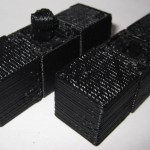
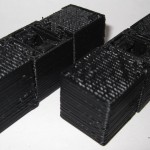
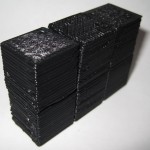
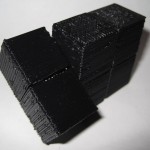
My prior copy of this 3x2x1 Rubik’s Cube was printed a few parts at a time – I’d print one part, test it, print up another, etc. Last night I was able to use my production file to generate all seven pieces in one go. It took 1 hour and 45 minutes to complete the print job, but well under three minutes to clear most of the pieces of the raft off the parts and assemble the puzzle. In order to help people modify and improve upon my design, I’ve upload the original Sketchup files, the STL I used, as well as my own GCode.
I am interested in trying your gcode, how did you generate it? How well does it minimize strings between the printed parts? I’ll look at is to see how it starts and the temp…
In case you’re wondering too, the answers are as follows:
I generated the Gcode using my slightly tweaked RepG v18 built-in Skeinforge settings for ABS with a raft, with a build temperature of 220C.
The Gcode does pretty well with minimizing stringing. However, some of the credit has to go with the part placement in the STL production file as well as the nature of the object. As soon as you assemble it and start to rotate the parts, most of the remaining strings and little blobbies will pop right off.
Owenscenic, please let me know how your print of this turned out! Please post a picture!
I’ve wondered for a while about the cost of operating a MakerBot. Let’s break it down and see what happens:
Plastic. According to some calculations on the MakerBot Operators group, the cost of MakerBot ABS is around $0.03 – $0.04 per cubic centimeter based upon a price of $70 for 5 pounds (or 2268 grams) of ABS, a density of 1.2 grams per cubic centimeter. 1 Using the current prices of $81.36 for a 5 pound coil after shipping, I calculate the price of ABS at $0.035 per cubic centimeter. Since we’re talking about such large numbers, let’s just round on up to $0.04/cc.
Time. Skeinforge has been estimating about 85 minutes to print 19 cc of plastic. This comes to about 4.5 minutes/cc.
Electricity. At at $0.20/kWh, a MakerBot probably draws around $0.03 per hour.
Thus,we may estimate the cost of operating a MakerBot in terms of consumption of goods and resources (excluding computer, human, and MakerBot time and wear and tear) as follows, where V is the volume of the extruded object in cubic centimeters or “cc”:
Supposing I wanted to recoup the entire cost of my MakerBot to date and spread it across the entire life of a single 5 pound roll of ABS. 2 Let’s round the cost of the MakerBot, all repairs, and all extra MakerBot related materials up to $1,500.00. One 5 pound coil would have 1890 cc’s of plastic. This would come to $0.794 per cc of plastic. So, I would suggest the cost of buying a MakerBot and printing off an entire coil of plastic would probably end up costing you about $0.85 per cubic centimeter of plastic.
Absolute cheapest MakerBot usage I’ve seen anywhere at Metrix:Create for members printing from Thingiverse is $0.30/minute, which would print the totally MakerBottable 3x2x1 Rubik’s Cube for $25.65.
The picture to the right is of a kite that I built several weeks ago and only got around to actually flying this weekend. It’s basically made out of office supplies. :)
Originally I just wanted to make the Tyvek sled kite from the Howtoons shown in Craft Magazine, Volume 8. 1 But then I wanted to see how much of the kite I could assemble just using things from the office. The answer is, basically all of it.
Tyvek from Tyvek office envelopes, rather than a large sheet or roll of Tyvek house wrap. My office is sent dozens of these things a day. It didn’t take long to collect 30 plus.
Clear packing tape. I used this instead of Tyvek tape. Tyvek tape would have worked a LOT better, but I have no complaints.
Rather than use a washer, I used a spare keyring. I had other various office supply bits hanging around in case this didn’t work out. Paperclips, binder clips, etc.
Yardstick.
Scissors.
Since the envelopes are significantly smaller than the sheet of Tyvek rolls, I had to either make my kite smaller or stitch them together into a larger sheet. I did both. I scaled the plans down to about 2/3rds the size from the diagrams and then used packing tape to put them all together. To get the most surface area out of each envelope, I burst all of the envelopes at the seams and then taped them up. Once I had a 36″ tall sheet, I started cutting it into the pieces I needed, re-taped it back together as indicated by the diagram, and then set it aside for weeks while I didn’t fly it. :)
On the day of the launch I made the tail out of strips of leftover envelopes taped together with the gluey bits from some of the envelope flap sealants and more packing tape. I punched a hole in the three ribs using a pen, ran the line through each of the three ribs, reinforced it with more packing tape… and launched.
The only non-office supply things used in the construction were: