Have you printed in HDPE?

I just noticed MakerBot discontinued their 5 pound rolls for HDPE.  This page is essentially taken down.  However, when it was last up it contained the following product description:

Update: Discontinued. It’s not fun to print with this stuff.

This is HDPE plastic aka High Density Polyethylene aka Milk Jug plastic. This is a nice, smooth, high quality plastic. It comes as a filament in 5lb coils with a diameter of 3mm.

This plastic is cheaper than ABS, but has a higher shrinkage factor which makes printing large objects more difficult. It does have a much lower coefficient of friction so you can print things that are very smooth.

I’ve never printed with this stuff.  Have you?  A higher shrinkage factor than ABS sounds pretty awful.  Then again, I mostly print fairly small parts, so then again I might not care.  And, for the last listed price of $30 for a 5 pound roll… it’s a dirt cheap printing option.

And neither one is Atlantis

We’re still missing two continents.1

I put up a collaborative MakerBot Map yesterday.  As of this moment we’re still missing MakerBots in Africa and Antarctica.

Oh, and what the hell is up with Greenland?  Why can’t they be their own continent?!  Those guys need a better lobbyist.

  1. I suppose the title of the post would make more sense here… []

Too much information

Have you read The Hitchhiker’s Guide To The Galaxy?  Of course you have.

You remember that bit where they put Zaphod in the machine designed to drive people insane by showing them the entire universe all at once?  Well, that’s how Google Wave feels to me.  There’s a LOT of freaking information there.  I made the mistake of looking directly at the MakerBot wave.  It was like falling into the gaping maw of eternity.  I’ll stick to RSS feeds, MakerBot Operators group, and Twitter, thankyouverymuch. 1

  1. You can find it in your Google Wave account by looking for “with:public makerbot”…  If you dare! []

Marco!

Polo!

I’m always curious to see where other MakerBotters are located.  Sure, I could always check out the RepRapMap1  However, sometimes I may want to know where just the MakerBot are.  Someone on the MakerBot Operator’s group was looking for some pulleys for his homebrew MakerBot – and was pleasantly surprised to find out there were so many semi-local MakerBotters.

This morning I created a collaborative open MakerBot Map.  Stick a pin in it and let everyone know where you are!

P.S. Party at your house.  We’ll be there at 6.

  1. Gotta love the alliteration []

And I’ll form the head!

I remember buying saving up to buy a Voltron toy as a kid.  It was a very small model with plastic lion limbs that did not transform or detach.  It was basically a toy robot with lion slippers and mittens.

Still, I thought it was the greatest freaking thing ever.  Unfortunately, I have no idea where the heck it could be.  Anyhow, I can’t wait to try modeling and printing a replacement.  I really like Tony Buser’s idea of modifying the Leonardo Robot as a starting point.

Making Blocks II

Lego nubs and underbits

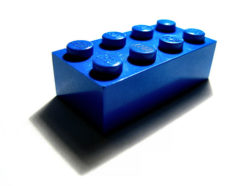
My lego prints connect slightly better to other printed legos than real legos.  I suspect this is in part to the ridged texture to both parts.  This also makes me think that printing legos is a fool’s errand.

While lego nubs are circular, the parts they fit into touch the circular nubs tangentially.  For instance a nub fitting into a corner piece would be held in place by two straight sides and held against a circular tube.  The picture to the right shows the underside and nubby bits for several lego (lego compatible?) pieces.  This system probably works because of the exacting tolerances of real lego parts.  I’m guessing they tested the nub heights and contact points to find an optimal mix of most of the same criteria I have for an interconnecting building block system.

Without tighter printing tolerances, I don’t think three tangential points are going to be enough to hold printed parts together.  Thus, it may make sense to have taller nubs on printed parts.  Then again, the ridged nature of printed parts may allow them to better fit together without having taller nubs.

One benefit to having circular nubs is that you can make interesting components where pieces pivot.  But, this is more of a lego-hack than an actual useful feature.  I’m not as concerned about this particular usage because I could always design a printable pivoting part.

So, other than that one narrow usage, why circular nubs?  Why not circular nubs with circular holes?  Why not square nubs with square holes?  Or circular nubs with notches in them?

Making Blocks

The design question I keep coming back to is “How do I create a reliable interlocking system for blocks?”  My criteria for a robust and useful system are:

  1. The interlocking system should allow interconnections in three dimensions.
  2. The pieces should snap/interlock together reasonably well/easily.
  3. The pieces should stay assembled reasonably well.
  4. The pieces should snap apart reasonably well/easily.
  5. The pieces should not require additional tools to be assembled and disassembled.