Warning: All responses from Dave are real, in the correct order, and unchanged. I may have embellished my questions and responses.
MakerBlock: Dave! How do you spell your last name?
Dave: dduranT.. T!!!!
MakerBlock: How exotic! I’m having trouble pronouncing the last bit, so I hope you don’t mind me just calling you “Dave.” Well, how did you do it? Oh, and what’s your favorite vodka?
Dave: Patience, practice, Grey Goose.
MakerBlock: In two words or less, did you print slowly or fast?
Dave:Really, REALLY fastly.
MakerBlock:Um, I guess that counts. I mean, you did only use two words – but you used one of them twice. And I don’t think “fastly” is a real word. Did you run the extruder slow or fast? Please be sure and end your response with a preposition.
Dave: Slow but not as slow as I expected I’d have to.
MakerBlock: Did you use a custom nozzle or the standard MakerBot nozzle?
Dave: I do have a 0.35mm hot end from makergear.com (props to makergear – much awesome to be found there) but haven’t installed it yet. I’m still using the 0.5mm nozzle from MBI.
MakerBlock: Could you describe your setup for us? Please be sure and include at least one plug for your all-time favorite MakerBot / RepRap blog written by me.
Update: Since this post others have achieved sub-0.1mm layer prints with their MakerBots as low as 0.075mm/layer
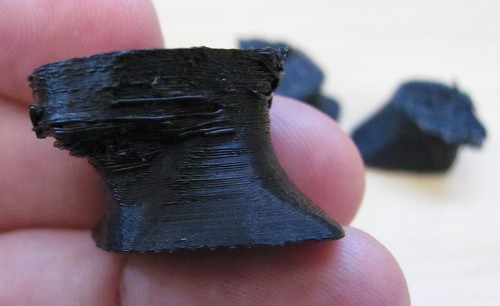
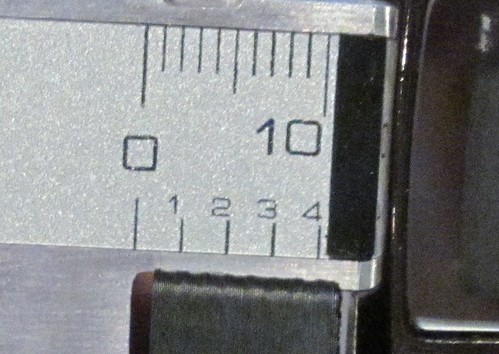
Ddurand123 has probably just taken the world record for highest resolution. The current record holder is Rick Pollack at 0.15mm per layer. Ddurant123 was able to print a 10mm test cube at 0.1mm per layer.
Dave! How did you do it?
Did you print slowly or fast?
Did you run the extruder slow or fast?
Did you use a custom nozzle or the standard MakerBot nozzle?
Edit: Dave, sonny abuut misspenning your nmae. My bed.
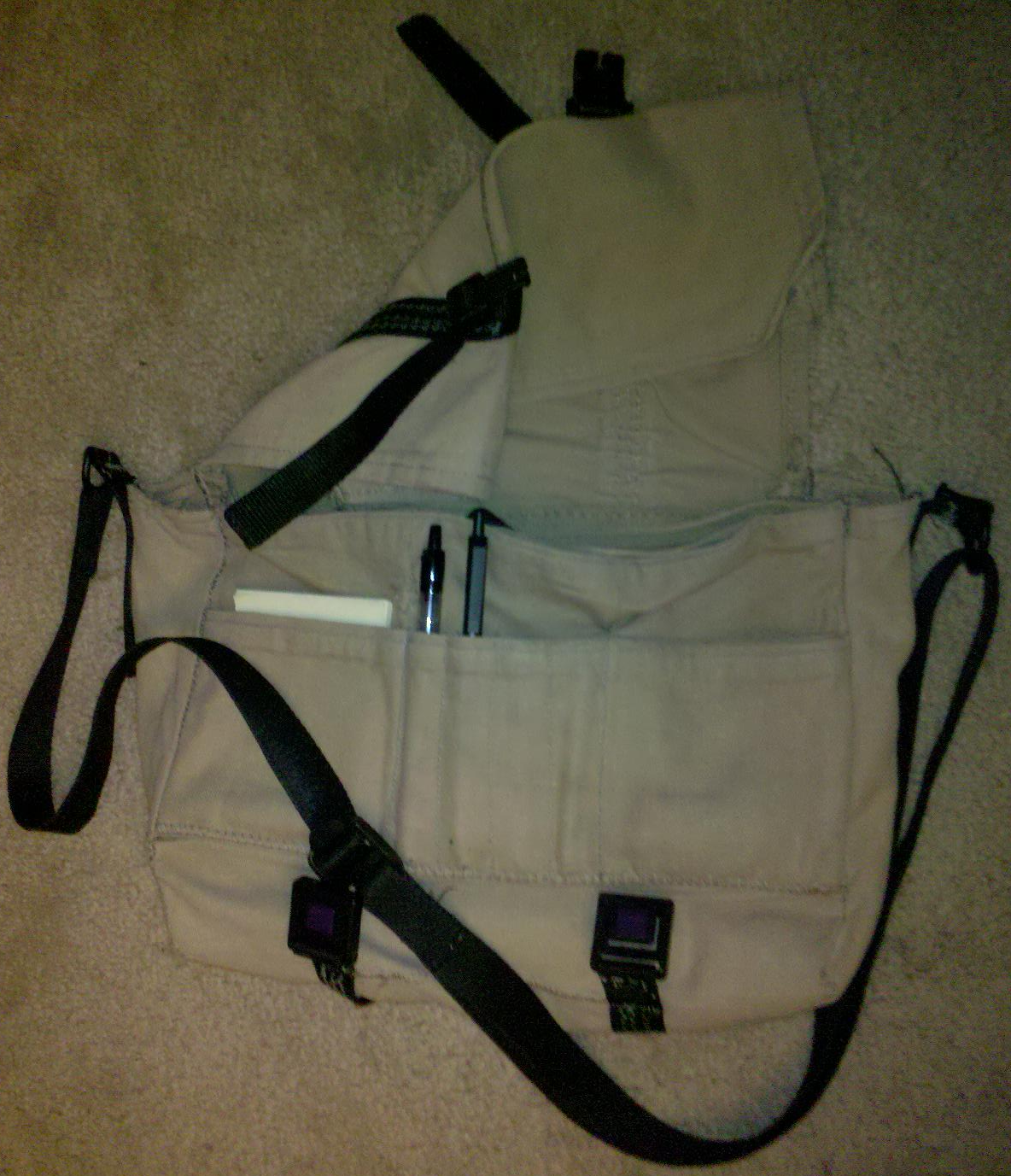
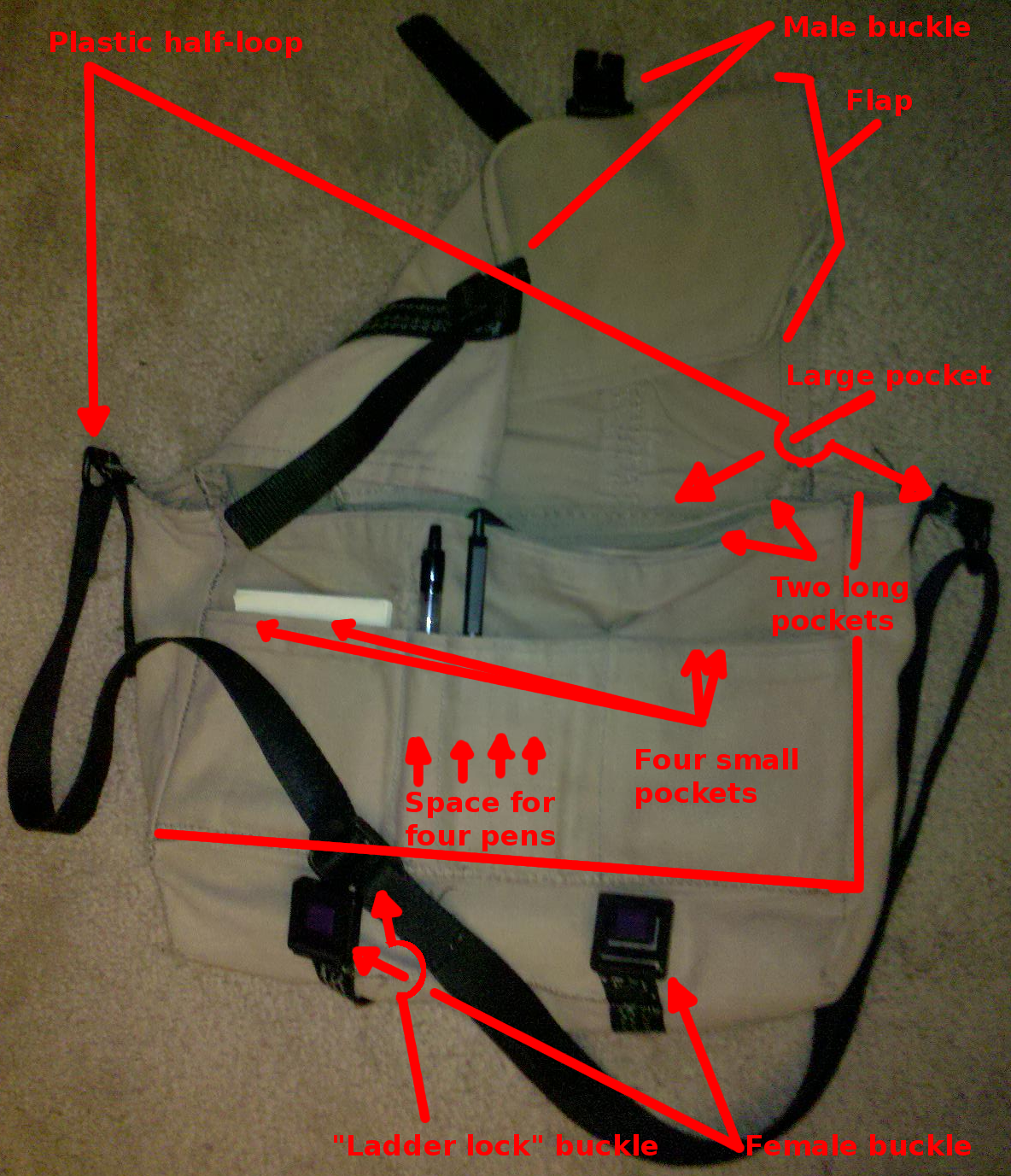
In college I used to carry a camera bag where I kept my stuff. Car keys, notebook, pens, pencils, etc. This was an old faux-leather camera bag my dad used to use years ago. I loved that thing. Unfortunately, it was stolen out of a friend’s car while we were at a concert.
Over the next few years I thought about what I liked about that bag, what I liked about other bags I had seen, and what I would want in an ultimate bag. I wanted a bag made from tough canvas, hopefully as tough or tougher as denim, and preferably a khaki color. I ended up going with a relatively thick canvas from a fabric store.
I also wanted a bag that was big enough to accommodate a full size 3″ binder (the type I thought I might use in grad school), small pockets, wide pockets, a large pocket, and a spot for pens and pencils. It has thick nylon straps around the bag for holding it together and surprisingly expensive plastic buckles. I sewed the entire thing with khaki colored upholstery thread.
Bag with notes
If I were to re-make this bag, I would change several things:
I would try to put the pen holder flaps horizontally rather than vertically. When the bag is mostly empty the vertical pens poke the bag flap upwards. I think the bag would probably fit better if pen holders were horizontal. It would also make it easier to reach in and grab a pen when the top flap is buckled down.
I think it would be pretty useful to have one or two small pockets on either side for stowing away a pen on the outside of the bag.
I don’t really ever use both long pockets. I’d probably nix one.
I’m always using the four small pockets – they’re incredibly useful. I’d definitely keep those. However, I think they might be even more useful if they had a velcro flap to keep them closed. I have a feeling velcro is a lot easier to attach than zippers. On top of that, zippers can jam – velcro is basically all good.
I would make the large interior pocket a little wider. It’s about four inches wide – it could be widened to about six or so.
I would absolutely, positively print all of the plastic buckles on my MakerBot.
I would add a plastic lanyard/carabineer/key hook. Sometimes I want to toss my keys in and don’t want to worry about them bouncing out (not that they ever have).
When I sewed it together I used a setting on the sewing machine that put the thread seams really close together. With the thickness of the thread and the closeness of the seams, this ended up essentially making perforations in the cloth. I would still use thick canvas and thick upholstery thread, but I would set the seams to be wider apart.
I’ve often thought that the bag would be a little better if it were lined or reversible. If I’m going to line the bag, I might as well make it reversible anyhow. If I did this, I would make one side black and one side khaki color. I’ve used this bag as a pillow more than once – and having two layers would make it more… fluffy.
I’ve been caught in the rain with this bag on more than one occasion. While this has never been much of a problem, I think a thicker canvas (perhaps the kind used as a painter’s tarp – the kind that’s partially sealed with plastic and/or rubber) would make an excellent water repellent version.
I’ve taken to carrying zip ties in my laptop backpack. They’re just always useful. I think it would be nifty to have a long thin pocket where I could stash a few of these. They would take up practically no room and also act like ribbing.
Have you ever taken a good look at those luggage tags at the airport? Whenever I go to an airport, I always snag several of them. They are springy and very very difficult to break.
I would definitely use a much wider carrying strap. I think something about three inches thick would be ideal. Perhaps seat belt strap material?
What about a spot for sticky notes (already there in the small pockets), a cell phone, sunglasses, bluetooth, or camera? Maybe a spot for my sonic screwdriver…
Not that this has ever stopped me from doing stuff before.
My MakerBot kit was my first foray into robotics. Or electronics, for that matter. Frankly, if I can do it you can too. Even so, talk about blowing out a MOFSET1 is enough to make me very cautious about how I upgrade my bot’s electronics. All I know about this MOFSET thing is that it is bad if it burns out – and it can burn out with enough (or not enough???) power.
Actually, it’s pretty simple. I really enjoy blogging about my MakerBot, stuff I make, how I make it, what I see other people do with their Makerbots, and awesome robots in general. It helps me get ideas for things to write, things to design, and things to make – and hopefully things you like to read.
Heck, some of my favorite things only came about because someone e-mailed me or commented on one of these posts. (I mean, a soft-pawed albino stoat of Southern Wales??? WTF? That was so much fun!)
There’s a new Tall Print record holder in town. Brian J. Pierce aka Chooch printed a 154mm tall Chicago’s Willis Tower. Brian reveals the secret: “My bot is hacked, but using mostly original parts that came with the kit and printed parts to achieve the new record.”
What’s the hack? Well, Brian says in the comments, “I’ll be releasing the Pfierce Z-axis extender kit in a couple of weeks. It comes with 6 spacers and a new and improved z axis crank.” Below is a crop of picture of Brian’s setup.
Chooch's Vertical Hack
I think there’s a lot of interesting stuff in this setup:
Check out the build quality on the Z axis wobble arrester – it’s terrible!!!
Now, check out the build quality on the print – it’s pretty good! Nice job! I guess that arrester is working.
If you look at the place where the top panel meets the sides, you can see printed bits. It looks like he’s used a series of “spacers” (perhaps 6?) to raise the top panel above the sides.
If the recent MakerBot competition and media coverage1 and showed us anything, it’s that there’s a lot of people who are interested in getting a MakerBot.
I’ve noticed that all the RepRap and MakerBot polls thus far are really geared towards people who already have such a machine. But, what if you don’t have an awesome robot that makes other robots? Well, I’m a curious guy, so I put together this poll. It’s fewer questions than the census and WAY less invasive! 2
In the comments of a recent post Tony and I were discussing how we were each thinking about how to design and print an 11th Doctor sonic screwdriver. 12 Let’s set aside the nature of the object in question for a moment and consider the constraints, problems, considerations, and potential design solutions.3
There are a number of challenges facing one wishing to print this particular object. Although the discussion4 pertains to the design challenges and decisions in this project, I’m hopeful it will be helpful to myself or another when it comes to some other design. Thus, let us think only of the design challenges, problems, and potential solutions.
Sketch of Screwdriver
This newest one is too large to be printed as one single piece.
It has a number of overhangs.
It has a number of moving pieces.
It lights up.
It is a comprised of a number of different colors.
I don’t know the exact measurements.
Even if you want to print the non-extending, non-spring loaded, non-LED, non-swiveling bits there’s a fair number of considerations. Often my most successful way of solving a problem is to just get started and figure things out as I go.
In this case I got started by examining the pictures Tony and I had located. Quite separately we had both pulled the images out of the animated GIF. I created a new smaller image of the open and closed versions side by side, for comparison’s sake. Then, I reoriented both of them so they were vertical rather than on a slant. Then I resized the picture of the screwdriver in someone’s hand56 so that it was roughly the same scale as the other two images. This was placed next to the first two. I traced the images in Sketchup and spun the parts around and ended up with a reasonable facsimile of a portion of the screwdriver.
The problem with designing and printing in segments is figuring out how to assemble it.
Snap-fit?
Glue together?
Bolt together?
Friction fit?
Do we design it so that it can be disassembled easily?
And, what about other considerations? If we want to install any electronics, lights, etc we probably want it to be easy to disassemble. Ideally, the entire assembly7 would be hollow in order to incorporate electronic parts. Besides, “if you can’t open it, you don’t own it,” right? That means no easy glue or snap fit solution. Bolting together means non-printable parts. I generally have a preference for 100% printable designs when I can manage. Here are some of the ideas I considered and dismissed:
At first I was thinking of printing it in a series of tubes that fit over one another. This approach has several problems.
I considered a screw thread approach. Basically a series of tubes which were screwed together. I wasn’t crazy about the idea of generating a number of helices, but would do so if a good design required. Although, I did like the idea of being able to just unscrew the entire thing when I wanted to take it apart. There’s also the very visceral act of assembly by taking all the bits off the platform, cleaning them, and screwing them together in about 15 seconds without any additional tools.
A variation on the above. A system where the parts have a knob/groove connection similar to those very cool cylinder containers on Thingiverse. Twist, lock. It can be undone, and requires creating grooves instead of a helix, which is significantly easier.
I considered a system where I create a long tube with a knob at one end. Then, create all the other parts so they can slide on. Affix something to the other end when done, glue/bolt, done.
A variation on the above where all the parts are printed as tube, but press fit together. Designing them to the correct tolerances would be tough.
Then I thought about printing it in vertical halves. Again, problems. Again, none are insurmountable, just problematic.
Cosmetically, I’m not crazy about the nut/bolt holes which would be required to assemble two vertical halves.
Alternatively, a snap-fit would be great – but a good one would not be easily un-snap-able.
Press fit using circular tabs going into circular holes like every Happy Meal toy you’ve ever seen. There’s no real problem with this except that printing small nubs and circular holes is difficult. Then again, I could print larger holes/nubs. However, this means less room for a hollow interior.
Napkin sketch
While sketching up the above in Sketchup8 I hit upon an idea. I could print the assembly in sections9 – but not necessarily similarly constructed sections. In this I was inspired by some of the design ideas I saw/recreated while creating a derivative 3x2x1 Rubik’s cube from TomZ’s 1x2x3 Rubik’s cube. If you look at the design of this style of Rubik’s cube (either of these will do) you’ll notice the two cubes at either end have little bits that stick out into half-cylinders which widen into half-disks. When you take two of these end cubes and set them together you end up with a full cylinder terminating in a full disk. These two are then captured in the two center cubes which have half-cylinder, half-disk grooves – which allow the two end pieces to rotate freely.
So, what if I printed large sections of the screwdriver as pieces that fit together vertically – but had a groove around the edge? You could leave the inside mostly hollow. Then, you could slide a ring or thin cylinder around it. If so, the ring would keep the two halves in place. The ring could be kept in place either by friction or a notch/groove system. The point is this design would:
Allow the interior to be hollow
Require only printed parts for assembly
Not be overly complicated to design
Be easily assembled and disassembled
Napkin sketch on right.
Amusingly, this only gets me 1/3 of the way. I still need to figure out how to design the bits that slide and the bits that swivel the claw like bits at the end. So, Tony, what you got?
In case anyone from the BBC cares – I’m not doing this for pecuniary gain. I’m just a nerdy American Doctor Who fan who enjoys making things. [↩]
FYI, this unbelievably long post has been brought to you by CryozapCyrozap, Schmarty, and Cameron. I wanted to serve up truncated RSS feeds, but nooooooooo… they just wanted you to have to endure more than a thousand words of my rambling nonsense. [↩]
Well, this is just me babbling, so it’s more rambling musings than discussion. Then again, if there’s a single comment it becomes a discussion. Single non-spam comment. [↩]
No doubt the hand of some snooty fancy hand model. [↩]
I’ve exhausted my cookie cutter ideas for the moment.
With 10cm x 10cm square being about the proper size for a cookie,I would point out that cookie cutters are a really fantastic implementation of a MakerBot print. So much so that I looked into purchasing “CustomCookieCutters.com.” Don’t bother – it’s taken. However, it certainly seems like a viable niche business.