Why make blocks?

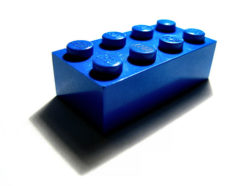
Making blocks with a MakerBot is almost counter productive.  Why would you want to make something out of plastic that can be used to make other things out of plastic?  Why not just print the final plastic object as a single piece all at once?

I like the idea of being able to physically play with the design of something.  Sketchup is easy to use, but legos are even easier.  I never worry about an operation that I can’t Ctrl-Z my way out of.  Plus, it’s even easier to go from idea to objection with physical building blocks.  I think it would also be a very interesting way to get around the overhang and size limitations of a CupCake CNC.

What would you print with colored ABS?

I was trying to think about what I would print with new ABS colors from MakerBot.  Here’s my list:

  • Green: Little green army men, dinosaurs, a green lantern ring?
  • Yellow: Yellow safety whistles, a yellow ring to defeat the green lantern ring
  • Red: Red clown noses, red dice, replacement monopoly houses
  • Blue: Naked smurfs

Yeah, I suppose that last one was unnecessary…

Adventures with PLA temperatures

Kinda rhymes, no?

Given Rick Pollack’s PLA printing success and temperatures at barrel entry rather than nozzle, I should probably start delineating between temperatures at the barrel and nozzle.  If barrel entry temperature is truly a critical factor, then he’s totally right about how going by nozzle temperature is like driving a bus with just the rear view mirrors.

However, this gives me pause.  Everything I’ve read about ABS suggests it may be best to melt it right at the nozzle as quickly as possible.  I’ve found that ABS cools very rapidly too.  PLA on the other hand takes a while to cool (but, then again, I was running my extruder too hot) – with the parts being quite flexible for some time after printing.  If barrel entry temperature is that important, then it seems that PLA must need a longer time to melt.  If this is the case, should the nichrome be wrapped higher on the barrel?  If so, then Rick’s heater cores (which already seem very convenient) are downright brilliant – since you can probably easily adjust where the heat is being applied.

From Nophead’s comment I gather that I was, indeed, running my extruder too hot.  I found that at my ABS temperatures (220+) made the PLA just drip right out of the heater – and once that had basically stop it would then intermittently release little amber droplets of plastic.  I must have been really cooking it.

With the limited printing I managed with PLA I found that it printed well with my non-temperature ABS Skeinforge settings.  So, before I go back to PLA I think I’ll finish tuning my ‘bot using Nick Ames’ Skeinforge tutorial.
Rebuilding my extruder

Over the weekend I rebuilt my extruder after some adventures with a blowtorch.

I used Rick’s single nichrome wrap method, which served me well on my last re-build.  The documentation of his method is absolutely fantastic and a must-read if you’re rebuilding your heater.  (That page is about PLA, but the nichrome wrapping is pretty universal).

I’m not sure if I wrapped my thermistor better or what, but I seem to be getting more consistent readings from it.  Perhaps this is due to RepG v12?  I would tend to think not since I’m using RepG v12 with the Zach 1 temperature table – the same table I was using before RepG v12.

How are you printing with PLA?

I’d like to print in PLA, I really would.  No warping?  No rafts?  Smells like syrup?  Makes kittens and rainbows?  Sign me up!

Rick from MakerGear has the following suggestions for printing in PLA:

  • Have a 150-160 C degree temperature for the entry of the barrel
  • He notes that the nozzle temperature is roughly 190 C degrees
  • However, later he suggests printing at 220-235 was possible
  • He suggests not to worry overmuch about PLA in the threads – its just one of those things

Nick McCoy offered several pieces of wisdom:

  • He found that 10W-30 oil added lightly to the PLA as it entered the extruder, by adding oil to a piece of cotton wrapped around the filament, helped it print without jamming
  • He noticed that pausing the extruder for more than a few seconds would jam the barrel
  • He found he could print at 180-210 degrees (I assume he’s measuring the nozzle temperature as you would with an ABS setup)

Nick’s results suggesting a nozzle temperature of 180-210 seem to match up with Rick’s findings of 190 or so.  I think I’ll give Polly another shot and see if I can extrude at those temperatures.

Reusing the PTFE barrier

Long story short – it’s possible.

I was concerned that after having PLA ooze through the threads that I would be forced to use my backup PTFE barrier.  However, I’ve been pleasantly surprised to discover that I can print just fine with my reassembled unclogged extruder.  I’ve been able to print several things without so much as a hiccup.

So be delicate with your PTFE even after plastic has oozed into the threads – you may just be able to use it if you can clear out the plastic from the threads.