How to Raise Your MakerBot from the Dead

Happy Zombie Day
Happy Zombie Day!!!

… or Happy Zombie Day!

My extruder is back online! Huzzah!  Since I had it disassembled I made a few minor modifications.

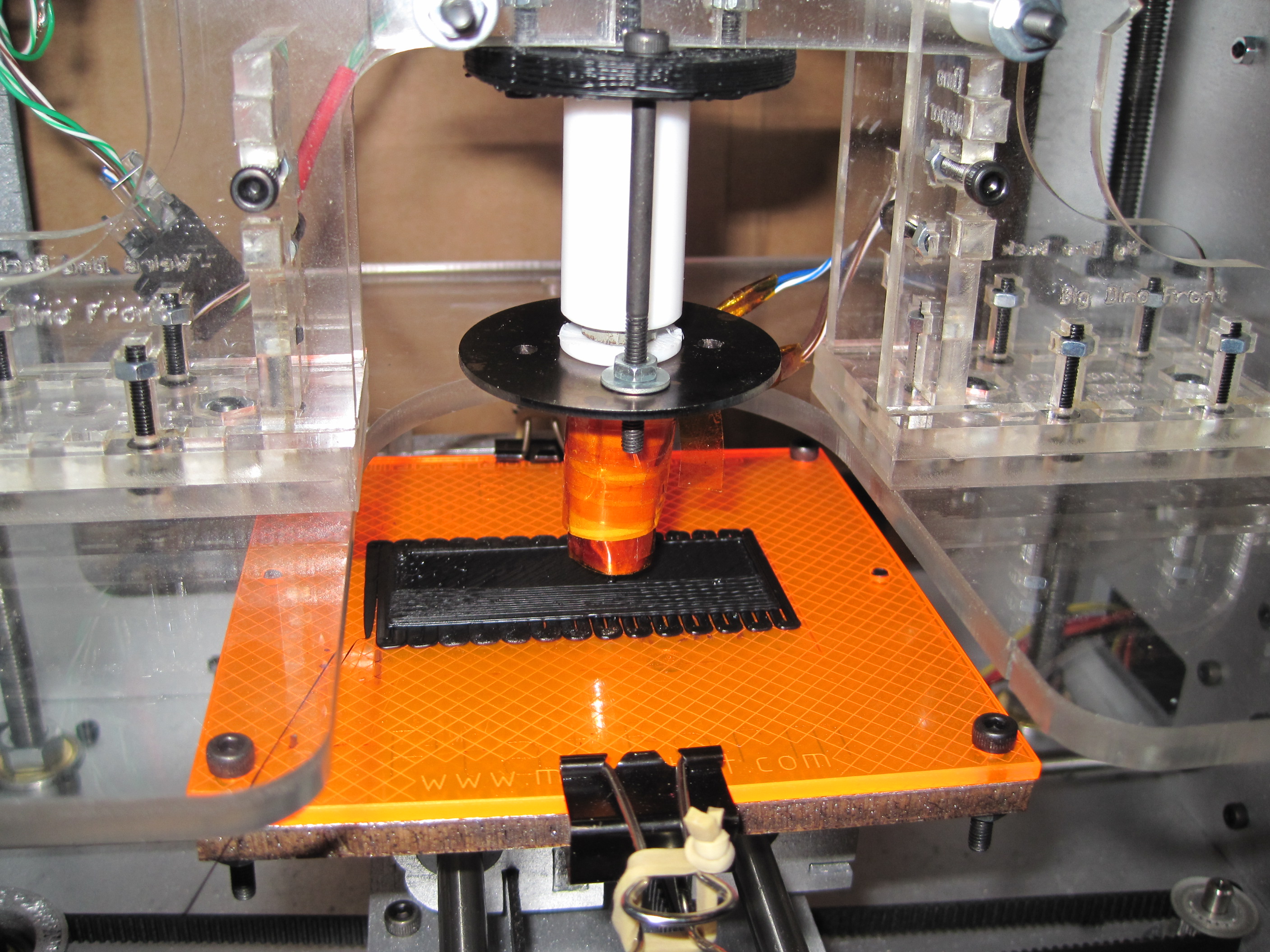
  1. I’ve added binder clips to the front and back edges of the build platform.  I found that my acrylic build base is slightly deformed and probably getting more so with each build.  This is a temporary fix while I get around to picking up a new build base.
  2. You’ll notice I’ve also added pieces of rubber band.  I cut a long rubber band into two pieces about an inch long, tied them off to make small loops, and put them around the handles to the binder clips.  I don’t want to take the handles out of the binder clips because then they’ll be difficult to move/remove/replace.  But, as I printed they tended to vibrate creating unnecessary noise.
  3. When ABS oozed down my PTFE threads and around the barrel, I sliced off about 1mm to use as a washer between the nut and large washer.  The reason I’ve heard suggested for the PTFE washer is that it keeps the large metal washer from acting as a heat sink.  The nut is right on the barrel and is able to heat right up along with the rest of the barrel.  When the large washer is pressed on the nut (as it is supposed to) it is able to absorb heat through the nut as well as it’s contacts to the barrel.  The thin surface area contact between interior hole in the large washer and the barrel probably doesn’t allow for much heat to be transferred to the large washer.
  4. I’ve read it mentioned that wrapping an extruder with nichrome is a two person or three handed job.  I’ve found it to be fairly easy with just my two hands.
    1. I use a small piece of kapton to tape the nichrome to the extruder head/nozzle oriented so that it is lined up parallel to the barrel. 1
    2. From the point where I can see the nozzle touch the barrel I leave about 2-3cm of nichrome hanging off the edge, with the rest of the nichrome pointed up towards the barrel.
    3. Then I wrap the nichrome up the barrel in a single layer keeping a tight contact with the threads until there’s about 2cm or so left.
    4. Then I tape down all of the nichrome on the barrel, except the last 2cm.
    5. I untape the part of the nichrome on the nozzle.
    6. As I was out of those little metal connectors provided by MakerBot, I had to improvise a little.
      1. I stripped the leads on the nichrome so that about 3mm was exposed and used needle nose pliers to put it into a hook shape.
      2. Then I stripped the leads to the insulated wires so that about 15mm was exposed, used my fingers to twist the leads, doubled it back along itself, twisted it again so that there was a little loop.
      3. I hooked the nichrome into the loops of braided copper leads and crimped it down using the needle nosed pliers.
      4. Solder and done.
    7. I then liberally applied kapton to wrap the barrel and nichrome so that it would be unlikely the wire or leads would ever have to bear any of the stress should I move the extruder around.
  5. With my last two extruder assemblies I’ve taken a slightly different approach to attaching the thermistor.  This method makes it easier to pull the thermistor out, but slightly more difficult to install it in the first place.  Here’s what I do:
    1. I laminate the thermistor between two layers of kapton tape just past where it meets the insulated wires.  Only the very tip of the thermistor is exposed.
    2. I wrap the barrel in nichrome as above, then ceramic tape, then wrap that in kapton – without the thermistor inside.
    3. Once the entire barrel is wrapped up just as I want it, I use a utility knife to make a vertical slice up the ceramic tape starting at the edge of the nozzle until I reach the point where the nozzle meets the barrel.
    4. I then peel back the ceramic tape and kapton, exposing a V shaped portion of the nozzle.
    5. I put the tip of the thermistor down into the V, replace the ceramic tape and kapton over it, and tape it down.
    6. I then re-wrap the barrel in kapton again.
    7. The first time I disassembled my extruder I screwed up my thermistor when unwrapping the barrel.  While this makes it more difficult to get the thermistor into the assembly, it also makes it so much easier to pull it out and reuse it.
  6. At the top left of the above photo you can see a small black box with green and white wires coming out of it.  That’s where I added an ethernet jack connector to the extruder assembly to make it easier to connect/disconnect the extruder.
    1. When I assembled my MakerBot I used insulated wire out of an ethernet cable.  Since I only needed a few sets of insulated wire, I ended up with one piece of ethernet cable that still had the ethernet jack on it with four wires sticking out.  I also had two ethernet ports left over from my opto-endstop kits.
    2. I plugged the ethernet jack into the ethernet port and tested the leads on the wires against the leads on the port.  Once isolated I soldered wires to the four leads that lead to the four wires from the jack.
    3. I then soldered the four wires from the ethernet jack to the thermistor and nichrome.
    4. I took the wires I soldered to the ethernet port and ran them through the hole on the right side of the MakerBot in the back on the top.  Then connected those leads to the appropriate ports on the extruder board.
    5. Once the wires were soldered up and extruder assembled I plugged the ethernet jack into the ethernet port and checked ReplicatorG to see if I could get a thermistor reading (yes) and heat the barrel (yes).

As I tinker and modify my MakerBot it seems I’m moving towards a system where I try to make the extruder assembly as modular as possible.  I didn’t have this as a conscious thought when I started, but that’s where these modifications have been headed.  While it is very convenient to have a totally modular extruder only connected to the robot by four bolts and an ethernet cable, that system is most useful if you are using drastically different print heads (such as a frostruder, Paxtruder, Bowden extruder, etc).

If you’re just swapping between PLA, ABS, or other plastic filament or color variations thereof, you can reuse the vast majority of the extruder assembly – the board, the motor, and the entire acrylic plastruder.  If you had a different heater assembly you could just undo the two screws that attach the heater to the extruder, disconnect the thermistor, disconnect the nichrome, and swap in a new set.  Although I don’t have a fully assembled second heater section yet, this set up makes a lot of sense to me just for ease of maintenance and repair.

  1. While I sing Christmas carols with my friends Meryl and Cheryl. []

He’s saying the things I think!

…only in a way that is far less wordy and verbose than the manner in which I would typically attempt to describe the sorts of things I am thinking about.

Thank you, Cory Doctorow.

“”The way you improve your iPad isn’t to figure out how it works and making it better. The way you improve the iPad is to buy iApps. Buying an iPad for your kids isn’t a means of jump-starting the realization that the world is yours to take apart and reassemble; it’s a way of telling your offspring that even changing the batteries is something you have to leave to the professionals.”

This is part of what is at the core of the Maker philosophy – empowering people to learn about the stuff of which civilizations are made, rather than being a plankton-like consumer/spectator.  When something goes wrong, you don’t have to take it back to the store or call the (*shudder*) Geek Squad. 1

This is the heart of civilization, improving upon the work of prior generations.  You have the luxury of being smarter than Einstein and wiser than Oppenheimer with 20-20 hindsight.  You can know everything they know and improve upon it all.  You can fix it yourself. 2  You have all of the tools you need right now, in your home right now.  You can use the stuff you already have to build the tools you need to build absolutely anything within imagination.

  1. Geek Squad.  Don’t get me started. []
  2. Or, heaven forbid, improve it yourself. []

I don’t think I’m THIS enthusastic about anything

Which means, depending on how you look at things, this is either a commentary on how nutty some people can be or how empty my life is. 1  Here’s a comment from a woman who purchased an iPad:2

“Have you touched one?” she said after being asked why she showed up at 7:30 a.m. at the Apple store. “It’s going to change everything about how you live. You are going to be connected to everything. You are 30 seconds away from anything you need to know. It’s really amazing.”

This quote makes it sound as if by purchasing an iPad the sky will open up and the Dali Lama will start IM’ing you for advice about life, the universe, and everything.  I like Apple, I like Apple products, and I love how they’ve raised the bar as to what we expect from computers3 , portable music devices, and mobile phones.  That said, they did not invent the internet when they launched the iPad. 4  I’ve been 30 seconds away from anything I needed to know the day I got my first web-enabled phone.5

  1. And, I don’t think I lead an empty life.  I’ve got a MakerBot, you know. []
  2. Thanks to Tony Buser for the link []
  3. Especially personal computers []
  4. ‘Cause, you know, that was Al Gore. []
  5. Well, actually, the day I started down the road to my internet addiction – but that’s not the point. []

$100 CNC mill?

I caught sight of this through Spacexula‘s RepRap Aggregator Feed – a $100 open source CNC mill.  I was just thinking the other day how cool it would be to have an additive and subtractive CNC machine sitting next to one another.

But, $100?!  It’s like someone would be paying me to build the thing.

So what are you going to make?

I remember the first time I heard this question.  I was babbling to a friend of mine about how I wanted a MakerBot.  His response was to ask:

What is it you need that you want to spend $1,000 getting?

My first inclination when I hear this question to say, “Anything.”1

My second inclination is to step back, think about it for a moment, and then wonder whether I am going to ever actually print $1,000.00 worth of stuff. 2

Thanks to Jeff Keegan for unintentionally reminding me to post this.  :) 3

  1. Sometimes I’m tempted to respond, “Anything I damn well want, Nosy Noserton.” []
  2. Although, at this point, it would be closer to $1,250 of stuff… []
  3. That bastard. []

I actually felt sorry for that bastard

Edit: Jeff – Just in case you read this – I do not really think you are a bastard.  I follow your blog and am very appreciative of your in depth posts and analysis on all things MakerBot/RepRap.  The title is more about me feeling like a sucker than a commentary about you.

Jeff posted about totally abandoning his dreams of building a RepRap Mendel.  He said what pushed him over the edge was the constant question, “So, what are you going to build with it?”  Of course, the guy had to post this on 4/1.

I actually felt sad at the thought of him turning his parts into a “melted sculpture of failure.”

I suppose it’s not his fault.  I traded my MakerBot for some magic beans yesterday.

Full RepRap for sale

A complete1 Mendel for sale?  That’s incredible!

There has been a truly amazing progression2 in RepRap parts lately.  While I’m not crazy about eBay as a way of selling3 , it’s a very democratic4 way of disseminating RepRap parts.  The first few parts and sets of parts were all printed, then molded, now MOLDS are for sale?!

Yes, the Platonic ideal of RepRap is that a machine makes the components of the next machine.  But, is it not also part of the RepRap ideal that these machines be disseminated as far and as widely as possible?  It’s really great you can use a RepRap to build another – but that doesn’t mean it’s the best/most economical way.

These RepRap mold are advertised to be good for roughly 50 pourings.  It is advertised to create 9 vertexes at once, but they all appear to be 1/2 vertexes.  The posting also suggests it takes 12 vertexes for a full RepRap.  So:

  • 12 vertexes per RepRap / 0.5 vertexes halves = 24 vertex halves required
  • 24 vertex halves required /9 vertex halves per sheet = 2.67 sheet uses per RepRap
  • 50 uses per sheet / 2.67 uses per sheet = 18.75 sets of RepRap vertexes

Admittedly, this is only a set of molds for the frame vertexes, not the entire set of parts.  However, it’s really only a matter of time before a set is up for grabs.

This makes me wonder – is there a different market value to printed parts rather than molded parts?

  1. ish []
  2. transmission?? []
  3. having sold things on eBay myself []
  4. fair? capitalistic? []

New cell phone!

So, I finally got over my fear of commitment and bought a new cell phone.  I had my prior cell for about 4 years, my cell before that for 3 years, and my cell before that for 3 years.  I keep them well beyond the point where people make fun of my old beat up cell.

I just picked up the Motorola Droid and I’m pretty happy with it so far.  A site that I use regularly that’s almost totally powered by Javascript and AJAX works beautifully with this phone where Windows IE on cells freaks out, Opera Mini does a reasonable job, and the iPhone does a fairly good job.  Web browsing is fast, rendered quickly, connects to e-mail, and all sorts of good stuff.

The thing I’m perhaps the most pleased about is that I can tether the phone to my laptop to use it as 16G extra storage OR as a broadband modem – for no extra fee. 1 2  I wouldn’t often use my laptop away from WiFi, but when I do a little Droid powered broadband love is going to be sweet.

Now back to your regularly scheduled nonsense.

  1. Full disclosure:  You have to download and install a free app called PDANet to be able to connect through the phone.  Not a big deal for me. []
  2. I’m already paying for broadband to the phone, why should I pay for it again in the form of a broadband card for my laptop? []