It’s a dream of mine to kinda live off the grid. I say this is a dream, but really, it’s probably more about a vague goal and ideal. Being a 21st century digital boy, I’d want some nearby cell towers and a satellite internet dish next to my solar panels and windmill powering my green house at the absolute outer edge of Amazon’s delivery capabilities. And, as long as I had a crazy supply of ABS and a big enough RepStrap, I could make any freaking thing I wanted. (Bruce Sterling’s article/short story on this point is an interesting read).
Part of the dream is about where I live and my lifestyle – it doesn’t say much about what I want to do. I’d like to spend my time inventing and building cool thing and being clever. :) One of the most interesting things about my professional career is that it affords me the opportunity to be clever. Perhaps it is due to a streak of narcissism or speaks to a need for attention, but damn I love seeing and doing clever things.
If you’ve seen Fight Club, you know Tyler Durden doesn’t think much of being clever. I, on the other hand, think it’s cleverness that sets us apart from the animals. At first we thought it was words or tools – but we’ve also found animals that use both (in their own way). In the end, it probably comes down to being clever – using and sharing what you know, teaching others, and learning and thinking up new ways to do things.
There are a few times in my life when I recall seeing or learning something so clever, that I felt smarter for having experienced it. I remember seeing a calculus T.A. point out a new way of looking at a problem which made all the difficult bits melt away. The most recent was probably when I assembled my MakerBot. I actually felt smarter for having assembled this machine – sometimes wondering at design decisions only to later realize the deeper purpose for this notch or that peg.
I suppose it would technically be my favorite MakerBot quote from the last month, but I only saw the video today. The internet has made time such a squishy thing…
I assembled mine over the course of about a week – but that includes priming, painting, getting a few miscellaneous parts, and a fair amount of hesitation as I fretted over an unfamiliar building process outside of my expertise. If I were to start over again, and I were skipping the priming/painting I figure I might be able to assemble one in about 8 hours or so.
It’s actually pretty easy. Since I own my own domain, in this case MakerBlock.com, all I have to do is tell my server that I want all mail that would normally bounce to be redirected to a default address.
The upshot is that I can make up ANY e-mail address I want, and be assured the resulting e-mail will come back to me.
How does this help me avoid e-mail spam? Easy! When I give my e-mail address to a website, in this case Ponoko, I make sure the e-mail address is sufficiently descriptive so that I’ll know who gave out my e-mail address. Suffice it to say, I’m receiving a fair amount of pharma/romance related spam to an address I gave Ponoko. Giving them the benefit of the doubt, they didn’t sell my e-mail address – but either their server, database, or someone’s address book was compromised. This is only a mild consolation.
However, this just tells me who is sending me spam. To shut it off, all I have to do is set up a filter for that address or shut it off at the server. Turning it off at the server is a little more work, so I usually just create a mail filter that tosses everything to that address into my junk/spam folder.
I did everything I could to make sure I would be there. I bought an advance two-day family pass. Even though I live in the Bay Area I booked a local hotel just so we could get there that much earlier and stay that much later.
Alas, everyone in my family caught a nasty bug and we’re still laid up. At least I was able to give away our tickets as we drove away from the hotel.
In the meantime – did you go? What did you see? What did you learn? Please let me live vicariously through you!
Sorry for the self-pitying whiny post. I’m sick and it’s my prerogative. [↩]
I’ve been really looking forward to the MakerFaire (Bay Area) for – oooooh – probably about a year now.
Last year was the first time I had attended and I got to see a giant bronze snail car, a Victorian house car, the steampunk area, a giant set of rotating metal wings, pneumatic rockets, LCD guitars, numerous R2D2’s, a chunk of the Long Now clock (the very same which inspired Stephenson’s book Anathem), bicycle powered rock bands, a CandyFab, and, of course, a fully operational MakerBot complete with the MakerBot guys printing off amazing things.
I looked, I saw, I even hoola hooped. And I’m looking forward to seeing all new amazing stuff.
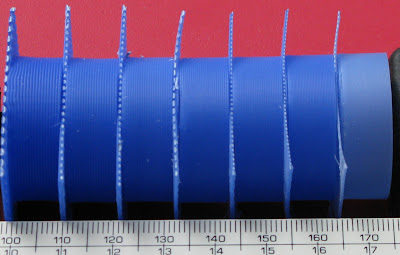
This most recent Z-Woggle arrester/eliminator is one of the most interesting. Unlike the super-fantastic Z axis crank, this part does more than just make the MakerBot easier to use – it will almost certainly improve the quality of your prints. Also, unlike it’s predecessors it does not require the installation of a second set of Z axis rods.
Another thing I like about this part is it easily made with a 3D printer, but much more difficult to manage with just a laser cutter.
One possible issue I could see with this part is that it may cost you a slight bit of Z axis resolution. Since the part doesn’t appear to fit snugly in the Z stage, the Z axis rod will have to rotate a little before it will “catch.” (Or, so I suspect).
I don’t know if this thing was added as a joke or not, but it makes me sad. The author posted this description, “Apparently there is still a competition who can post the least printable object in obscure formats or preferable entirely without file and instructions.”
This is like having a contest over who can leave the biggest turd in someone else’s pool.
Actually, I suppose it’s more like who can donate the shittiest book to a library. Yeah, you could do it – but why?
One of my interests outside MakerBot/RepRap is origami, the Japanese art of paper folding. At it’s inception it was really only a hobby for the rich – the only ones who had access to such a luxury as paper. Modern technical origami restricts one to only a single sheet of square paper transformed only through folding – no cuts, glue, tape, etc.
A lot of very interesting origami models have been developed over the years by some incredibly talented artists through a combination of experience and trial and error. These kinds of models have so much personality they almost appear to be real – rather than mere squares of paper. One of my favorite origami artists of this “genre” is Eric Joisel. I still find it hard to believe his models, such as the “Woman in Dress 2008,” can really be made of just a single square of paper.
There’s been a movement in the last two decades to bring a more methodical and mathematical approach to design, sometimes with the assistance of a computer. One of my favorite technical origami artists is Robert Lang). His models tend to the more realistic, rather than representational (as with Joisel). His insects, such as the stag beetle, are a prime example.
Lang has used his background in mathematics and origami to develop a giant collapsing/expandable lens – so that it could be transported to outer space and then deployed. This allows a normal space craft to deploy a much larger lens than would otherwise be possible.
Robert Lang's "Stag Beetle BP, opus 477"
Unlike Josiel’s models which are typically totally unique and irreproducible by anyone (including Josiel!) Lang’s mathematically assisted models are usually carefully documented by diagrams or, increasingly frequently, crease patterns. A crease pattern is what you would get if you totally unfolded a completed origami model. Typically only the “major” structural folds are depicted in a crease pattern.
Brian Chan's "Attack of the Kracken"
An interesting intersection between mathematics and origami is the problem of determining the most efficient manner of placing the most number of equally sized circle within the smallest possible area, called, “circle packing.” The reason this is important to origami is that the center of each circle can be turned into an appendage. Lang has developed a computer program that allows the creation of truly arbitrary proportions – any number of points with any kind of ratio of one appendage to another.
Brian Chan's crease pattern for "Attack of the Kraken"
Even to someone who doesn’t have any experience with origami or the mathematics involved, the appearance of circles in crease patterns can start to make intuitive sense. One of my all time favorite origami models is the “Attack of the Kraken” by Brian Chan. (Check out the larger pictures of that model. The entire thing is just one sheet of paper. If you look closely you’ll see some of the tentacles are grabbing sailors!) In addition to a picture of his final model he has also posted a picture of his crease pattern for that model, even labeling which parts of the model are derived from which regions of the sheet of paper.
If you’re the least bit interested in origami, I’d highly recommend (in this order) Peter Engel’s “Origami from Angelfish to Zen,” a documentary on origami called “Between the Folds,” and Lang’s book “Origami Design Secrets.” The Angelfish to Zen book is one of my favorite books for background on origami and a very accessible introduction to the hidden geometry underlying even the most simple models (and real life too!).
The ball joint I designed a little while ago just hit the featured things page. I think it is the only thing I have designed for which someone else created a derivative. Just after I posted the ball joint r3becca posted her amazing Beco Blocks. (I do not for a moment think r3becca’s blocks are a derivative or even inspired by my own shoddy work. I mention the timeline simply because I am always astounded how often two people can come up with slightly similar solutions totally independently of one another. My favorite example is the feud between two origami masters who each claimed to have designed the same origami pig, nicknamed the “Case of the Purloined Pig.” If you’re interested in origami, you should check out Peter Engel’s “Origami from Angelfish to Zen,” and this essay from the Bay Area Rapid Folder’s website on origami ethics). The ball joint I created is printed as a single piece and then snapped so it can then rotate, but the result is only okay. If the flanges that hold the ball joint in place are too thin, they’ll pop off. If there are too many threads between the ball and the flanges, it won’t rotate.
R3becca’s solution is far more elegant – two pieces printed separately that pop together and stay connected well. The best part is that it has almost a complete range of movement. If I needed to add a ball joint system to an existing model, I’d almost certainly use one of the Beco Block assemblies as the connecting mechanism.