Retractable Tape Measure: Reloaded

Putting together my original spring loaded retractable tape measure taught me a few things.  I’ve made a few changes/revisions to this thing.

  1. The spindle in the center of the exterior part was too thin and susceptible to snapping.  I realized that I could thicken the base of the spindle to give it more strength.
  2. The spindle in the center of the exterior part didn’t seem quite long enough to hold the center spring holder part in place.  I’ve stretched the spindle to be slightly taller – by about 2mm or so.  I’m hoping this will leave a groove in the spindle where the interior spring holder will naturally move towards and allow the entire thing to spin more freely.
  3. The interior spring holder would have been much more useful if it were attached to a large disk to help keep the wound tape in place.  This disk has been added in this latest version.
  4. The interior spring holder has two sets of notches.  One can be used to attach the measuring tape.  The second can be used to attach one end of the metal spring.  Unfortunately, one set of the notches was too narrow and required more cleaning than should be necessary.  I’ve widened this one notch for easier printing.

Retractable Measuring Tape – Exploded View

Retractable measuring tape
Retractable measuring tape - exploded view

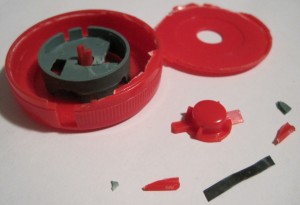
I suppose the title is a bit of misnomer.  There was no actual exploding involved.  What you see to the right are most of the interior parts from my retractable measuring tape.  It had a spring that kept the little red button pushed out – but that disappeared as soon as I opened the plastic shell.

Breakaway multipart prints

I’ve already said how much I appreciate Zaggo’s designs.  Watching his treasure chest being built on my ‘bot was really really cool.  The hinge pins were printed already inside of the hinge – something made possible by the nature of fused deposition modeling.

While this toy car by kparanya was probably the first captive breakaway multipart print I’ve seen on Thingiverse, I was more inspired by Zaggo’s treasure chest.  :)  It should be possible to print entire geared assemblies using this kind of system.  Admittedly, you’re probably not going to get precision geared parts, but you could probably make a decent toy or rough tool.  Once you start using the piece it should essentially grind out any extra plastic threads.

Anyhow, something to think about.

New Print: Zaggo’s Treasure Chest

Treasure Chest Open
Treasure Chest Open

It’s hard to pick a favorite design from Zaggo.  Some are fantastic upgrades – such as the Z axis crank.  Some are functional – such as his whistle.  But, his treasure chest is a special case.  This design contains two parts which are printed simultaneously – with the hinged lid being printed with the pins inside the hinge.  Just print, pop the lid off of its support pieces, and close the model.

One truly amazing thing about Zaggo’s models are his gcode files.  A gcode file is created when you take the digital image file as an STL (which basically describes the exterior volumes of the model) and feed it into Skeinforge (which creates instructions for the printer to operate the extruder and move the 3 axes).

Although Skeinforge settings are typically considered to be unique to a ‘bot, everything I’ve ever printed using Zaggo’s gcodes has turned out perfectly.

Treasure Chest Closed
Treasure Chest Clos

New Print: Retractable Measuring Tape

A broken measuring tape reel that won’t retract isn’t any more useful than a measuring tape without a reel.  Thus, there was no harm in cracking thing open to see if I could repair it.  Inside I discovered some parts were broken/missing and some parts were lost in the process of delicately opening the case. 1

Measuring tape
Measuring tape

The modeling of these replacement parts was a very different task from prior replacement parts.  As some of the original  parts were either missing or too damaged to examine, I had to design replacements from the working/intact parts I did have.  The best part is that this involved far more creativity than my prior printed replacement parts such as the window latch and toy fire truck swivel.

My fix started off by modeling a new interior metal coil spring holder.  However, the axle from the original plastic part had become so damaged that it was no longer usable.  I had to redesign the exterior piece as well.  Unfortunately, the printed exterior piece had its own spindle which promptly popped right off.  This lead me to use the two bolts/nuts as the axle.  This provides more friction than is ideal – but the entire assembly still works.

I know exactly how I would redesign this with a few additional parts.  If I had a single skate bearing and some longer bolts, I’d build a far more robust version.  As if I needed an excuse to go out and pick up a pile of skate bearings and an assortment of metric bolts/nuts.  :)  Alternatively, I can conceive of a version without a bearing that has a foldable crank similar to the foldable Z axis crank.

  1. Read: jamming a screwdriver into the case and prying apart []

New Print: Darth Vader

I tried to print Bre’s Darth Vader head but there was either a problem with the STL or my gcode.  When arhimed uploaded a smaller cleaner version of Darth Vader’s head I just had to print it up.  (Just updated to add another picture of this piece).

Darth Vader Head
"I find your lack of faith disturbing."
Darth Vader Head
"The force is strong with this one."

Sweet, no?  Again, this is a pretty extreme close-up.  While there are very minor striations created by a super small Z axis wobble, the model is smooth – nearly silky in texture.

Open Source Interconnecting Building Blocks

I’d really like to see a robust printable open source interconnecting building block system for the MakerBot.  Something than can build large (or small and intricate) rigid structures with moving parts.  So far there’s:

  1. The lazzor-cutable metabrick from metalabs.
  2. Lego compatible laser cut blocks by clothbot
  3. The printable metabrick by wizard23

Of the one printable variety, it doesn’t really lend itself to rigid structures as it uses a round clamp to attach to a round pole.  Don’t get me wrong, it is a very cool piece and I’m really glad someone designed it – it just isn’t what I’m looking for.

I’m wondering if a slot/groove system might work – similar to the system used in Zaggo’s prinstruder or the modular boxes by Domonoky.

Legos versus Construx

As a kid I preferred Construx to Legos.  Construx allowed me to build large objects with moving parts in three dimensions.  Whereas Legos main point was that it came in better colors.

I’ve designed a few Construx pieces I’m looking forward to building.  The only problem is that at least one of them may be too large for me to print with my current set up without significant warping.