Papercraft Phone Stand

I recently saw an Instagram post from someone I follow who makes cardboard furniture in India.  His story of building cardboard furniture while in college during COVID, building hand sanitizer dispensers out of cardboard, licensing this, and then pivoting to creating a business around making cardboard furniture is pretty cool.  One part of the story is how this guy’s designs started getting ripped off by others who saw it was an inexpensive and easy to produce product.  Even with patent protections, ideas get ripped off all the time.  Anyhow, this IG post was about how he had invented a business card which opens into a phone stand and apparently rejected an offer for the equivalent of $1M to sell his patent.

When they won’t license the design or sell the business card itself, I’m not at all sure why it was patented at all.1 They apparently got 10,000 produced, gave most away, and turning down offers to buy individual cards.

This slideshow requires JavaScript.

Sometimes when I see something interesting, I think about how it’s constructed and how I could build one using my own resources.  Just a quick glimpse at the video reveals pretty much everything one would need to build one.  A quick mockup in Inkscape and I had a version printed out on copier paper.  It was slightly flimsy, but it works just fine.  If I did this again out of cardstock, 300GSM paper, or even thin cardboard, I bet it would even better.

This slideshow requires JavaScript.

It’s a neat little tool – and I think I will make a few more for personal use.  Mine has a rounded front “nub” rather than the angled one in the video.  I could see adding an RFID tag/sticker, QR code for info, and other minor functional augments to be more useful to me.  I think there’s even a few ways to improve my design a little.

  1. I tried looking up the patent, but couldn’t find it anywhere []

OpenSCAD Render Times

Thanks to @raster, I’m going to do a side-by-side taste test of several different flavors of OpenSCAD.1 To give each one a similar test, I’m trying out my D-Pad design from … uh, earlier this morning.2

Version Release F5 Preview F6 Render Notes
2021.01 Stable 09:50.220 2.302 Best place to start
2024.01.13 Current 04:37.763 0.948 I’ve been running this one for a while
2025.04.04 Latest 04:36.593 0.483 Latest snapshot

Obviously, the good folks working on OpenSCAD have dramatically improved preview/render times over the last four years.  The speed boost in using a later snapshot is pretty significant if you’re doing any kind of complex designs.  They must be using some kind of cache system to make the render times so fast.

The speed differential between 2024.01.13 and the latest snapshot is so slight, I’m not going to switch things up unless I bump into a design that struggles with rendering some complex feature.

#OpenSCADClub
  1. OpenSCAD 3D Printed Spring
  2. OpenSCADClub Week 2: Directional Pad
  3. OpenSCAD Render Times
  4. One Simple Trick Can Save You 30 Minutes…
  5. OpenSCAD Club Cookies


  1. *I’m not avoiding work!* YOU’RE avoiding work! []
  2. Like, way earlier…  midnight or so… []

OpenSCAD 3D Printed Spring

OpenSCAD spring design by @rasterweb
“I’m trying to come up with a good way of creating this in OpenSCAD… I have something using a bunch of hull’d cylinders but I’m wondering if there is a better/easier way to do it.” @rasterweb

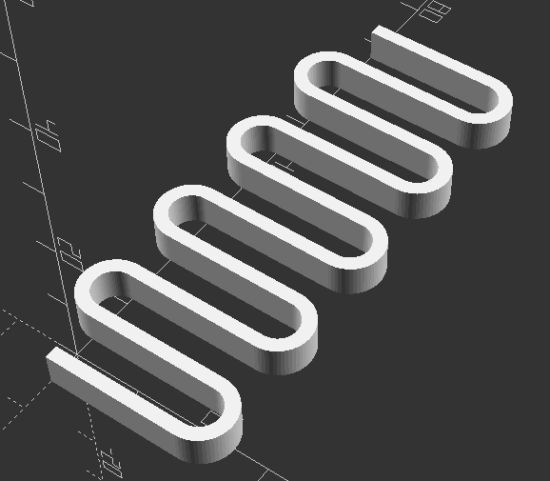
A friend posted a design pondering whether there was a better way to design an object in OpenSCAD.  As so often happens when I approach a 3D design, one solution pops up in my head… and is immediately discarded as garbage.  That first thought was to create a negative of the interior of the spring, then iterate along the length of a stretched cube.

In the end, I opted for1 creating a flat version of a single “loop”, made from differenced hulled circles, repeated over the number of desired loops, then trimming alternating ends (so it wouldn’t look like a chain).

OpenSCAD spring by MakerBlock

Here’s the OpenSCAD code to produce this spring:2

//  Settings
    $fn = pow(2,6);
//  Spring Dimensions
    springH     = 5;
    springOD    = 10;
    springW     = springOD*2;
    springOR    = springOD/2;
    springTh    = 2;
    springIR    = springOR-springTh;
    loops       = 8;

    spring();

module spring()
    {
    linear_extrude(height=springH, center=false)
    for (i=[0:loops])
        {
        translate([0,(springOD-springTh)*i,0])
            difference()
                {
                spring_loop();
                translate([-springOR+(springW+springOD)*(i%2),0,0]) 
                    square(springOD, center=true);
                }
        }
    }
    
module spring_loop()
    {
    difference()
        {
        hull()
            {
            circle(r=springOR);
            translate([springW,0,0])
                circle(r=springOR);
            }
        hull()
            {
            circle(r=springIR);
            translate([springW,0,0])
                circle(r=springIR);
            }
        }
    }

Some notes about my OpenSCAD style:

  • I like to use OD/ID/OR/IR to mean outer diameter, inner diameter, outer radius, inner radius.
  • I think the “spring_loop” module could be simplified slightly by calling another module which creates each hulled circle, but weighing the additional module code against just retyping a little code I opted for what got it done faster.
  • I like to specify the facets on circular objects right at the top of the file. This way, I can adjust the smoothness of the object by just changing just the exponent part of the $fn system variable.
  • Reasonably parametric. There’s some additional further optimization that could be done in the spring alternate end clipping.

Can’t wait to see what @rasterweb makes with a 3D printed spring!

#OpenSCADClub
  1. OpenSCAD 3D Printed Spring
  2. OpenSCADClub Week 2: Directional Pad
  3. OpenSCAD Render Times
  4. One Simple Trick Can Save You 30 Minutes…
  5. OpenSCAD Club Cookies
  1. And, please forgive the inside-baseball / OpenSCAD-speak []
  2. To display the code above I had to use the WordPress block editor. 🤮 []

MakerBot: Toy or Tool? [02/25/2010]

or this post could be titled …  “Open source intern tells all!”1

A review of the MakerBot Industries Cupcake CNC today from a former MakerBot intern discusses the MakerBot’s use as a tool.  Some of the comments bring to suggest its usage as an expensive toy.  I’ve used my MakerBot as a tool to print tools and as a tool to print toys.  I suppose at the point I’m using it to print up toys I’m really using as a toy.

I’m fairly confident my MakerBot will pay for itself.  That’s not a claim most people can make about their toys.  I have printed replacement parts for toys, broken parts around the house, and broken tools – thereby saving me those replacement costs.  This probably doesn’t amount to more than $20 or so.  That’s not a great return on an investment, but it is returning

Drafts Zero - The Lost Blog Posts

  1. The Lost Blog Posts
  2. Plastruder! [Draft 12/25/2009]
  3. UNTITLED [Draft 12/25/2009]
  4. Preparing to print [Draft 12/27/2009]
  5. More prints [Draft 01/04/2010]
  6. Prototype Pricing [Draft 01/19/2010]
  7. MakerBot tuning [Draft 01/20/2010]
  8. Plastic Screw Anchor [Draft 02/02/2010]
  9. Magic [Draft 02/03/2010]
  10. How are you printing with PLA? [Draft 02/16/2010]
  11. Rebuilding my extruder [Draft 02/16/2010]
  12. MY robot [Draft 02/18/2010]
  13. more things i learned [Draft 02/20/2010]
  14. First commissioned piece! [Draft 02/22/2010]
  15. MakerBot: Toy or Tool? [02/25/2010]
  16. Idea for Skeinforge settings… [Draft 03/27/2010]
  17. RepRap and MakerBot alternatives [Draft 04/05/2010]
  18. RepRap Parts for Sale [Draft 04/07/2010]
  19. Where is the Othercutter? [Draft 06/08/2015]

  1. …  ’cause, you know, it was all… open source. []

More prints [Draft 01/04/2010]

Over the last two days I’ve printed a MakerBot coin, two chess pieces (both knights), two replacement Scrabble pieces (one printed vertically, one printed horizontally), two different tries at printing a dummy SD card, and a very loud whistle.

I’ve had difficulty re-printing the whistle once I changed some of my Skeinforge settings.  (Dang.)  I’ve also ended up with a plank of plastic instead of a Darth Vader head.  It was being printed out with these really wild spikey bit sticking straight out of the head – several centimeters beyond where the raft ended.  Non-optimal.

Drafts Zero - The Lost Blog Posts

  1. The Lost Blog Posts
  2. Plastruder! [Draft 12/25/2009]
  3. UNTITLED [Draft 12/25/2009]
  4. Preparing to print [Draft 12/27/2009]
  5. More prints [Draft 01/04/2010]
  6. Prototype Pricing [Draft 01/19/2010]
  7. MakerBot tuning [Draft 01/20/2010]
  8. Plastic Screw Anchor [Draft 02/02/2010]
  9. Magic [Draft 02/03/2010]
  10. How are you printing with PLA? [Draft 02/16/2010]
  11. Rebuilding my extruder [Draft 02/16/2010]
  12. MY robot [Draft 02/18/2010]
  13. more things i learned [Draft 02/20/2010]
  14. First commissioned piece! [Draft 02/22/2010]
  15. MakerBot: Toy or Tool? [02/25/2010]
  16. Idea for Skeinforge settings… [Draft 03/27/2010]
  17. RepRap and MakerBot alternatives [Draft 04/05/2010]
  18. RepRap Parts for Sale [Draft 04/07/2010]
  19. Where is the Othercutter? [Draft 06/08/2015]

Preparing to print [Draft 12/27/2009]

Unfortunately my MakerBot did not come with a print button.  I’m (slowly) going through the MakerBot tutorial on how to print. For those of you with a Windows box, the first time process should be as follows:

Well, I’m still getting the hang of this…  I’ve frisbee’d two mini-mugs so far.  :)

Drafts Zero - The Lost Blog Posts

  1. The Lost Blog Posts
  2. Plastruder! [Draft 12/25/2009]
  3. UNTITLED [Draft 12/25/2009]
  4. Preparing to print [Draft 12/27/2009]
  5. More prints [Draft 01/04/2010]
  6. Prototype Pricing [Draft 01/19/2010]
  7. MakerBot tuning [Draft 01/20/2010]
  8. Plastic Screw Anchor [Draft 02/02/2010]
  9. Magic [Draft 02/03/2010]
  10. How are you printing with PLA? [Draft 02/16/2010]
  11. Rebuilding my extruder [Draft 02/16/2010]
  12. MY robot [Draft 02/18/2010]
  13. more things i learned [Draft 02/20/2010]
  14. First commissioned piece! [Draft 02/22/2010]
  15. MakerBot: Toy or Tool? [02/25/2010]
  16. Idea for Skeinforge settings… [Draft 03/27/2010]
  17. RepRap and MakerBot alternatives [Draft 04/05/2010]
  18. RepRap Parts for Sale [Draft 04/07/2010]
  19. Where is the Othercutter? [Draft 06/08/2015]

Combining Multiple Video Files

Rather than send me a single set of video files, my client’s vendor sent me… 149 separate MP4 files, ranging from a few seconds to about 11 minutes long.  I have no interest in sorting through dozens of video files, cataloging them individually, and then trying to review them in order.

While I would have thought VLC would have been a good drag-n’-drop way to stitch them all together, the version I had and the newest version available both weren’t letting me save multiple files into a single file.

A bit of googling and I stumbled across an old friend – ffmpeg!  I hadn’t used this program to transcode video since the early days of DIVX, backing up DVD’s back in the late 1990’s / early aughts.

Here’s the process I settled on for my Windows machine:

  • Created a batch file to create a list of the video files (which included spaces, commas, and all kinds of nonsense command line tools hate).  The entire contents of the batch file was:
    • dir *.mp4 /b > list.txt
  • Since I’m using Notepad++, I used the find/replace function to search / replace on “list.txt”:
    • /r/n
    • ‘/r/nfile ‘
  • Even using some find/replace magic, I still needed to adjust the first and last lines, but that wasn’t so bad.
  • Then, the videos which had been named in semi-logical pattern, were not in strictly alphanumeric order.  I re-ordered them in the text list to the order I’d wanted to view them in.
  • I dropped the FFMPEG executable, downloaded from this mirror, into the folder with the video files and list.txt, then made a new batchfile which contained the following:
    • ffmpeg -f concat -safe 0 -i list.txt -c copy combinedfilename.mp4
  • Now, I could have typed this into the command line, but since I wanted to batch certain files together, it was just easier for my purposes to have the batch file.  Plus, now I have the executable and the batch file for future use.

Anyhow, I hope this helps save someone, perhaps even myself, a few minutes of hair pulling and searching.  :)

Adventures with a (Cheap) Vinyl Cutter

I don’t have any affiliate links to shill, but I really like Monoprice.  They sold cheap re-branded 3D printers, decent office equipment, and sometimes they will have an absolutely ridiculous deal on one of their products.  I’d say, overall, the quality is “pretty good” across the board and when you can find a deal on something, it’s an easy decision.  I picked up an extra Monoprice Mini Delta 3D printer because it was so cheap, I could use it for parts and not feel bad.1  I’ve been happy with their egg cooker, USB hubs, HDMI cables, various random testers.  The other day I saw they had a sale on their “MakerCraft Mini Craft Cutter” for $80, when it’s normally $230, with free shipping and had to buy it.  If you missed out, I’d highly recommend signing up for their newsletter.  About twice a year they have some deal that’s just bananas.

It’s been sitting off in a corner for nearly two months while I’ve been distracted by Maker Faire preparations and work, but tonight I gave it a shot.  I’d say, like most other MonoPrice things, it’s “pretty good.”  The included software “Sure Cuts A Lot Pro 5” is not very intuitive, the documentation on the machine and software is pretty lacking, and the tutorials aren’t very helpful either.

Even so, with some futzing around I was able to run a test cut and mostly get another design cut out.  Pictures later.

Here are some of the things I learned:

  • After you drop the blade into the machine, be sure the carriage and move all the way back and forth.  It’s very easy to have it protrude upwards very slightly, causing a horrible clacking / grinding noise.
  • I’m not sure if it’s me, the way I loaded the sticky back cutting mat, or some combination, but the large design I cut out was  off the piece of vinyl by about 1″.  I would recommend making sure your piece of vinyl is about as big as the 8×10 cutting mat.  I am not sure, but I suspect the “vertical” direction has a lot more variability than the “horizontal” direction.

I tried to cut things several times without success.  I tried a lot of different ways to get it going, so I don’t know what got me cutting.  At first the machine would beep at be intermittently, and then regularly.  I have no idea what caused that to happen – or why it stopped.

After the machine registration / cutting mat homing procedure, which sounded about as much as you would expect a small plotter to sound, it was surprisingly quiet.  I’ve never used a craft or vinyl cutter before, so I guess I had just built it up in my head.

I’m going to try cutting some more things tomorrow and look forward to posting some more progress.

I’ve cut several medium complexity designs out of HTV and it was incredibly tedious.  I tossed a very complicated design into this craft cutter and it quietly ripped it out like a champ.  For $80 shipped, I would easily recommend this device to anyone who wanted to experiment with a craft cutter and wasn’t afraid to spend some time tinkering with software and settings.

  1. And, later, I had to! []

Night Before Going to Maker Faire

Annnnnnnnnnnd…  my robot which has been working for a solid year is now completely unresponsive.

My wife’s robot is working, Dexter Starfighter’s robot is working, Kim’Dael LightingSlayer’s pendant is working.

And my robot not only doesn’t work, I have spent so much time trying to get it functional that I still don’t have a good way to mount it on my shoulder.

I could cry.

Prepping for Maker Faire Bay Area 2024

It’s always a whirlwind heading into Maker Faire.  This year is no exception.  This past weekend we got things mostly ready for the Rocklin Maker Faire.  All of our robots were functional, which was really great.  A quick update to document progress and also act like a to-do list of sorts:

  • MakerKnit’s companion robot
    • My wife has knit her octopus
    • I’ve installed the Adafruit QtPy, NeoPixels, and touch sensors connected via BrownDogGadgets conductive thread through the legs
    • It’s been programmed to “blink” the two LED eyes randomly plus a small number of light shows for the body
    • Designed/3D printed several eyes, settling on a nice design that should make the eye animations look good
  • Kim’dael LightningSlayer’s Pendant
    • The youngest’s project has morphed from an LED arm to a CircuitPlayground in a pendant that just plays some notes when she presses buttons.
    • A long extension for the battery pack, using thicker gauge wire wound through the back of stock CircuitPlayground enclosure, is now the “necklace” portion for this project.
  • Dexter Starfighter’s ED-E
  • MakerBlock
    • My robot wasn’t quite ready for Maker Faire last year, but “ready enough” to share.  Last year the little bot was just sitting in a jar I carried around and not really visible to anyone.
    • This year I’ve added feet (entirely cosmetic), changed the battery pack around so it is removeable, swapped out dome diffusers, and am working on new animations/behaviors.
    • I realized that my old LED goggles were… janky.  This was because I had soldered some buttons to one side and then wired them into the Trinket directly, without any resistors.  While it /worked/, it caused some problems whenever I pressed a button.  I pulled the Trinket out and swapped in my new favorite board, the QtPy.
      • I really prefer programming / updating via CircuitPython over Arduino since there’s no pre-compile time and fussy Arduino connections.
      • Besides the programming/uploading, I love the built in RGB, up to 6 capacitive touch sensor, and easy serial communication
      • As an added plus, I soldered on the 2MB flash chip so the project as a ton of space. 1
      • And at almost the same price as a Triket ($0.50 more than the original, $0.50 less than the M0 Trinkets), it’s just easier to swap them into any project I would have previously put a Trinket into
  •  Soldering
    • I’ve really upgraded my soldering experience and it’s made a world of difference.  We moved about a year ago and there’s a space in the house where I can keep a soldering station out and ready to use.  Just having it available is such an upgrade.  I’ve had several handheld / pen style soldering irons over the years and they’re usually pretty terrible.  In fairness, this is also because I’m kinda terrible at soldering.  I had a basic garbage soldering iron from the local hardware store, upgrade one that had a little temperature control from Adafruit, and then upon the recommendation of a friend upgraded a few weeks ago to an X-TRONIC soldering station.
    • I gave my old soldering iron to my neighbor so he could work on a project for his wife.  As I got to finishing up work on the above projects I realized I couldn’t find my pen soldering iron from Adafruit – and that I didn’t want to find it anyhow.  It was fine.  It worked.  But, my soldering iron holder was cheap and flimsy and easy to tip over and the helping hands I had from Adafruit were “okay” for very small projects, but the joints came loose easily and the helping hands kept falling off.  Rather than spend $20 on another soldering iron I would hate, I dropped $70 on the X-TRONIC station which has built in helping hands and soldering iron holder.  Setting aside that it heats up very quickly, has good temperature control, melts solder quickly, and has great helping hands… it has a way to hold the soldering iron in a way that isn’t constantly anxiety inducing. 2
    • Having the soldering station handy has meant I don’t really mind whipping out a quick battery pack extension cable for our projects.  I just need to strip some wires, fire it up, drop some solder, and turn it off again.
    • I may have ruined the first soldering iron tip kinda quickly.  Again, I have no idea what I’m doing.  I would add solder, dip the tip in flux, wipe on sponge, and then do it all again.  This is a terrible process since all it does it add extra contaminants and gunk to the tip, reducing the ability of it to transfer heat effectively.  Instead, after watching a video, I learned I should run it at the lowest temperature appropriate for the solder/joint, just dab the tip in the brass wool to clean it up a little, then maybe wipe on the slightly damp sponge, and absolutely coat the tip in solder before putting it down.

Things left to do!

  • Things to finish
    • I’d really like to finish up the Fallout themed shirt/vest to go with my project
    • A way to attach my wife’s octopus to a purse strap
    • A better way to wear my robot on my shoulder – may use a similar foam paldron
    • A big chunky seat belt looking thing for the strap wearing my robot
    • I’ve got designs for a new bag to wear/carry around Maker Faire, but haven’t sewn them up yet – maybe this week!?!!?
  • Make sure we have
    • Enough batteries, battery packs, etc for our projects
    • USB chargers for our LiPo batteries in goggles
    • Finish my goggles (install battery, update code, possibly change out diffusers
    • Bring a few Maker Coins to give out (I bought 100 of the 5,000 minted, probably never to be minted again…)
    • Ways to show people links to learn more about our projects – probably via QR codes – though I might also use an RFID tag :)

Okay, back to work on… work… so I can get back to making!

  1. Note to self:  It requires a different version of CircuitPython, Haxpress, to make use of the chip storage []
  2. I used to tape the cord of my soldering iron to the table and then place it on the flimsy stand []