WordPress plugin – OCD Plugin Stats

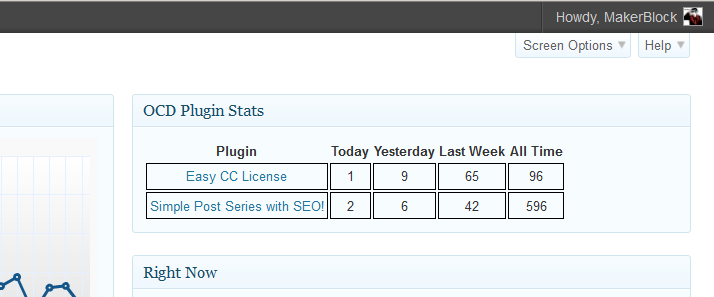
OCD Plugin Stats WordPress plugin screenshot

I’ve just published another WordPress plugin called OCD Plugin Stats.  This isn’t a plugin that would really interest most people.  If you’re a WordPress plugin developer and like seeing the stats for your plugins, OCD Plugin Stats will let you monitor all the stats for all of your plugins in one convenient location in your WordPress dashboard.

Unless you publish your own plugins, I can’t imagine anyone would be terribly interested in such a thing.  My reason for making this plugin was that (a) I found it useful, so perhaps others would too and (b) I wanted to learn how to create a WordPress dashboard widget.
Default Series Title

DrawBot – Onwards and Upwards!

A few thoughts about operating a DrawBot, in semi-organized fashion:

  • Vertical Surface Drawing.  There is an interesting tension in the design of a vertical line-driven drawing robot.  As the drawing surface orientation approaches horizontal, the easier time the robot will have using a standard pen to draw, the more difficult it will be to control the drawing component via a line system, the  greater the weight that would be required,1 a greater weight puts a greater stress on the line and the motor and has some effect on the responsiveness of the drawing component, and the more the weights on the drawing component would be in contact with the drawing surface – possibly causing smudges.  The closer the surface is to vertical, the easier it will be to actually operate as a line-driven robot, the less weight required,2 but the more difficult it would be to have a pressure from the drawing component on the drawing surface.
  • Robot Portability.  Right now my robot is quite portable – and, of course, there are costs and benefits associated with this.  Right now I’m limited to the “size” of my robot at 2’x4′ since that’s the size of the piece of plywood I bought and on which the motors are mounted.  However, it is very easy to just move the robot by putting the plywood in a different location in the house.
  • Robot Location.  This is, in some senses, the flip side to robot portability.  I’d love to put the ‘bot up on the wall and draw something really really huge.  I don’t see that happening until I’m more comfortable running the robot, have found a better pen/paper combination, and – perhaps most importantly – figured out how to run the robot wirelessly or off an SD card.
  • Drawing To-Do’s:  Ideally, I’d like to put the robot to work drawing something on an epic scale.  A high resolution photograph of earth, moon, or pretty much anything from NASA.  Perhaps a map of middle earth, the 100 acre woods, or the Princess Bride story?  A photograph of the world at night, with highlights of the world’s electricity consumption.  Or, some of the INSANELY awesome super sweet posters from various XKCD comics.
Default Series Title
  1. This my theory, anyhow.  My reasoning is that as the surface approaches horizontal, the more weight you’d need to pull at the drawing component because more of the force of the weight would be absorbed directly by the drawing surface itself – along with some friction as it passes over the surface as well. []
  2. See reasoning regarding weight above. []

DrawBot – Pen Selection

I just tried several pens.  Here’s what I’ve found:

  • “Fine point” Sharpie, black.  This is the kind you typically use.  It makes a huge, stinky, black line that leaks all over.  Not recommended.
  • “Ultra fine point” Sharpie, black.  This also leaked right through the paper, made a super thick line, and made such a mess I stopped the drawing.  Not recommended.
  • Pilot Precise Roling Ball V7, Fine, red.  I really like this style of pen for writing.  These gel pens feed ink easily, the ball point rarely gets messed up, and it’s just all-around easy to use.  Unfortunately, as you can see from some of the drawings, it didn’t like drawing at a nearly horizontal angle.  Even though I can see through the side that the pen has sufficient ink and that it is reaching the pen tip, it just wasn’t working very well.
  • Piolot G-2 10, black.  While excellent for writing, this pen was miserable for use in a DrawBot.
  • Uni-ball Deluxe Micro, blue.  So far, this pen is AWESOME.  It seems to write amazingly well on a nearly horizontal surface, no bleeding, and it draws a very fine line of blue.  I fully intend to buy several different colors of this pen.  I believe it comes in all kinds of colors – black, blue, green, and red.  If the drawing I’m having the robot work on now turns out, you’ll get to see just how awesome this pen really is.

As an FYI, Sandy recommends:

Very smooth paper (like Bristol board) with hard-tipped fineliner pens.  In the UK he uses ZIG Millennium pens.  He suggests that Pigma MICRON pens may be a good choice for those in the states.  I’ve used Pigma Micron pens for years and really like them for pen-and-ink drawing.  They’re great on regular photocopy paper as well as serious art paper.  I would have tried a Pigma pen, but I couldn’t find any around the house.  I know I’ve got a stack of them – I just can’t find ’em.  If and when I do, I’ll update this post.

Default Series Title

DrawBot – Printing, Part II

After actually calibrating my machine, the results are MUCH better.  I still need to adjust the settings a little, but otherwise I’m very very happy with this result.  As you can see, the drawing is flipped.  Once flipped back, I think it is reasonably apparent this is Van Gogh’s Starry Night.  Here are a few things I’m going to try:

  • The pen I was using seemed to stop working in certain regions of the drawing.  I bought a few new pens on my lunch break today.  Both are art marker pens – one blue and one red.  Unfortunately, both are too wide to fit in my current gondola.  For now I’ll use a thin sharpie.
  • There is a slight curvature on the top and bottom of the drawing.  This is probably due to a miscalculation in the mm per rotation.  The downside to using a spool, rather than a sprocket/ball chain or gear/toothed belt, is that as the spool contains more cord, the diameter of the spool actually grows larger.  This means that when there’s a lot of line on the spool each rotation releases more line and when there’s very little line left on the spool, each rotate releases less line.  However, given the diminished space requirements, I don’t think this is going to be such a big deal.
  • I mostly measured the machine width.  Basically what that means is that I did measure it, but then got distracted, then used what I recalled the width to be inches to calculate the width in mm.  Clearly, there is room for increased precision.
  • For weights I’m using a bunch of spent batteries in a ziplock baggie tied with a wire to the gondola.  Too many batteries were causing the line to be too jagged.
Default Series Title

i find i want to add more posts in some random series, just so i can use my new plugin

Wouldn’t that be something?  A bunch of posts… all associated with one another by nothing more than some kind of random brain process fueled by stubbornness, a fever, and too much caffeine?

Default Series Title

DrawBot – The Assembly, Part III

I debated with myself over how best to lay out my build log for this DrawBot. 1  Is it better to post the build process as I’m working on it, so that it would span numerous posts, or is it better to try to keep posting all the major steps into one post so that it is easy to follow?  At the cost of appearing repeatedly repetitious over and over again, I think if I were following along at home I’d want to read either one long post that covers everything or a small series of posts that cover the few major steps.  It’s easier at this stage to put all the information into one long post, revising it as I go along and pruning the ubiquitous2 nonsense out as I go.

Here’s what I’m adding in this iteration:3

  1. A section about optional hacks to the Adafruit Motor Shield
  2. More detail about the various libraries and the sketch necessary to upload the Polargraph source code
  3. Instructions for uploading the Polargraph source code
  4. Slightly better organization of my build outline

Continue reading DrawBot – The Assembly, Part III

  1. FYI, I was explaining this DrawBot to a friend at a party yesterday.  He suggested I create a wipe board robot instead, similar to the Lady Ada and Matt Metts robots, and call it the BotWiper. []
  2. Don’t you just love that word? []
  3. Since this information is 95% stuff you would have seen from the prior Assembly post, I’ll put it after a little “More” tag. []

DrawBot – The Delivery, Part IV

It always kinda freaks me out for a moment when I am talking to someone and they reference something I’ve written in a blog post.  It takes me a little bit to process that the act of blogging isn’t really a solitary one – that I’m usually interacting with the people who read it.  While I understand intellectually that there are people who read this, part of me1 2 3 4 5 6 7  is nevertheless surprised. See, I was on a conference call tonight and someone mentioned they were happy to hear I was experimenting with a DrawBot8  ANYHOO!

My order from Adafruit arrived today!  This was my very first order from Adafruit Industries and I have to say all of the parts were packed very well and thoughtfully.  It’s a small thing, but I like how the Adafruit logo is printed right on the external USPS shipping label.  The box was sealed with clear packing tape and then additional paper packing tape was put down over that,9 with everything inside bundled inside bubble wrap. 10 11 12 13 14 15 16 17 18 19 20

This order contains my very first stand-alone Arduino. 21  It’s an Arduino Uno and it thoughtfully comes with four little rubber feet, several cool stickers, and a little thank you note for supporting open source.

It’s really just as well that the USPS website didn’t update until after 5pm, otherwise I would have been tempted to rush home to fawn over the parts.

Default Series Title
  1. The self-effacing / self-depricating part wonders … why?! []
  2. Don’t you worry gentle reader, that is by far the smallest part of my psyche. []
  3. Ladies and gentlemen of the jury…  Allow me to bring your attention to Exhibit A. []
  4. I suppose you’d probably get more out of this post if you weren’t always poking around in the footnotes trying to see if I’ve written something clever here. []
  5. In fact, I really try to keep the clever stuff out of the footnotes entirely. []
  6. Boobs. []
  7. I ask you, ladies and gentlemen of the jury…  is this the work of a sane man?  A stable man? []
  8. Hi Brian! []
  9. Nothing could escape that box.  Not even light. []
  10. Pop! Pop! []
  11. Apparently I’m having a very parenthetical day. []
  12. I didn’t even know such a thing was possible []
  13. I think it stems from my… []
  14. Oh!  Shiny! []
  15. extreme ADD []
  16. Okay, would you like a story about my ADD? []
  17. You would?! []
  18. Of course you would! []
  19. Ages ago I was in the boy scouts and I had, as all good boy scouts do, a copy of the boy scout’s handbook.  Everyone was instructed to write their names on the sides of the book so that they would be able to tell them apart.  I wrote my first name along the side and half of my last name.  Apparently, I got distracted halfway through writing my last name … and never finished it []
  20. Thirty years later I’ve more or less moved on.  I suppose I may go back and finish writing it, but I’m clearly in no hurry. []
  21. I say stand-alone since there are apparently already Arduinos in my home – in my MakerBot Cupcake powered by a Sanguino and MakerBot Thing-O-Matic rocking an Arduino Mega. []