So, here’s the thing. I really really really like the Maker Faire. I’m just torn as to the most optimal way to experience it.
First of all, I love taking my wife and daughter to Maker Faire. Getting to see so many amazing things all in one place – and getting to see them all through my daughter’s eyes is absolutely incredible. I could spend the entire weekend just walking from exhibit to exhibit with them.
Second of all, I love talking to Makers and finding out what they do, what they love to make, and how they learned all the things they did to get there. I honestly feel smarter just for having gone each year.1
Third, helping man the MakerBot table last year was AWESOME! There was basically a constant crush of people coming by all super interested in what a MakerBot was and what it could be used to make. Everyone was friendly, polite, interested, and had such excellent and insightful questions. Imagine a place where you got to just hang out with people you like2 and people would stop by and ask you to tell them all about your favorite hobby. Chances are you could talk endlessly and cheerfully about it.
Fourth, I’ve build and made some things over the last year of which I’m kind of proud. While all the actual innovation credit must go to Sandy Noble and others, I like to think that my little drawing robot is uniquely mine. It would be a lot of fun to put it up and have it draw a huge picture all weekend. It would be even better with a time lapse video playing nearby.
So, what’s a maker to do? Experience Maker Faire with the family, spend my time talking to makers, man the MakerBot table, or put something on display myself? In all likelihood I’ll probably hit the Maker Faire before the family is up, help MakerBot, catch up with the family. 3
Oh, Natalie Imbruglia, only you know how I feel!
Admittedly, it wouldn’t take much for that to happen [↩]
I’ve got this other website with several thousand registered users. This morning I wondered – how many of these users are really active users and how many registered and then abandoned their account. I was kind of shocked to discover that for one of my target demographics, only about 20% of those registered users visited the site in the last 180 days.
What I need to do is bring those users back. Do you have any suggestions?
This isn’t my absolute proudest parenting moment, but it is way up there. Thursday we bought a bunch of small rolls, suitable for small sandwiches, from the grocery store. Friday night I was talking about how delicious they are and how suitable they are for small sandwiches. At which point my daughter tells me she’s going to eat them all leaving none for me. I say some fatherly thing about sharing or somesuch.
Her response was… “These aren’t the rolls you’re looking for.”
Over the last two days or so I’ve drawn the largest picture yet with my DrawBot. I started it on Friday night and, with numerous pauses and other misadventures, finished it this morning. The drawing is roughly 12″ x 18″ or so. 1 With no apparent rhyme or reason the drawing would pause numerous times. I would estimate about 25 or so. Also, the pen had a difficult time towards the end. I believe this was in part due to the angle of the pen on the drawing surface and the quantity of the ink left. As of this morning I was still using version 1.1.2, but I’m installing version 1.1.4 right now. 2
Click on some other serial port other than the one I’ve been using
Disconnect and then immediately reconnect the USB cable from the computer
Click on the original serial port I had been using
As soon as the Drawbot reestablishes a connection with the Polargraph controller software, it starts drawing right where it left off
I used to export a copy of the existing queue before doing all of this, and while it is still a very good idea, it doesn’t seem necessary.
This exact process has worked several times in a row without a problem. Interestingly, step number 3 above3 is critical. If I exclude this step the program crashes.
For this drawing I used a Pilot Precise Rolling Ball V5, extra fine tip, black. I had used a red pen of the same make for a prior drawing and it worked reasonably well.
I’m in the process of designing a new pen gondola. I think something that can angle the pen downwards would help the pen apply ink to the page.
Interestingly, I noticed after about 80% of the drawing was done the pen had a little bit of paper fuzz on it. Once I removed this, the pen seemed to work a lot better.
The pen stopped drawing completely after about 85% of the drawing over all. This was a bit disappointing. However, since I was drawing from the top right to the bottom left and the version of the Polargraph controller I was using allows you to specify which area to start from, I just restarted the same drawing from the bottom right corner and ended up with a very satisfactory result.
In other words, it’s a nice day to start again.
Default Series Title
I rolled it up and gave it to a friend before I thought to take a photogram [↩]
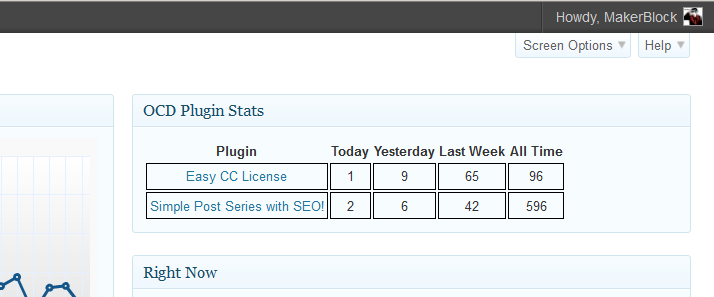
I’ve just published another WordPress plugin called OCD Plugin Stats. This isn’t a plugin that would really interest most people. If you’re a WordPress plugin developer and like seeing the stats for your plugins, OCD Plugin Stats will let you monitor all the stats for all of your plugins in one convenient location in your WordPress dashboard.
Unless you publish your own plugins, I can’t imagine anyone would be terribly interested in such a thing. My reason for making this plugin was that (a) I found it useful, so perhaps others would too and (b) I wanted to learn how to create a WordPress dashboard widget. Default Series Title
I’ve written a new WordPress plugin! It uses the Creative Commons API to grab the appropriate license based on your license choices. While there’s still room to improve the plugin, I’m pretty happy with the way it’s turned out. I’ve made a conscious effort to use best plugin programming practices – and learned a lot in the process. 1
A summer rose from our garden, drawn by a freakin’ narcoleptic robot
The drawings are getting better with a little tinkering. I’ve designed, printed, and installed new motor spools. These have a thicker central core, so they should be able to collect more monofilament line with slightly less distortion. I’ve made a few changes to the setup. Dialing in the starting area and calibrating the starting home point were pretty important.
I’m still having a little trouble with the robot occasionally stalling out. Although, now I think it is a symptom of the controller software rather than a problem with the Arduino. There’s no set time after printing, no set time after running the program, or other noticeable precipitating event which seems to cause this problem. At some point during a drawing, the controller software just reports the Arduino as being busy. 1 Here’s what I do to correct the problem:
Disconnect the USB cable from the laptop
Click “Queue->Export Queue” and save as a text document
Open the text document and perform the following operation
Select, copy, paste the first line above the first line – so now you see a duplicate. So, for instance in the image above I had to copy “C05,2700,2370,10,247,END” and paste this above the same line – so that it would look like the robot would be receiving the same command twice.
Edit the line “C05,2700,2370,10,247,END” so that I change the command to start with “C09” and delete the last two numbers and the “END” statement, so that it now looks like, “C09,2700,2370,END”
Save the text document with these changes
Shut down/close the controller software
Restart the controller software
Reconnect the USB cable to the laptop
Click “Setup->Serial Port…” and click on the serial port of choice
Click “Queue->Import Queue” and choose the text document I just edited
Start the queue again!
The reason I suspect this is a controller software and not an Arduino firmware issue is that I don’t have to reset the Arduino at any point – just disconnect the USB, restart the controller software, reconnect the USB, and start the queue again. I would think that if there were a problem with the Arduino firmware, I would need to reset the board itself.
The lowest you can specify as the “grid size”2 in the Polargraph controller software is “20,” but you can use a smaller value by editing the “polargraph.properties.txt” file. In the image above I used a grid size of “10” which appears to cover 1/4 the area of the size 20 pixel. That image probably took about five hours to draw. I think it looks really nice. The image above seems to have been distorted by my scanner. It came out almost perfectly square with a slight warp to the top right corner. 3 You can see some bare spots in the image above – that’s where the pen, for whatever reason, just wasn’t making a mark on the paper. I suspect it has something to do with that region of the paper being either slightly smoother and/or slightly more depressed than the surrounding regions. Otherwise, there would be no reason why the next row would have a similar defect nearby.
I’ve noticed the controller software also tends to forget the machine width, page size, and page position. I’ve updated this, saved it, and uploaded it to the Arduino several times, but it doesn’t seem to stick past a reboot of the software. Ultimately, these are very minor concerns and really just something to be aware of when I’m printing. I just about couldn’t be happier with the controlling software. That piece of software plus the Arduino sketch together have basically made this a nearly effortless project. Besides a hiccup soldering a circuit board wrong, this entire project went together very quickly and yielded almost immediately gratifying results.
I’ve done several drawings in the last few days. I’m still having trouble getting a perfectly rectangular and centered result. I may have to adjust the Y offsets and double-check my machine measurements. I still also notice a slight upwards warp to a drawing in the top right corner. But, I’m looking forward to additional experimentation – it’s all part of the adventure!
Last, but certainly not least, I want to make it clear that Sandy Noble’s software for the Polargraph/drawbot is really really great. That I am having some minor calibration troubles speaks more to my incompetence than Sandy’s excellent program. So, a great big thank-you to Sandy for his continued hard work on this software!
I found a container of canned air at work. I practically emptied it into my laptop and desktop keyboard. I held the desktop keyboard vertically and ran the air can up and down.
In doing so, I accidentally zapped my hand. Cold! I know the directions say not to do it, but then I did it again because it was kinda fun. The directions are pretty clear – no shaking, no zapping skin, immediate and thorough washing of the afflicted area, and no (under any circumstances) huffing. I didn’t inhale.