Swing State: The state of being on or near a swing
This election has been an interesting one to watch – especially since following the analysis on Nate Silver’s 538 blog at the New York Times. It seems like there are really two different kinds of campaigns going on right now. (Actually, I’m pretty sure this has been happening every four years – I’ve just been too oblivious to notice). Living in California, I only see one kind of campaign – a half-hearted attempt from the GOP and Democratic parties to vie for votes, but a lot of political fundraising. I’m sure that those living in a swing state like Ohio or Nevada see an entirely different election – because this is where the money raised in other states gets spent. 1 All of this makes me think of a national campaign in terms of a RTS video game2 – you farm and defend in one area so that you can fight in another.
Which makes me think, why should I be the plankton? Why shouldn’t I be the one whose vote is being courted? And, really, shouldn’t one vote count as much as another vote? Of these three the less petulant question is about the worth of a vote. If a presidential election comes down to the opinions of 11.5 million people in Ohio, this means that a single vote cast in Ohio has more of an impact on an election than 300 million other possible votes. 3 So, it seems that although Ohio only 3.69% of the population, their votes mean more than the 96.31% of us. Fully admitting I have no idea what I’m doing with these numbers, and someone else please correct me, it would seem an Ohio vote is worth 26.10 more than the vote of a non-Ohio voter.
This makes the very cynical part of me want to move to Ohio for six months every four years. What responsibility and what power! Imagine being able to cast a super-vote for the presidential election.
WarCraft II and StarCraft I being prime examples [↩]
Admittedly, I’m leaning heavily on Google here. Google tells me that Ohio has a population of 11,544,951 and the U.S has a population of 311,591,917 circa 2011. Clearly, these are not all people who are eligible to vote. But, making the totally unfounded and unresearched assumption that Ohio has a roughly similar proportion of voters to general population, we can estimate with wild inaccuracy, or at least flagrant disregard for a scientific method, a rough proportional impact of an Ohio vote versus a non-Ohio vote. [↩]
I made a large pot of coffee on Saturday, more than I would drink in a single morning, specifically because I’m lazy and thought I would just drink the second half of the pot the following morning. 1 Saturday morning I didn’t see any of the white mugs we’ve been using lately, so I switched to one of the Impressionist-artist themed mugs in the back of the cabinet. I drank my coffee, had a good day, and all was right and well with the world. The following morning I poured another mug of coffee, drank that and went back for a second – to discover there was barely any coffee left. I had just made enough for four cups, so what gives?
It turns out that the white mugs are smaller than the Impressionist mugs by about 1/3. After making more coffee it slowly dawned on me… very slowly… I had been under-consuming coffee2 for almost the last year by about two-thirds of a cup.
Totally unrelated story of this morning. The coffee shop near my work is apparently undergoing a remodel. Which explains why no one was there to serve me coffee. Back across the street to a restaurant that I generally don’t frequent to get coffee. 34 I go in, ask for coffee, and the woman behind the counter5 asked me if I had been there before. “Yes, a while ago, but I usually get my coffee from Pete’s.” She went on to explain they have all fair-trade organic coffee, it doesn’t have an aftertaste, and it’s very good. I said something polite and non-committal – but, really, I would have still bought it and drank it if she had told me their coffee was made from baby seals and brewed with orphan tears.
It occurs to me that I could have done a “This is not normal. But on meth it is.”-meme style joke. 6
I’m a simple man and this is an unreasonably complex cafe. You walk up to the counter, order your meal, then sit down, if you want water you go get it yourself, someone brings your meal to you, and then you go back to the counter to pay. It’s this weird hybrid between self-service and service that I’m just not comfortable with. [↩]
Plus, they were kinda rude to a friend of mine. [↩]
Occasionally I will opt into a mailing list – but very very rarely will I do so with a real e-mail address. 1 One of the domains I own allows me to specify a “catch all” e-mail address where mis-addressed e-mails will be sent. The most useful part of this is that I can give out an e-mail address of any sort I want @mydomain.com and the e-mail will be redirected to the account I actually check. Later if I discover that it wasn’t such a good idea to have given out an e-mail address like that, then I can always forward all e-mail to that address to trash.
For the most part as long as you’re not giving your e-mail address to really sketchy websites or posting them in plaintext somewhere, I’ve found many newsletters/e-mail marketers are pretty ethical. What’s interesting are those companies that have passed on my (fake) e-mail addresses. What I’ve found is that they tried to market to me at that address for a few years – and then apparently gave up – at about the same time that I began receiving spam to that address.
Which brings me to a minor rant. The company I work for2 posted all of the employees’ e-mail addresses online in plaintext. What a colossally bad idea. Although I’ve asked the IT guys to at some level of obfuscation3 to our addresses, the requests have gone unheard. My work e-mail, which is managed by Gmail, does a pretty good job at catching spam – but this seems an unnecessary step. Even with these protections, I’m still getting phishing e-mails, Nigerian scams, “medications” over the internet, offers to purchase plaques commemorating awards, and all kinds of nonsense.
Uh, yeah, I don’t know where I was going with this one. :)
I just saw a commercial for canned biscuits with the tagline of “Let the Making Begin.” 1 More amusing – the bottom of the screen has “#makernation.”
I suppose it’s inevitable that popular trends get co-opted by marketers. Given that the maker-trend is about actually diving in and making things for oneself, generally from scratch, it seems at odds with “making” by just opening a can and putting the contents in an oven.2
I’ve mentioned that I’ve got this software-as-service website. 12 Today, while dealing with a tech support problem, I realized what I love most about this type of business.
But, first, the tech problem. A user e-mails me saying that he can’t log into the site from his iPhone (running iOS6) any more. First, I try his login/password to confirm they work. They do. I have him try refreshing the page – I’ve heard the new iOS sometimes causes weird caching problems. He still can’t log in. I try logging in from an iPhone 4 running iOS6 and an iPhone 4S running iOS6. No good. I get him to confirm he’s clicking “remember me” when he logs in. Yes, he is. I finally tell him I can’t explain what’s going on – I’ve tried to replicate his problem on another iPhone 4 running iOS6, just like his, and I can’t figure out what happened.
He e-mails me a little later to say that he figured out that his iPhone had been set to reject cookies, and thus, he was not able to log in.
Which brings me to the thing I love about my SaaS business. When someone says the site doesn’t work, all I have to do is confirm that it works in some browser somewhere on the internet – and then I’m basically 99% sure the problem is on their end. Now, I can help them troubleshoot a problem to a certain extent, but for the most part if my site works in any one browser, it should work anywhere. I don’t have to worry about their operating system, software conflicts, and other nonsense like that. Just get to the internet and the site should work. Default Series Title
Ellison: Why do it on a wall? Why not a drawing robot that draws on a large piece of paper on the ground? I think you’ll get better results from that.
I think there are a lot of good reasons reasons – some aesthetic, some technical, some practical – for having a DrawBot that draws on walls (or other vertical surfaces).
Aesthetically, I really like having a DrawBot that draws on vertical surfaces. When placed in the room or an adjoining room, I can watch it scritch-scratching away at an enormous drawing. In much the same way a snail’s meandering trail can be captivating, a DrawBot working out a TSP single-line-art drawing turns an apparently meaningless series of turns into a mass of scrawls that resolve into a work of art as soon as you take a step back. 2
Technically, the DrawBot is an exceedingly simple device. You could build it out of little more than Arduino, a motorshield, two motors, string, a pen, and whatever you might have lying around. Much of these pieces you could probably even scavenge for or salvage from other things. In fact, only the Arduino and motorshield are things you wouldn’t be able to dumpster dive for. The device works by moving the two motors in concert, such that by varying the length of string reeled in or out by a given motor is used to move the pen in an XY plane. The one “ingredient” not listed in the preceding sentences is, of course, gravity. If the point where the two strings meet at the pen did not hang essentially straight down, pulled constantly by gravity, the pen could go just about anywhere. If you were to place a normally vertical standing DrawBot flat on the ground, the pen would no longer be pulled away from the two motors – and would just flop onto the drawing surface. Now, you could add two more motors and more string and build a gondola that holds the pen vertically on a flat DrawBot surface while writing a lot more code… However, I am doubtful you would get any more precision out of such a setup. And, if you really require precision – an XY plotter might be more to your liking. An XY plotter build would require lots of hardware (belts and metal rods or metal extrusions), more tools, and be big and heavy, and limited in the size of its drawing capabilities. It would also be capable of really amazing speeds. That’s a lot of extra materials, work, custom coding, and loss of drawing capacity for a dubious trade off in
As a matter of practicality, the simplicity of design and materials means this is an extremely cheap project. An Arduino is only going to set you back about $30 and clones are as cheap as $15. I picked up two of Adafruit’s motor shields on sale for $12 each, but they’re normally $20. Screws and/or bolts, beaded cord or wire or fishing line, a big piece of wood or mounting things directly to a wall, 3D printed spools or just leftover spools from thread, a 3D printed gondola or a lasercut gondola or even a big red binder clip.3 Seriously, if you’ve got about $35 and some free time, you’re basically half way to building an awesome fun robot that can make arbitrarily large drawings. If you’re willing to buy all the materials, it probably won’t cost you more than $150.
I’ll say it again – a Polargraph DrawBot is a quick, cheap, easy, entertaining, and useful robotics project – especially for beginners. Outside of my 3D printers, this was easily the most rewarding DIY project I’ve ever attempted. The results are astoundingly disproportionately awesome to the amount of time, energy, skill, and money used to achieve them.
And, I wonder – if you could map all snails in the world at the same time, could they be working in concert on an enormous message? Perhaps something along the lines of “So long, and thanks for all the fish”? [↩]
I just love that Polargraph video by Sandy Noble. To see binder clip in action, skip ahead to 0:27. [↩]
Whose open source work I use for my own DrawBot [↩]
The next time he’s in stock, you better pull the trigger – he runs out of stock SUPER fast [↩]
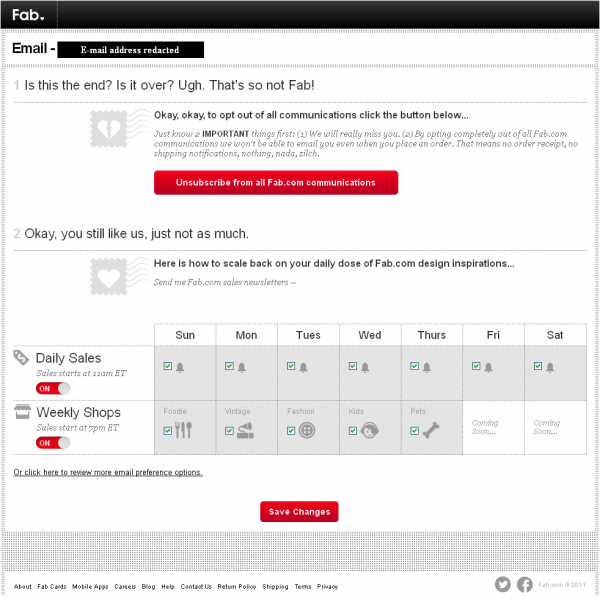
The other day I got sick and tired of my inbox getting daily e-mails from Fab.com. It’s a fine site, but I don’t need a daily e-mail from just about anyone. 1 Naturally, I sought out the unsubscribe link at the bottom of one of the daily e-mails and clicked. What I found was not the bland “Please confirm this unsubscription action.” page, but rather a “Oops! Perhaps we came on too strong! Sorry about that, how about we dial down the crazy just a tad? Would that do the trick? Listen, baby, we can work this out. Maybe just a few e-mails a week about things you might really REALLY like?” I’ve included a screenshot above, I loved this page so much. Heck, I loved it so much I closed the browser window and didn’t unsubscribe. 2
What I like about this page is that:
It isn’t a robotic “confirm unsubscription” link, but a very human and personal sounding page. Unsubscription pages are basically kiss-off pages where a company loses contact with a person. In such cases, it’s easy to write off the user as a lost cause. This doesn’t have to be the case.
That personal sounding message really made me stop and actually re-think what I had come to that page to do. Did I really want to unsubscribe? Maybe I shouldn’t try to go cold turkey? I really wouldn’t want to miss out on something amazing… 3
I was presented with some very simple options for managing the e-mail frequency. I could, with a single click, turn off whole swaths – or even whole days – worth of messages. I’m guessing for many people, this might be the right way to tone back e-mails. I think they could have gone farther with this – by adding a button where you could dial back the amount of e-mails. As a tongue-in-cheek message, they could indicate the current level of e-mails were at an “11”4 and a javascript dial to bring it on down to a 1 or 2.
The first full paragraph of the “opt out” message is particularly interesting. Fab.com suggests that if you unsubscribe, they won’t be able to even e-mail you a receipt for an order. Surely there is a middle ground between marketing e-mails and confirmation/order e-mails. But, by eliminating the line entirely, they ensure someone who was once a customer of Fab.com is unlikely to unsubscribe since they’re more likely to order there again. 5 I’m willing to bet that Fab might have very slightly higher e-mail retention if they gave the option of turning off all-but-confirmation-style e-mails. Even if that’s not the case, such a policy is likely to increase the retention of previous customers.
Here’s what I would do if I were over at Fab.com and helping6 in their e-mail marketing department:
Monitor and track the number of users who go to their unsubscribe pages and don’t unsubscribe. If people don’t unsubscribe when they visit that page for the first time, I would make a point of having their e-mails dialed back, with as much as a 75% reduction effective immediately. Later, this could theoretically be increased slowly.
Do some A/B split testing7 on whether a playful e-mail marketing dial has any effect on customer retention after they visit the unsubscribe page.
Do some A/B split testing on how the sheer number of e-mail messages sent affect the percentages of people hitting the unsubscribe links. At the end of the day, you just don’t want a potential customer going to that page – nothing good can come of it.
Assuming there’s X daily sign-ups for the e-mail marketing, you’re going to want an unsubscribe rate of Y to be less than X. If you never send a single e-mail it is very likely no one will unsubscribe. On the other hand, if you’re pounding your customers multiple times an hour, you’re probably going to lose them all. The optimal result for an e-mail marketing campaign is a difficult thing to pin down. Success for a given e-mail isn’t necessarily a binary thing, but a sliding scale of success from “did not click unsubscribe,” to “did not mark as spam/junk”, to “opened e-mail,” to “visited site”, to “made a sale”, to “made a sale of an item featured in e-mail.”
Facebook, Twitter, and LinkedIn send reminders – usually reminding you about your friends and suggesting things you’ll want to see. 8 However, I probably don’t receive more than one e-mail a week from any of these sites. If these older, more established, sites don’t e-mail me more than once a week, Fab.com should really re-think starting with a default of daily e-mails.
Please take all of the above with a grain of salt. I’ve got a web based SaaS B2B business that would really benefit from more A/B testing and e-mail marketing, and I’m not doing it yet. :)
Well, except YOU! I love getting YOUR e-mails! They keep me warm at night! [↩]
I finally did unsubscribe today, but that’s besides the point. [↩]
Then again, I have yet to visit the site after my first visit some eight or nine months ago. [↩]
After all, the user is at your unsubscribe page. You stand a much better than even chance you’re going to lose them forever. You might want to try to engage them a little [↩]
More likely than, say, someone like me – who has never ordered from them. [↩]
That link goes to a post on this same site where I express my frustration with the WordPress ShrimpTest A/B testing plugin. I’m sure it was a great plugin – but it hasn’t work with the latest versions of WordPress for some time. I keep meaning to crack it open, poke a round, and fix it up a bit. Alas, it has not been a priority among other items. [↩]
The other day I wondered what people have done with their InkShields. 12 Then I got to wondering what people were doing to mount their InkShield printer heads and move them around. Then I thought… hey! It would be pretty awesome to attach an InkShield printer head to a Polargraph / DrawBot gondola.
I could see how an InkShield might improve a Polargraph. You could theoretically have a small sensor to test the ink levels and pump more ink in from a larger reservoir – and never worry about a pen running out of ink again.
I could see how a Polargraph might improve an InkShield. With a DrawBot string setup, you wouldn’t need a huge or expensive XY gantry – just a lot of string, two motors, and some other bits and bobs.
Default Series Title
An InkShield is an Arduino shield that allows the Arduino to control an inkjet cartridge. [↩]