So you want to learn about the thermal properties of plastic…

Okay, I need to bookmark this site and add it to my RSS feed.  After having read this blog on materials science as it relates to plastics, polymers with a specific focus on RepRap tech, I feel smarter!  Or, at least, more informed about why my fussy robot gnome can be so fussy.

Richard – thanks for these informative and down-to-earth posts!

Edit:  Hot Melt Adhesive Principles (2 of 2)

When good-robo-blogs go bad

I’ve played with the idea of a “robo-blog” before.  Basically it is a WordPress blog with a plugin that searches for content, truncates it, and includes it as a very short link/post.  It can be useful as long as it isn’t overused.  The moment people think they’re reading a bunch of posts collated by a computer (Computers???  Blech!) they’ll tune out.

Just as important as avoiding the overuse of this kind of auto-content/robo-blog system is that you set up the filters to be really really narrow so not just anything makes it onto your blog.

What happens if you set up your robo-blog with too wide a filter or to post too often?  We’ll, let’s take a look:

  • “Florence Printing Co., 233 SC 567, 573, 106 SE2d 258, 261 (1958)). Thus, contrary to State Farm’s assertion, the policy reasons supporting an award of …”
  • “525 F.3d at 65. A mere summary description of a cross-reference, as in paragraph 11, is a different matter and cannot alter the unambiguous language that
  • “App.3d 642, an employee of the Office of State Printing called in sick and then was seen two hours later playing cards in a cardroom. …”

What’s up with this “3d” stuff”?  Well, it looks like Botmill’s robo-blog settings are set a little too loose.  Yes, content is king, but better to have one highly relevant post a week than five off-topic posts a day.  The “3d” in the above teasers has to do with legal case citations to California and Federal cases – cases that happen to be in the third (3d) district.  Anyhow, I point this out because I found it amusing – not because I’m poking fun at Botmill.  Their robo-blog has found some neat stuff I didn’t see in the RepRap Feed – so thanks guys.

Although, wouldn’t it be great to live in the 3-D district of California?

Checking for lint

The other day I pointed out the crazy build quality achieved on a RepMan.  This is all good and well for RepMan owners – but can your MakerBot get this kind of resolution and build quality?

In a word, YES.1 A MakerBot is capable of moving the Z axis in increments as small as 0.003125 millimeters.  Obviously, the downside is that going from a resolution of 0.6mm thick layers to 0.2mm means your MakerBot will take three times as long to complete the print task.

But, you didn’t buy a MakerBot because you wanted to make things fast, did you?  You wanted a MakerBot because it was the only way to make the crazy things you’ve been dreaming about.

Then again, there’s no reason you couldn’t devise several different levels of Skeinforge settings – for varying levels of print resolution, speed, and durability.  With that in mind, you could rip out a quick low resolution draft of a part with a low resolution, check to make sure it is suitable for your purposes, and then take your good sweet time in printing a super high quality version.

Easy for me to say, eh?  I’m still dialing in my Skeinforge settings for maximum resolution – so having several different resolutions in my back pocket is a pipe dream yet.

What I’d like to do is print off and install a set of the Z-Wobble reducers created by MakiYoshida.  The only question I have about this (truly fantastic) part is whether you lose a little bit of Z resolution – or cause one or more of the Z axes to slowly misalign.  If the part holding the nut captive isn’t attached to the Z stage in some way (in the case of this Wobble reducer, via a plastic peg sitting inside the slot in the Z axis) you could end up with one or more Z stage axes slowly becoming misaligned throughout the build.

But, this is all belly button gazing (hence, the lint reference above).  I should print a “before” part, crank out four of these Z Wobblers, slap them in, and see how it compares!  If I can reduce Z wobble without going through the hassle, delay, and expense of getting perfectly straight Z axis threaded rods by simply printing off a few plastic bits…  I’m ALL over that.

I remember reading about the Gingery Lathe a long time ago.  Not knowing much about metalworking or lathes, I was impressed with the description as well as the claim that as you built a lathe from scrap and following Gingery’s directions, you could use the portions of the lathe already built to help finish it.

This got me thinking…  Wouldn’t it be pretty cool to have a MakerBot kit that came with all the parts to get it printing low quality/resolution parts – and then slowly print up all the bits you need to create a higher resolution, more reliable machine?  Then I began to wonder…  what if this is what I had already?  I’ve got the MakerBot – add in the X/Y tensioners, Z axis cranks, Z axis wobble arresters, replace clunky lasercut layered parts with single assembly printed plastic parts.

We’ve seen a MakerBot replicate, but how far can you push the machine with just printed upgrades?
  1. Well, in theory, right? []

Another Skeinforge guide

There are a lot of guides for calibrating Skeinforge to work with a RepRap/RepStrap/MakerBot out there.  There are numerous guides on the Thingiverse blog (1, 2, 3, 4, 5), one on the MakerBot wiki, numerous suggestions throughout the MakerBot operators group, the BitsFromBytes wiki, and my own compilation of others’ hard work on Skeinforge tutorials here in the MakerBlock blog.

BitsFromBytes build quality

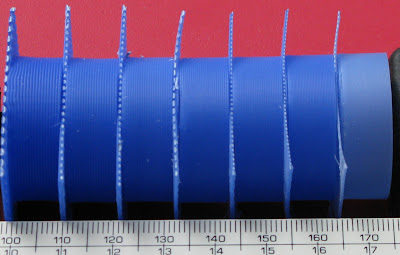
I just stumbled across one I hadn’t seen before on the BitsFromBytes blog.  The most intriguing bit about that blog post and it’s suggestions is their picture of successive builds.  The final build has pretty incredible print quality.

The layers on the rightmost print so close together as to make individual layers almost indistinguishable.  It looks that the leftmost layers are about 0.6mm thick.  The rightmost appears to have roughly 0.20mm thick layers.

Benefits of a printed MakerBot

There’s a couple of reasons that come to mind.

  • Bragging rights
  • Spare parts
  • LED lit PLA MakerBot
  • Removing the fiddly bits

I really like Webca’s faithfulness to the MakerBot Cupcake design.  However, once you are free of the constraints of trying to build a 3D object out of lasercut pieces – the possibilities are endless.  The small lasercut assembled bits underneath the X stage and the entirety of the Y stage could probably be printed up as a single chunk of plastic.  This would reduce the steps, materials, and dexterity required to assemble some of the fiddly bits of a MakerBot.

Making a MakerBot make a MakerBot

Not a MakerBot Replicator

Thingiverse user Webca has uploaded a printable MakerBot.

Back in February I thought it was audacious to hope someone would design a printable Y stage.  Later that day I realized that if you had a MakerBot Cupcake Deluxe kit, you’d have all the tools plus much of the materials to build another MakerBot – suggesting the second MakerBot would only be about $500.00 or so of extra components.  More the fool was I when I thought I had published a comprehensive list of the MakerBot printable components of a MakerBot.

Webca clearly dreams (and designs) so so so much bigger than I.  I am in awe of the awesomeness of that MakerBot made MakerBot.

150 plus printed parts, a month of solid printing, and more than 5 pounds of plastic.  So, what’s the final cost of a second MakerBot made MakerBot?  Setting aside issues of shipping and tax, it sounds like it would be about $50.00 worth of plastic plus all the bits from the $575.00 laserless MakerBot kit, plus some cables, cords, and power supply.

It’s a testament to MakerBot’s rock bottom pricing that a mostly-printed $625.00 MakerBot is not a tremendous discount off the $750.00 basic MakerBot Cupcake kit.  But, cost-savings is almost certainly not why he designed and printed this.  A month of printing and $50.00 of plastic is far more than it should take to print all the parts for a Mendel.

Yes, an unbelieveable amount of work, but now I want a PLA MakerBot…

There’s got to be more…

The recent Bre/MakerBot MakerFaire video mentioned that there were about 10 people running their MakerBots at this year’s MakerFaire.  According to the MakerBot Map, there’s only 10 MakerBots in the larger Bay Area…  Since I’m on that map and I know I didn’t go, there must be SO many more people who have MakerBots in the Bay Area!

Hey!  You!  Why not put a pin in the MakerBot map?  What if it turns out there’s another MakerBot operator across the street?  Wouldn’t that be great?

On cleverness

It’s a dream of mine to kinda live off the grid.  I say this is a dream, but really, it’s probably more about a vague goal and ideal.  Being a 21st century digital boy, I’d want some nearby cell towers and a satellite internet dish next to my solar panels and windmill powering my green house at the absolute outer edge of Amazon’s delivery capabilities.  And, as long as I had a crazy supply of ABS and a big enough RepStrap, I could make any freaking thing I wanted.  (Bruce Sterling’s article/short story on this point is an interesting read).

Part of the dream is about where I live and my lifestyle – it doesn’t say much about what I want to do.  I’d like to spend my time inventing and building cool thing and being clever.  :)  One of the most interesting things about my professional career is that it affords me the opportunity to be clever.  Perhaps it is due to a streak of narcissism or speaks to a need for attention, but damn I love seeing and doing clever things.

If you’ve seen Fight Club, you know Tyler Durden doesn’t think much of being clever.  I, on the other hand, think it’s cleverness that sets us apart from the animals.  At first we thought it was words or tools – but we’ve also found animals that use both (in their own way).  In the end, it probably comes down to being clever – using and sharing what you know, teaching others, and learning and thinking up new ways to do things.

There are a few times in my life when I recall seeing or learning something so clever, that I felt smarter for having experienced it.  I remember seeing a calculus T.A. point out a new way of looking at a problem which made all the difficult bits melt away.  The most recent was probably when I assembled my MakerBot.  I actually felt smarter for having assembled this machine – sometimes wondering at design decisions only to later realize the deeper purpose for this notch or that peg.