I’ve tried some of these methods, combinations of these methods, and here’s what I’ve come up with for my own life.
E-Mail
Reply quickly.
As Tony Soprano once said, “more important than the particular decision is that it happen in a timely fashion.” My number one rule of email management is simply this – reply immediately to anything that deserves a reply. Any timely response, even a non-optimal one, is better than a polished late response.
If you can’t get a quick response out because some action is required…
Act or Delegate, even to yourself. If there’s something to be done, do it already. From now on, you live in a world of “to done’s” not “to do’s.” If you can’t do it, then figure out what needs to happen first and work on that. If someone else needs to do it, ask them to take care of it and let you know when they’re done. If you need to do something else, copy yourself on the email and ask yourself to do it. Your own email will arrive in your inbox and you’ll need to…
Start a draft. If the matter really requires more information than you have at your fingertips or isn’t urgent, start a draft.
Turn drafts into emails. Every day turn drafts into emails and send them out. Since my job has become roughly 80-90% email, this is how I manage it all.
Ignore unimportant emails. Most of your emails are unimportant. Ignore them, mark read, move on.
Web Surfing
Tabs. Tabs are the enemy. They will rob you of your productivity. If you open a tab, read it, enjoy it, and close it or decide it is information you want to retain. If it is truly important and something you’ll need to refer to all the time, bookmark it. But, remember…
Bookmarks. Bookmarks are the enemy. These are kept to an absolute minimum and only for sites you really visit all the time. Otherwise, that information you wanted to keep will be lost in difficult to search bookmarks forever.
Everything else. If you find a web page, tweet, or some other information that you want to keep or reference in the future, share it or make a note.
Sharing
If you share information you help a friend and preserve the information in your sent folder, twitter stream, etc. Otherwise, make a note. The thing with notes is…
Notes
There are only two kinds of notes in the world. Information that is of temporary use and information that is of permanent use.
Temporary notes. Write these on whatever you have lying around. Discard when done.
Permanent notes. A permanent note really comes down to how you want to treat information. I like information either in an electronic searchable format or I want it written down so I can reflect on it or refer to it later. A permanent electronic note goes into Google Keep or an email to myself, in outine format, listing things in no particular order, with a few keywords in the subject line and body of the email near the link. When I need to find it again, I just search in Google Keep or for emails from me and specific keywords. A permanent written note goes in my…
Notebook
The problem with the Bullet Journal method is that it requires setup, discipline, and maintenance. If you screw those up, the notebook and all the lovely page numbers and organization systems become a burden, a hassle or, worse, useless.1
There are so many great things about keeping a notebook. It’s a quick and easy way to record interesting and useful information. While my handwriting is horrible, but I’m pretty decent at drawing and sketching. A notebook for me is something where I can brainstorm, start drafting an idea I can return to later, or where I can record information for posterity. I tend to work out ideas on scraps of paper before recording that data in a more permanent format by committing it to my notebook. Sometimes this means copying information by hand or, my personal favorite, literally cutting and pasting information into the notebook. The worst thing is probably that it isn’t particularly searchable.
Title and Date. Every entry in the notebook starts on a fresh page with the date at the top right corner and a helpful title at the top of the page. The date does more than provide you with context.
Cross Referencing. The dates at the top of the page function as your page numbers. When you need to refer to a page in the past, rather than referencing a page number, just reference the date of the prior page. When you write a cross reference down to a prior page, note the future date on the prior page.
DIY Flags. I placed several pieces of duct tape inside the front cover of the notebook. On top of that, I put several small 1/2″ x 1″ pieces of duct tape. These can be peeled off easily and folded over a page for a sturdy bookmark. More on this later.
Default Series Title
Well, this is my theory. I don’t actually know since I haven’t actually tried the Bullet Journal method… [↩]
While I’m nominally focusing this series of posts on paper circuitry, I’m actually looking to put together a resource for myself and others for any kind of electronics project. To that end, there are some ideas below that have nothing to do with affixing a circuit to paper, but that might still be an interesting or fun alternative.
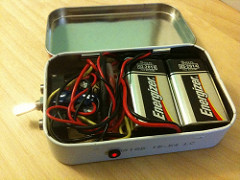
Altoids and other tins are cute, small, and easy to source containers for projects. However, since they’re metal be sure to take extra care to wrap your electronics (or the inside of the tin) so that parts aren’t accidentally grounded against the tin. When I put a project in a MintDuino tin I used the paper cardstock from the packaging to insulate the project board.
Anything from paper to plastic should work fine. Cutting holes in the tin required a little more trial and error – since punching holes and using tin snips caused sharp edges. I solved these problems by wrapping the sharp edges in electrical tape – further adding insulation.
Altoid Amplifier by sharonrosen
Repurposed Plastic Enclosure
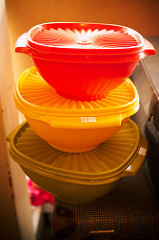
Tupperware
Plastic is probably a superior choice for an electronics project enclosure. As with tins, they come in a variety of shapes/sizes/colors, are cheap-to-free, and sturdy. Unlike tins, they don’t require any special insulation to work.
Besides rescuing containers from the recycle bin, don’t forget to check out your local dollar store. I picked up a particularly nice looking piece of tupperware with a big red screw top lid from the dollar store for a project and couldn’t be happier with it. If you do go to the dollar store, keep your eyes out for more than empty containers. Since everything in the store is a dollar, you can always dump the unused contents of a useful container.
If you do use/reuse a plastic container for a project, I would strongly suggest going very, very, slowly when drilling holes. Seriously, go as slow as you can manage to run the drill because rigid plastic has a tendency to crack under stress. Ideally, drill a small hole, then work your way up with larger bits. If you’ve got the equipment, you may want to consider actually melting holes instead.
3D Printed Enclosure
This is probably my favorite way to encapsulate a project. If you have access to a 3D printer and enjoy 3D design, you can have a cheap bespoke project container.
Off the Shelf Plastic Enclosures
I remember Radio Shack carrying a dizzying array of plastic enclosures when I was a kid. However, these days, I can’t think of a single reason to get an off-the-shelf project enclosure when there are just so many repurpose and dollar store options. I’m really only mentioning this option for the sake of completeness.
Lamination
I’ve really only tried one “lamination” project/experiment so far with very mixed results. However, I feel like this is a promising avenue for exploration and experimentation. These ideas allow for a project being sandwiched under or in between one or more layers of plastic. This could make a small and thin project more durable, while still leaving the parts visible for inspection and teaching. I also like the idea of potentially using additional with extra information printed on them which could be laid over the circuits for additional context and annotation.1
DIY Adhesive Lamination with Tape or Contact Paper
A much cheaper DIY alternative to off-the-shelf adhesive lamination sheets would be to use clear packing tape or contact/shelf paper. Both are inexpensive and durable options, but would need to be cut to size. I actually use the packing tape method to copy and consolidate cards for my minimalistic wallet.
Heat Lamination
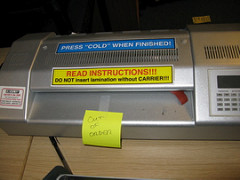
Laminator
I love the idea of designing a project, affixing it to a sheet of clear plastic like an overhead transparency, and then laminating it with a standard heat laminator. As the offspring of two elementary school teachers, I had ready access to a laminator as a kid and have some fond memories of (mis)using these machines. These days desktop sized laminators and the plastic heat lamination films are quite inexpensive and good for lots of different applications besides small electronics projects. My favorite laminator electronics use, ever, is easily this amazing modular solar panel project from rcpederson.
DIY Heat Lamination with Plastic Bags
Putting plastic bags back to work
This is an idea I’m really really looking forward to trying. Several years ago at a Benicia Mini Maker Faire I was introduced to the idea of fusing plastic bags together using a household clothes iron. The Makers showing this method let people cut scraps out of thin grocery and shopping bags, layer them between sheets of wax paper, and then fuse them together using an iron. They were using this process to create large colorful sheets of very durable plastic that could be cut and sewn like cloth.
While writing this post it occurred to me that this same method could be applied to paper circuitry, to embed a project within sheets of plastic. There are some interesting parallels to the process of using an iron to fuse aluminum foil to the toner on a laser printed page, described above. Additionally, by layering a project between sheets of plastic one might be able to dispense with some soldering since the fused sheets of plastic might be able to hold parts in direct physical contact with one another.
My Lamination Fail
The project I tried involved using 8B soft graphite art pencil traces and HVAC aluminum tape contact pads on copier paper, “laminated” in place with inexpensive clear packing tape. I believe my experiment didn’t quite work out because the packing tape may have pulled up some of the pencil traces, causing a break in the circuits. If you try to mix pencil graphite and packing tape, just be on the lookout for this possible issue.
There are several self-adhesive lamination plastic sheets available. Basically, there are two sheets of plastic, each with a sticky coating, which sandwich over your desired material. These come in various sizes from business card up to full 8-1/2″ x 11″ sheets.
These tend to be much more expensive than the heat lamination options, but require no additional materials. However, this is a decent option if your project cannot be subjected heat or pressure.
Encapsulation
Silicone Mold Material
As far as I know silicone rubber mold material comes in either a two-part liquid or two-part putty-like format. You mix the liquids in proportion, pour around desired object, cut apart and you get your mold. The putty kind is considerably less messy, but also much more expensive. You mix two balls of putty together well to activate them and they harden/cure into silicone rubber. I haven’t tried it, but I think either would work well to encapsulate a small electronics project.
Sugru
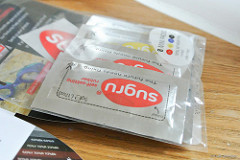
Sugru packs
Sugru is a moldable silicone rubber which starts off as a sticky putty which then dries2 into a flexible rubber. It is incredibly useful but very expensive with a relatively short shelf life.3 At roughly $4 per 0.5 gram packet, it is ideal for small fixes around the house, but would be prohibitively expensive for all but the smallest projects.
Oogoo aka DIY Sugru
Oogoo – DIY rubber silicone
Oogoo is a DIY version of Sugru made from 100% Silicone caulking and corn starch.4 Silicone caulking dries from the outside in and takes about 24 hours. By mixing in corn starch5 the silicone will also dry from the inside out at the same time – in as little as 5 to 10 minutes. Corn starch is easily found in many kitchens and a tube of silicone is very inexpensive (around $4 for a large tube).
I haven’t tried this process yet, but I’ve purchased the silicone and am looking forward to giving it a go. A note of caution – drying silicone is smelly due to the acetic acid released as the silicone cures. It will smell strongly of vinegar while it cures, but should be harmless.
Resins
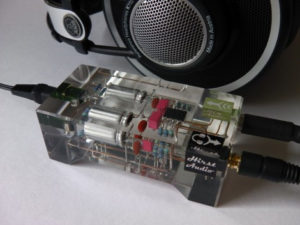
Resin encased electronics
As I mentioned above, some of these ideas have been kicking around in my head for years just waiting for the right inspiration to bring them together. More than four years ago I saw an interesting article on Hackaday about someone who had designed a circuit and then embedded the entire thing within a block of clear resin. There’s so much to love about this process. A resin encased project shouts, “I have made this thing; it is perfect and eternal.”
As I was writing this blog post I began to run into a George R.R. Martin problem – I have so many inspirations, so many ideas, and written so much that I felt I was in danger of never hitting “Publish.”6 Finally I decided to break up the post so that I can share what I have so far. I hope you find it helpful and gives you some ideas of your own – and share them here.
Default Series Title
Though, now that I think about it, this transparency idea could be used as an overlay for any flat project [↩]
Or cures??? I honestly do not know which is applicable – but I think “cure” is more accurate [↩]
Let’s just say the cost and shelf life is on par with conductive ink pens. [↩]
Do not use Silicone II, any quick-curing silicone, or anything less than 100% – this process won’t work [↩]
One of my interests outside MakerBot/RepRap is origami, the Japanese art of paper folding. At it’s inception it was really only a hobby for the rich – the only ones who had access to such a luxury as paper. Modern technical origami restricts one to only a single sheet of square paper transformed only through folding – no cuts, glue, tape, etc.
A lot of very interesting origami models have been developed over the years by some incredibly talented artists through a combination of experience and trial and error. These kinds of models have so much personality they almost appear to be real – rather than mere squares of paper. One of my favorite origami artists of this “genre” is Eric Joisel. I still find it hard to believe his models, such as the “Woman in Dress 2008,” can really be made of just a single square of paper.
There’s been a movement in the last two decades to bring a more methodical and mathematical approach to design, sometimes with the assistance of a computer. One of my favorite technical origami artists is Robert Lang). His models tend to the more realistic, rather than representational (as with Joisel). His insects, such as the stag beetle, are a prime example.
Lang has used his background in mathematics and origami to develop a giant collapsing/expandable lens – so that it could be transported to outer space and then deployed. This allows a normal space craft to deploy a much larger lens than would otherwise be possible.
Robert Lang's "Stag Beetle BP, opus 477"
Unlike Josiel’s models which are typically totally unique and irreproducible by anyone (including Josiel!) Lang’s mathematically assisted models are usually carefully documented by diagrams or, increasingly frequently, crease patterns. A crease pattern is what you would get if you totally unfolded a completed origami model. Typically only the “major” structural folds are depicted in a crease pattern.
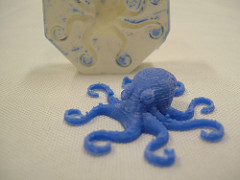
Brian Chan's "Attack of the Kracken"
An interesting intersection between mathematics and origami is the problem of determining the most efficient manner of placing the most number of equally sized circle within the smallest possible area, called, “circle packing.” The reason this is important to origami is that the center of each circle can be turned into an appendage. Lang has developed a computer program that allows the creation of truly arbitrary proportions – any number of points with any kind of ratio of one appendage to another.
Brian Chan's crease pattern for "Attack of the Kraken"
Even to someone who doesn’t have any experience with origami or the mathematics involved, the appearance of circles in crease patterns can start to make intuitive sense. One of my all time favorite origami models is the “Attack of the Kraken” by Brian Chan. (Check out the larger pictures of that model. The entire thing is just one sheet of paper. If you look closely you’ll see some of the tentacles are grabbing sailors!) In addition to a picture of his final model he has also posted a picture of his crease pattern for that model, even labeling which parts of the model are derived from which regions of the sheet of paper.
If you’re the least bit interested in origami, I’d highly recommend (in this order) Peter Engel’s “Origami from Angelfish to Zen,” a documentary on origami called “Between the Folds,” and Lang’s book “Origami Design Secrets.” The Angelfish to Zen book is one of my favorite books for background on origami and a very accessible introduction to the hidden geometry underlying even the most simple models (and real life too!).
I’ve been using Splenda instead of sugar lately. For single serving doses Splenda comes in little paper packets – like you see at restaurants. In order to keep them in line and at hand I designed and printed a sweetener holder.
It’s not that I’m not materialistic or a complete stoic. It’s just that my interests are so simple, narrow, and specific there just isn’t a whole lot I require out of life. But for other happy and fortunate life complications1 I’d live in a studio apartment almost completely devoid of furniture except for a futon, small table, one (perhaps two) and book shelf. Give me a library card and a laptop and I’ll show you a content man. For example – one of my hobbies is origami. Which boils down to basically a lot of paper. 2
While this means I’m easily content, it means those family and friends are frustrated at the thought of having to find me a gift. 3 So, for basically the first time ever I’ve put together a wish list with stuff I would love to get (in rough order):
A hobby which, hundreds of years ago could only be practiced by those precious few who had access to a luxury such as paper, can now be practiced by anyone in reach of a paper recycling bin. [↩]
500 sheets of A4 bright white multipurpose paper??? Score! [↩]
Since I have none of the equipment or skills to perform SMT soldering [↩]
Someone mentioned the modular thermistor set ups don’t detect temperatures properly – about 10 degrees too low?! Update: Rick of MakerGear clarifies this was the result of a ring terminal mounted thermistor. His modular thermistor kit pictured at the bottom of the this page shows that this kit allows you to make the entire thermistor attachment far more modular by covering it’s terminals in PTFE sleeves and then adding a connector. This only makes me want this kit more. Thanks Rick! [↩]