In order for me to design an OpenSCAD parametric model that can be adjusted to work for more people, I need to get a better handle on the necessary measurements and how they effect the final design. Below is my understanding of the necessary measurements and how those measurements necessitate changes in the final prosthetic.
- What are the design ideals, besides functionality?
- While answering a different question, Marc Petrykowski suggests, “My goal as the designer and printer is to make the hand as near perfect as the other hand so it feels the same to the body and brain, thus they will respond with the effected hand like it was their real non effected hand. Also as stated above, the degrees of flexion and extension and the size/length of the fingers are all incorporated into the final design before the printing the hand.”
- Thus, all other things being equal, he tries to craft a hand that is as similar as possible to the non-effected hand.
- What are the main parts of the Cyborg Beast?
- I’ve drawn a picture with the main features of the Cyborg Beast printable prosthetic. There are really just a few parts – the palm, the “gauntlet,” fingers, and thumb. The gauntlet fits over and is secured to the forearm and is connected to the palm by two hinges. The palm goes over the user’s effected hand and is connected to the fingers and thumb.
- What are the necessary measurements?
- Marc Petrykowski has provided a set of photos to demonstrate the various measurements. They appear to all be in millimeters. Please forgive my layman’s description of these various measurements. Measurements are taken of the effected and non-effected sides so that a prosthetic can be made that will fit the effected side, but have similar characteristics to the non-effected side.
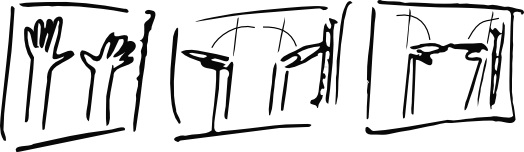
- Flexion angle. This would be the maximum angle of movement from holding your hand out and then bending the hand at the wrist towards the inside of the wrist. An example is pictured above as “Figure 1.”
- Extension angle. This would be the maximum angle of movement from holding your hand out and then bending the hand at the wrist away from the inside of the wrist. An example is pictured above as “Figure 2.”
- Knuckle width. This is the width of the hand at the knuckles. In Figure 3, you’ll see this as “H1” and “h1.”
- Wrist width. This is the width of the hand at the wrist. In Figure 3, you’ll see this as “W” and “w.”
- Hand measurements. I’ve identified these as “H1 – H3” and “h1 – h4” in Figure 3 above.
- Forearm width measurements. I’ve identified these as “F1 – F3” and “f1 – f4” in Figure 3 above.
- How does each measurement inform the design?
- Again, this is merely my guess, impression, or understanding of how each measurement results in a design change. For the purposes of these diagrams, I’ve assigned each measurement a letter or letter/number combination. When applicable, I’ve differentiated between the effected (lower case) and non-effected (upper case) hands.
- Hand Measurements (Figure 1,blue and green)
- Knuckle width, non-effected hand, “H1”. This is necessary to creating a prosthetic of the size that will match the non-effected hand.
- Knuckle width, effected hand, “h1”. This is necessary to creating a prosthetic of the size that will fit the effected hand inside the palm.
- Wrist to pinky knuckle, “H2” and “h2,” the purpose of which is to ensure a prosthetic that will fit the effected hand inside the palm.
- Wrist to middle finger tip, “H3” is the overall length of the uneffected hand. The purpose of this is to create a prosthetic of roughly the same size as the uneffected hand.
- Wrist to index finger knuckle, “h3” is for making sure the prosthetic palm will fit around the effected hand.
- Wrist to middle3 finger, “h4” is for making sure the effected hand will fit inside the prosthetic palm.
- Wrist Measurements (Figure 1, orange)
- Wrist width, “W” for the non-effected hand and “w” for the effected hand. The purpose of the effected hand measurement is to ensure a good fit between the prosthetic palm and the effected hand and the purpose of the non-effected hand measurement is to allow the prosthetic palm to match the non-effected hand more closely.
- Forearm Measurements (Figures 1, purple and red)
- Various measurements from “F1” (and “f1) just below the wrist to “F4” (and “f4”) which is the width of the elbow. As best as I can tell, these measurements are to ensure a good fit of the “gauntlet” on the effected forearm.
- Elbow to wrist, “F5” on the uneffected arm and “f5” on the effected arm. I’m not sure what the purpose of this measurement is, but perhaps it is to ensure the effected arm with prosthetic is roughly the same length as the unaffected arm.
- Angle Measurements (Figures 2, 3)
- Somehow the flexion and extension are incorporated into the design. I do not know how these settings inform the design.
- How accurate do these measurements need to be?
- Within 1mm, rounded up would be best. Thanks to Peregrine Hawthrone and David Orgeman for the input.
- Questions begetting questions
- If you’ve ever made one of these prosthetics, please let me know if there’s anything I’ve gotten wrong.
- It appears the measurements effect the design as follows:
- Measurements “h1, h2, h3, h4 and w” dictate the size of the palm. The ratio of the increase/decrease is then applied to all the finger bits. The measurement “H3” is used to adjust the size of the palm and fingers on the effected arm.
- Measurements “f1, f2, and w” dictate the size of the gauntlet.
- The additional measurements on the corresponding uneffected arm could be used to make the prosthetic over the effected arm appear more like the uneffected arm.
- I’m guessing the other unused measurements (“f3, f4, f5”) are used as part of the Creighton University research study, to measure the physical changes in the extremities before, during, and after use of these prosthetics.
- How does the flexion and extension change the design?
- Have you printed the Cyborg Beast designs I’ve uploaded? What are your thoughts?
Thanks for reading and helping! Comments appreciated!
Default Series Title