Printable Parametric Prosthetics: Design Features

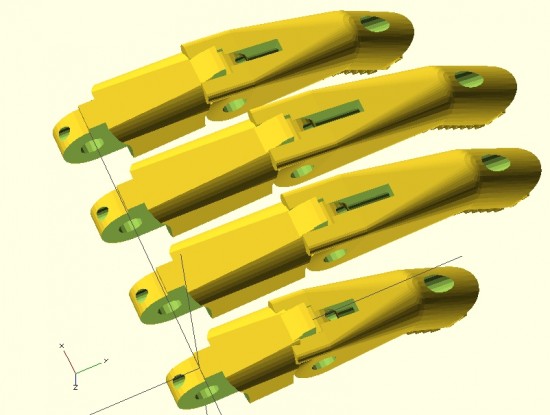
Parametric fingers - different lengths, same scale, with no distortion to hardware
Parametric fingers – different lengths, same scale, with no distortion to hardware

I’m not ashamed to admit it – I’m proud of these parametric designs like few of my other designs.  I’ve worked to make this design as customizable and organic as possible.  The two modules that define each finger can be customized in two important ways – they can be lengthened1 as well as scaled up or down – without any distortion or change in the size of the holes for the hardware, elastic cords, or tension cords.
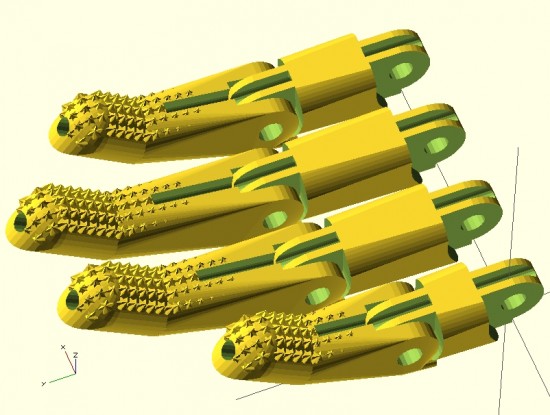
Parametric fingers - with grippy bits
Parametric fingers – with grippy bits

Being able to lengthen2 the finger segments is important because it allows the user to create fingers of different lengths, as normal fingers are of different lengths, all without having to actually scale the fingers to different sizes and without causing a change in each finger’s diameter.

As I’ve discussed in earlier posts, being able to scale the parts up and down without distortion to the hardware holes is important because it allows users to use standard hardware throughout different designs.

For now, it’s back to work on the parametric palm to ensure a proper fit with these parts.

Default Series Title
  1. Or shortened []
  2. Or shorten []

Progress on Parametric Printable Prosthetic

This slideshow requires JavaScript.

So, I’ve been hacking away at an OpenSCAD sketch of the Cyborg Beast 3D printable DIY prosthetic.  At the moment I’m working on designing the left palm.1 I’m reasonably happy with the version so far.  I’ve also managed to separate out the cutouts for the hardware from the design of the hand itself.  The benefit to doing so is that it should later be possible to scale the hand up or down, but keep the hareware cutouts the same size.

It’s easy to print a hand, fingers, and thumb scaled to 110%, but finding Chicago screws that is 110% may be more difficult.  There’s still a LOT of work to do here, but I think this is a good start.  Below are the same three views of the two versions (OpenSCAD parametric and original Cyborg Beast).

This slideshow requires JavaScript.

As I’m going through and replicating the design aspects of the Cyborg Beast, more design issues crop up:

  1. The grooves where the fingers fit into the palm are either tapered or flared in a non-uniform manner.  To get a better idea of this by reviewing the two pictures below.
  2. The holes for the elastic cord to cause the fingers to return to the open position do not appear to be of uniform diameter, uniform distance apart, or equally centered in the knuckle blocks.

This slideshow requires JavaScript.

I can’t tell if these are critical design features2 or just design elements that don’t provide additional function or utility.  If you happen to know, your input would be greatly appreciated.

Default Series Title
  1. And, really, once the left palm is done it’s an easy to mirror this part to make a “right palm.” []
  2. I’m guessing not []