Glowing Logo Cube by Domonoky

Red glowing logo box!

Domonoky uploaded his “Glowing Logo Cube.”  I’m loving this thing.  The second I saw it, I thought of The Pandorica from the season finale of this last season of Doctor Who.  Here’s a papercraft version of the Pandorica from AFT Downloads, a website devoted to Doctor Who papercraft:

Papercraft Pandorica

That image below is from Peter McKinstry’s online gallery of amazing work he’s done for Doctor Who and other super cool things.

The Pandorica
The Pandorica

All I would need to do in order to create a printable Pandorica would be to make a 3D printable version of the Pandorica faces, slot them into the glowing logo cube frame, and drop it into the base.

Chess set: 1/4 complete

I’ve been working on printing a chess set today.

Yesterday I was troubleshooting my automated build platform.  I could use it reasonably well as a heated build platform, but the automated part was not working so well.  The main issues I was having were the thermistor only registered 255, the automated build platform only ran backwards1 , and the extrusion would not stick to the conveyor belt.

Believe me, some of these issues were incredibly dumb.  No worries, I’ll fill you in on the extent of my ignorance soon enough.  It’s not like I’ve got a finite supply, right?

I took out the automated build platform conveyor belt – and lost one of the little plastic bushings in the process.  I’m pretty sure I can rig a serviceable facsimile, but my printer has been down so much lately that I just want to actually PRINT things.  I’ll work on fixing up the automated build platform and troubleshooting it later.

So far I have, in black ABS, 8x pawns, 2x knights, 2x rooks, and am in the process of printing a bishop right now.  (I know that’s more than 1/4 of the way done – but I was 1/4 of the way when I started this post).

Default Series Title
  1. WTF? []

Working on my automated build platform

I had some technical trouble with my automated build platform today.  (Yesterday?  Last night?  It all blurs.  :) )

I’ve fixed some problems and found others.

Right now I think there may be a slight kink in my filament spindle box.  The extruder motor kept running but no plastic came out in one build job.  I can successfully print using the ABP as a heated build platform – but it is only really successful with single print tasks.  More than that and it screws up the raft.

I’m tempted to lightly sand the automated build platform belt to see if that helps.  If not, a friend suggested using blue painter’s tape on the platform.  I’ll try the tape first tomorrow.

Jump in!

A friend of mine pointed me in the direction of this post about a guy who is making $600/month now after spending just one day on market research, development, and product launching.

I think this guy’s success is epitomizes Guy Kawasaki’s advice – jump in.  You can agonize over a business idea, sketch new logos or designs, talk about your ideas at parties or with friends, but you will never know unless you do some market research and then, if the research is good, actually try.  Yeah, it’s going to be tough and a lot of work – and incredibly rewarding. 1  If it were easy then everyone would do it.

If you have a crazy idea that just might work, I would encourage you – do a little research and then jump in.  It may not work out, but it definitely won’t if you don’t try.  If you need a little inspiration, definitely read Guy Kawasaki’s Reality Check and Tim Ferriss’ Four Hour Work Week for some really great nuts-and-bolts plans on how to go from a small idea to a small business in no time flat.

  1. As Dennis Leary would say, get a helmet. []

DIY laser cutting

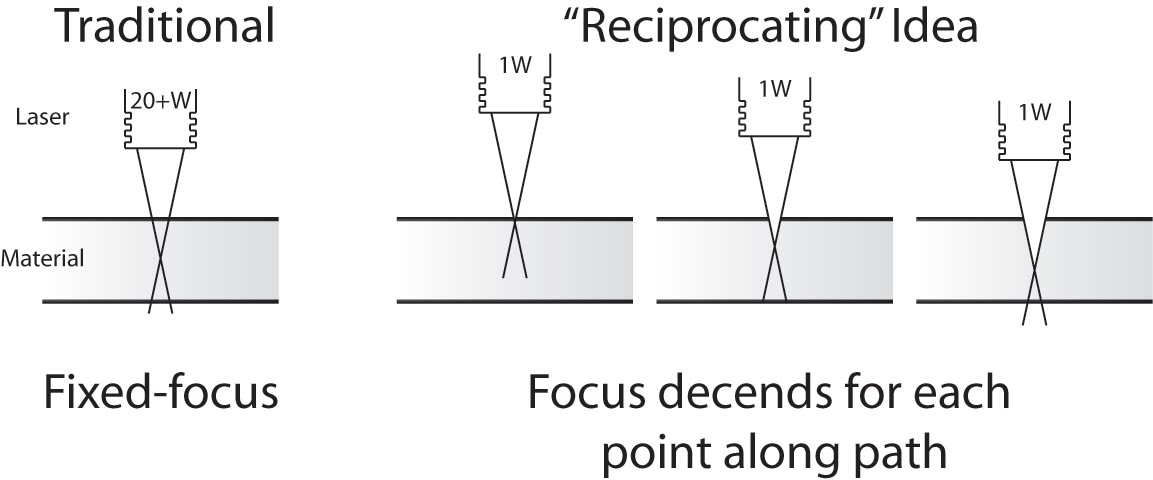
Peter Jansen's reciprocating laser concept

Peter Jansen’s latest post about selective laser sintering (SLS) is nothing short of amazing.  Most of his posts on the RepRap Builders blog posts deal with his adventures and research into SLS fabrication – basically directing a laser over a bed of powder to fuse powder in successive layers into a 3D object.  Since the object is being created in a bed of powder and any new layer is supported by the powder above it, the powder print media becomes it’s own support material.

His latest post diverges from his adventures with SLS 3D printing and details his efforts at building a DIY laser cutter.  His idea is for a “reciprocating laser” which would change the focal length or the height of the laser above the material being cut.  Peter points out that commercial high power laser cutters essentially brute force burn through the entire depth of the material to be cut.  They’re so powerful that it doesn’t matter that the laser is out of focus and “cooler” at different depths.

He has demonstrated a proof of concept using much lower power laser to cut material by lowering a much lower power laser as it cuts material.  The downside is that the lower power laser requires a much longer time to burn through the material – having to hit the same area several times at different depths to cut all the way through.  His proof of concept setup was about the size of a CD/DVD drive – since CD/DVD drives, motors, and housing provided most of his building materials.  So far he’s been able to burn through most of two CD case backs – about 2mm together.  He’s hoping to push it to cut thicknesses up to 3.0mm to 4.5mm.

The incredibly small size of his setup means that it can only very small pieces of material.  However, this gave me two ideas:

  1. If the low power lasers are so cheap, why not install multiple lasers at different focal lengths?
  2. If the entire setup is that small, what about making the entire setup mobile? 1  Think hexapod CNC mill.  If a laser cutter wheeled or hexapod robot was as small as a CD drive, you could conceivably just take out a large sheet of acrylic or thin plywood, set the robot in the dead center, and let it go. 2
  1. This reminds me of one of my favorite sayings.  “If Mohammed won’t go to the mountain, the mountain must come to Mohammed.” []
  2. The robot could stay oriented in any number of ways.  You could draw a grid on the material, the material could have a thin paper coating with LeapFrog style micro-dots that told the robot it’s location, you could project a grid onto the material with light or guide it with another laser like a laser guided missile. []

Note to self, too

The Mummy Box Set - and detail of box
1. The Mummy Box Set - and detail of box

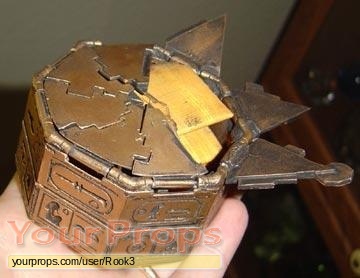
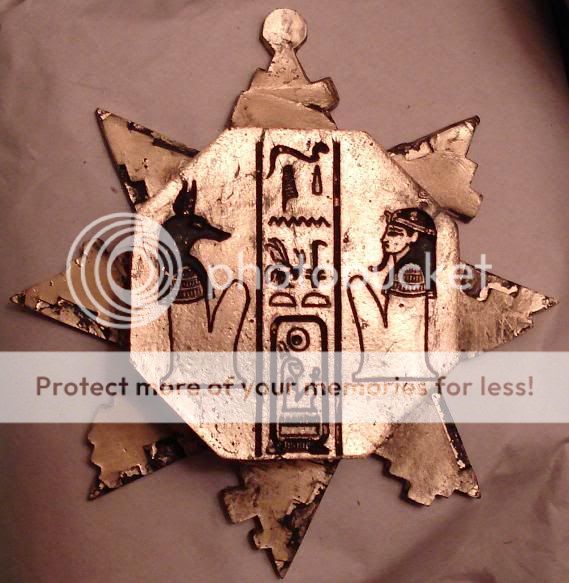
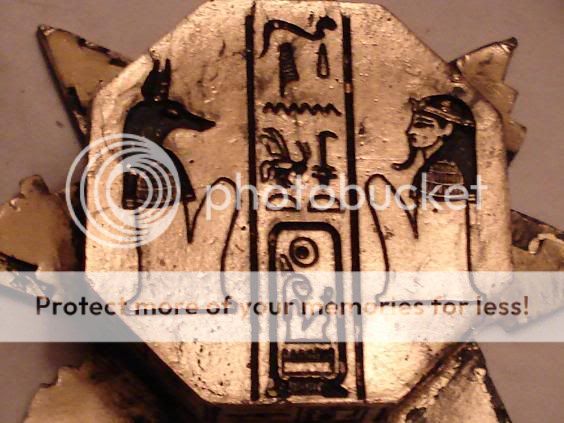
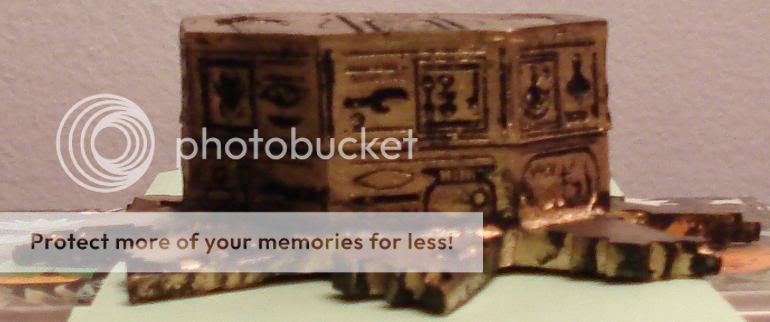
One of my favorite movies is The Mummy, and the coolest prop in the movie is a hexagonal puzzle box. When I get a chance, I’d like to design this object too. Here are some photos and informative links I’ve found:

  1. The cover of the Mummy Box DVD Set.
  2. What appears to be a homebrew prop replica.
  3. What appears to be an actual movie prop.

Sure, it’s frivolous.  However, I like the design challenge inherent in replicating this prop, getting the pieces to fit, perhaps even getting it to spring/pop open.

Home brew prep replica
2. Home brew prep replica
Mummy Puzzle Box Stats
Measurement of height 6-7/18″
Measurement from front to back 3-3/4″
Measurement of width, all sides 2-3/4″
Measurement of width, corner to corner 2-3/4″
Measurement of height 1-1/2″
Measurement of width, from base 5″
Measurement of all links 1-1/4″
Color Antique Gold
Other design details Top shows Seti I’s Horus name (men-maat-re), flanked by Anubis on the left and a male figure on the right, separated by vertical lines. Sides are inscribed with haphazard hieroglyphs including “Son of Re” and “Amen-Re.”
Puzzle Box - full picture
3. Puzzle Box - full picture
Puzzle Box close up
3. Puzzle Box - close up
3. Puzzle Box - side view