
I like to think about projects in discrete parts, trying to solve one part, then moving onto another section. In the case of this DIY lightsaber build, I’ve been burning some brain cells thinking about this project. Just by looking at the publicly available images of the TwistSaber, what can I infer about it’s construction?
Planetary Gears
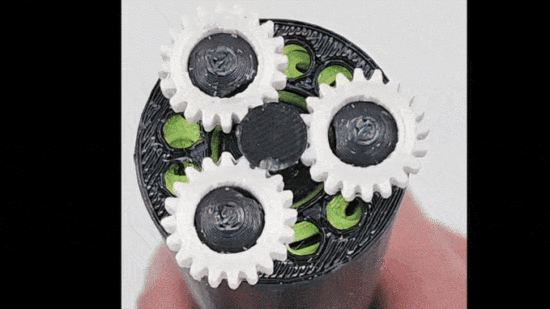
I would guesstimate the gears are probably about 8 mm in height. When I want to make a very sturdy part, I’ll use a 3 mm thickness. However, these gears look extra chonky, so let’s go crazy. Making further, and more in depth, guesses… Let’s see what happens when we toss the above image into Inkscape and try to lay some star shaped polygons on it.
I would estimate the ring gear has 58 teeth, the planetary gears appear to have 20 teeth, and the sun gear to have 10 teeth. When you’re dealing with printing with tight tolerances and thick (0.4 mm) extrusions, you can’t make the teeth too small, but you need enough teeth so permit smooth operation. In any case, we can count on some sweet OpenSCAD gear library magic to help us design these planetary gears.
Screw Threads
Since we’re already talking about the planetary gears, let’s think about the spiral core rotations and screw thread. If the 58 tooth ring gear goes through a half rotation, it will rotate the 20 tooth planetary gears by 26 teeth, causing just over 2 rotations of the 10 tooth central sun gear. The math should math like this:
- ((ringTeeth / planetaryTeeth)) * (0.5 rotations) * (planetaryTeeth / sunTeeth) =
- (58 / 20) * 0.5 * (20 / 10) =
- (58 /
20) * 0.5 * (20/ 10) = - 58 * 0.5 / 10 =
- 29 / 10 = 2.9
This tells us the half turn of the hilt should cause nearly 3 turns of the central spiral core. If we had a zero degree spiral around the central core, the screw thread would not be a spiral but rather a straight vertical line. If we had an absolutely crazy spiral, like a million degrees of turn, the screw thread would be nearly horizontal. We’re going to need a slope for the screw thread that causes 2.9 revolutions over 200 mm.
Screw Core
The three central screw segments have some interesting design elements.
By tracing the image of the screw threads, in alternating yellow and red, we can see the path of the screw threads on the camera facing side of the tube. However, by duplicating these tracing and flipping them along a horizontal axis, we can see this means there’s just two screw threads. In an earlier post I had wondered at the optimal number of screw threads. You want sufficient separate threads to work to actuate the core evenly, but not so many that they introduce unnecessary friction.
We already know from various videos and GIFs the screw core is attached to the hilt at the thinnest of the three segments. It’s interesting then that the two larger tubes have flared ends with rounded notches on one side. Although I don’t have a photo or still frame to show this, I suspect these are meant to lock against the base of the blades. My working theory is you insert the core into the nested blade segments, and then pull them back so they click into the base of the blades.
Here’s my thinking… let’s assume the spiral core pieces do not connect to the blades segments at all – except at the very bottom and very top. When you rotate the spiral core center, the other two core segments could extend – but might do so unevenly based upon how much friction there might be between any two adjacent parts. If the spiral core pieces do connect to the blade segments, then each of the three blade segments should actuate at the same rate (rather than whichever one has the least friction).
I need to give this more thought – I have an idea, which if correct might be a simpler way to design this mechanism for 3D printing. (It would be probably impossible for injection molding though…
Blade Segments
The blade segments are interesting in their own right. There’s no clear picture of how many rails exist within these blade parts. However, we might be able to extrapolate this from the portions we can see. In the second of these two screen shots, you can see two and a half sets of rail alignment nubs. If there is an equal number on the reverse, then perhaps there are five alignment rails inside each blade?
One nice thing about OpenSCAD is the use of parameters. There’s no reason I couldn’t design a similar device, but specify the blade segments should only be 20 mm tall, and then print out an incredibly stubby light saber. If the mechanism work, then I could just adjust the blade segment height from 20 mm to 250 mm and try printing it again.
DIY Lightsaber Build
Random thoughts.
1. Not sure if the blade segments could connect to the core pieces. The inner core piece doesn’t have to connect to the first blade segment as they would both be fixed to the handle. The middle core piece and segment have the last core piece and segment sliding between them.
2. I think you would find that the three core pieces would extend together. The last one doesn’t rotate as it is held by the blade, so when the first one is twisted, the middle has to extend as there’s no way to remain straight.
3. I think your “interesting nubs” are the means to lock the blade segment onto the screw.
4. The sun gear has a ledge to lock the planetary gears in.
5. They put lots of silicone lubricant on the threads.
1. I believe the central blade segment must connect to the outer spiral core. If it did not, nothing would prevent the central core from rotating. If we have three spiral cores, none of which are constrained, and we rotate the center one, all three will just rotate in place and none will lift vertically. If, however, the inner spiral core is rotated and the outer spiral core is prevented from rotating ((or, visa versa)) the entire assembly will expand. This is what I discovered by playing with the monocle / steampunk goggles. Now, I do agree the central inner core is not constrained from rotation by the outer blade piece. However, I don’t think the outer blade segment is affixed to the handle. Review of the various assembly videos show this complicated insertion, rotation, retraction, and clicking process that I believe was used to interconnect the blades to the spiral segments … somehow… to cause the three blade segments to collapse or expand at the same time. I think I’ll have a better idea of this once I have a prototype.
2. Oh, wait… yes. We agree entirely on this point.
3. I think the “interesting nubs” long the rim of the base of the blade segments are used to slide the blade segments along the rails on the inside of the next outer blade segment.
4. Yeah! It looks super cool. During the assembly videos, there’s a neat step where the central spiral core is pushed up and then down, then clicks into place.
5. I think printing tolerances and tons of lubrication are going to be key. The assembly videos show not only how lubrication is added to the gears, but also along the spiral core segments. They even created a tool for applying an even coat to the threads. (https://youtu.be/tQg-VCiUFM0?t=460) My Prusa’s pretty good with dimensional accuracy and there’s very little play in the OpenSCAD gear designs. I think I may need to reduce the size of the planet gears very slightly to account for this. But, more on this in a bit.