
Internet Famous! (Again! And other musings on my amazing trip to celebrity)

It seems like only three short months ago I was internet famous.  Oh, how fickle the internet gods!

The ball joint I designed a little while ago just hit the featured things page.  I think it is the only thing I have designed for which someone else created a derivative.  Just after I posted the ball joint r3becca posted her amazing Beco Blocks.  (I do not for a moment think r3becca’s blocks are a derivative or even inspired by my own shoddy work.  I mention the timeline simply because I am always astounded how often two people can come up with slightly similar solutions totally independently of one another.  My favorite example is the feud between two origami masters who each claimed to have designed the same origami pig, nicknamed the “Case of the Purloined Pig.”  If you’re interested in origami, you should check out Peter Engel’s “Origami from Angelfish to Zen,” and this essay from the Bay Area Rapid Folder’s website on origami ethics).  The ball joint I created is printed as a single piece and then snapped so it can then rotate, but the result is only okay.  If the flanges that hold the ball joint in place are too thin, they’ll pop off.  If there are too many threads between the ball and the flanges, it won’t rotate.

R3becca’s solution is far more elegant – two pieces printed separately that pop together and stay connected well.  The best part is that it has almost a complete range of movement.  If I needed to add a ball joint system to an existing model, I’d almost certainly use one of the Beco Block assemblies as the connecting mechanism.
https://makerblock.com/2010/02/internet-famous/

Dollar Stores

Have you ever browsed a dollar store, store going out of business, or garage sale?  The senses are overwhelmed with the sheer number and variety of things you’d never ever want to take home with you.  It boggles the mind to even conceive of how or why such things were created in the first place.  The frustrating part of it is – there’s probably a really good deal on something very useful somewhere inside that place.

Unfortunately, this is kind of how I’m beginning to feel about Thingiverse.  I love the idea of a place for sharing digital designs.   Over the last month it has gotten flooded with “things.”  People just uploading Sketchup, SolidWorks, or other 3d modeling files directly to Thingiverse, outright plagiarism, and stuff that could never be printable/cuttable/makeable (such as several objects with zero thickness).

I’m totally good with uploading an unfinished design, partial designs, or the outline of an idea.  But, for heaven’s sake, please include a title, description, and a copy of your file for sharing.  And, by sharing I mean an STL or DXF file – not a proprietary format.  By all means, include your source Sketchup or SolidWorks file, but please also include a file type that’s actually meant for assisting in the production of the thing.

Next in the cranky-pants series:  Hey you kids!  Get off my damn lawn!

Thing idea: Crayon mold

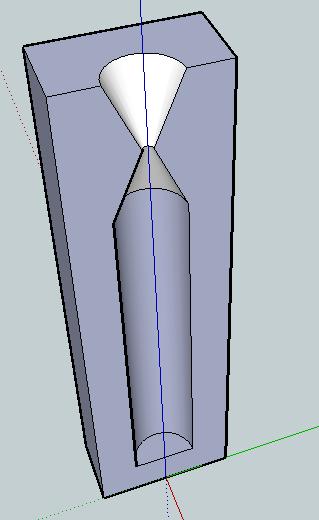
Crayon Mold v0
Crayon Mold v0

Problem: Broken crayons, useless crayon bits, or crayon shavings.  Crayola has their own crayon making system – a cross between an easy-bake-oven and little molds.  However, I don’t think it is quite versatile enough.  Plus, why pay $20 for what could be accomplished easily for $0.20 worth of plastic parts?

Solution: A printed crayon mold!

Description: Crayons melt at about 128 – 147 degrees Fahrenheit, or up to about 66 degrees CelsiusABS won’t melt until around 88-125 degrees Celsius, so there’s a wide margin for melting the paraffin wax crayons without distorting the mold.1

I would want at least three different molds – the normal crayon size, the fat crayon size, and then a triangular non-rolling crayon size.  I’m picturing a two part mold for each, with the seam of the two parts running along the crayon lengthwise and a half funnel for pouring.

In addition to the half-mold, I’d also design a snug fitting square block for fitting the assembled mold into.  That way you could stand it up and pour crayon wax into it.

Another potential use for this would be to place the pieces of crayon inside the mold, close it up, then heat.  This would allow you to mend a broken crayon.

Usage: I can think of several different ways to use this mold.  Frankly, I’m not sure which is easiest/most advisable/least advisable.  There are easily several considerations:

  1. Assembly:
    1. The mold could be assembled with crayon inside to be melted and repaired.
    2. Crayon pieces could be melted and then poured into the assembled mold.
    3. Crayon pieces could be placed in the funnel at the top of the mold, the entire system heated and crayon allowed to melt down into the mold.
  2. Melting:
    1. Crayon could be melted in a test tube or similar container in the oven, microwave, hot water bath (such as on the stove) or perhaps even open flame and poured into the mold.
    2. Crayon could be melted while inside the mold by placing the mold in a heat source (oven, microwave, hot water bath).
    3. Crayon could be placed in the funnel and allowed to melt down into the mold with the application of a heat source (oven, microwave, hot water bath, open flame?, or sunlight plus magnifying lens!)
  3. Cooling:
    1. Allowing to naturally cool to ambient room temperature.
    2. Placing in fridge.
    3. Placing in freezer.
    4. Placing in cold water bath.

I’m not sure which method of heating and cooling are optimal.  Though I’d suspect it is preferable to apply the least amount of heat over the shortest period possible.

Variations: It would be interesting to create these molds in different shapes besides cylinders.  You could top each one with a geometric shape, the head (or tail!) of some kind of animal or character, or something else entirely.  You could mold crayons into spheres, blocks, chips, or little figurines.  While not particularly sturdy, you could even mold them into building blocks or components of some larger device.  A clever person could use some left over nichrome wire to build a heated metallic funnel.

  1. That said, my extruder isn’t pumping out plastic until it hits 200 degrees Celsius at least. []
Test