
After finishing my printstruder (you can never have too many spare parts) I lowered the one warped Z axis threaded rod.  I probably lowered it about 1mm farther than it was before I had raised it to install the Z axis crank.

I guess sometimes that kind of thing makes a difference.  I’m watching my little ‘bot print up something right now… and it’s looking fantastic.  So far there’s no hint of the former regular but slight shift that you can see on the TARDIS and Dalek.  Mind, the TARDIS and Dalek are some of my best prints.  Anyhow, this is truly encouraging – with a nigh elimination of this warp, I am that much closer to printing precision parts.

One of the members on the MakerBot Operators group has posted his process for calibrating his ‘bot and adjusting Skeinforge settings.  It appears ridiculously thorough and I’m looking forward to trying it out.
Possibly Related Posts:


Plastruder

Printstruder

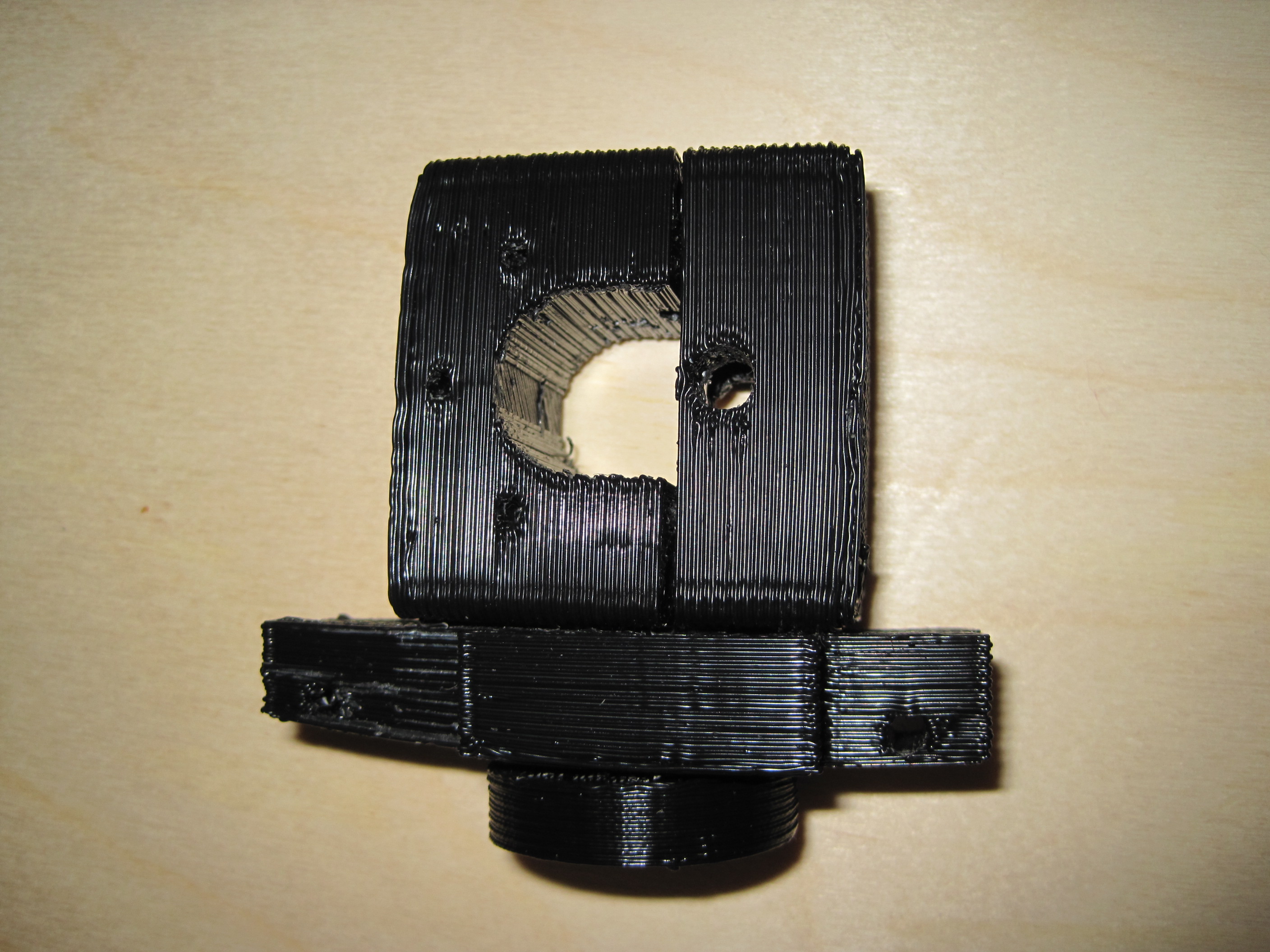
You can see how badly the cooling ABS warped on the base plate, especially on the left.  All of the parts, except perhaps the insulating retainer ring at the bottom, have a slight warp to them.  I expect most of my ABS prints will suffer from this to one degree or another until I install a heated build platform.  But, that’s a project for another day.

In these pictures you can also see the more pronounced effect of the warped Z axis threaded rod, again more prominent on the base plate.  The shifted layers occur approximately every 1mm or so.  As I’m less concerned with the cosmetic effect on a purely functional piece such as this, I didn’t bother adjusting this Z axis threaded rod until after I finished the prinstruder.

Possibly Related Posts:


My little bot is just crank out parts today.  :)

I’ve finished the Idler Bracket v3, Motor Bracket v3, Base Plate v3, and Insulating Retainer.  After a little cleanup the parts fit together very well.  I think one of the most interesting parts about printing pieces designed by others is seeing some aspect of the 3D model that doesn’t really quite make sense – but once it’s printed out and fit together you understand the design decision.

Take, for instance, a little divot in the Motor Bracket v3. I didn’t get why it was there… until I fit the parts together.  I can now see that it’s purpose is to act as a cone to funnel and guide the plastic filament.  This is the sort of wonderful little nuance that can be produced as part of a 3D printed object that would probably be difficult, if not impossible, to recreate in a lasercut layer system such as the plastruder.

Possibly Related Posts: